
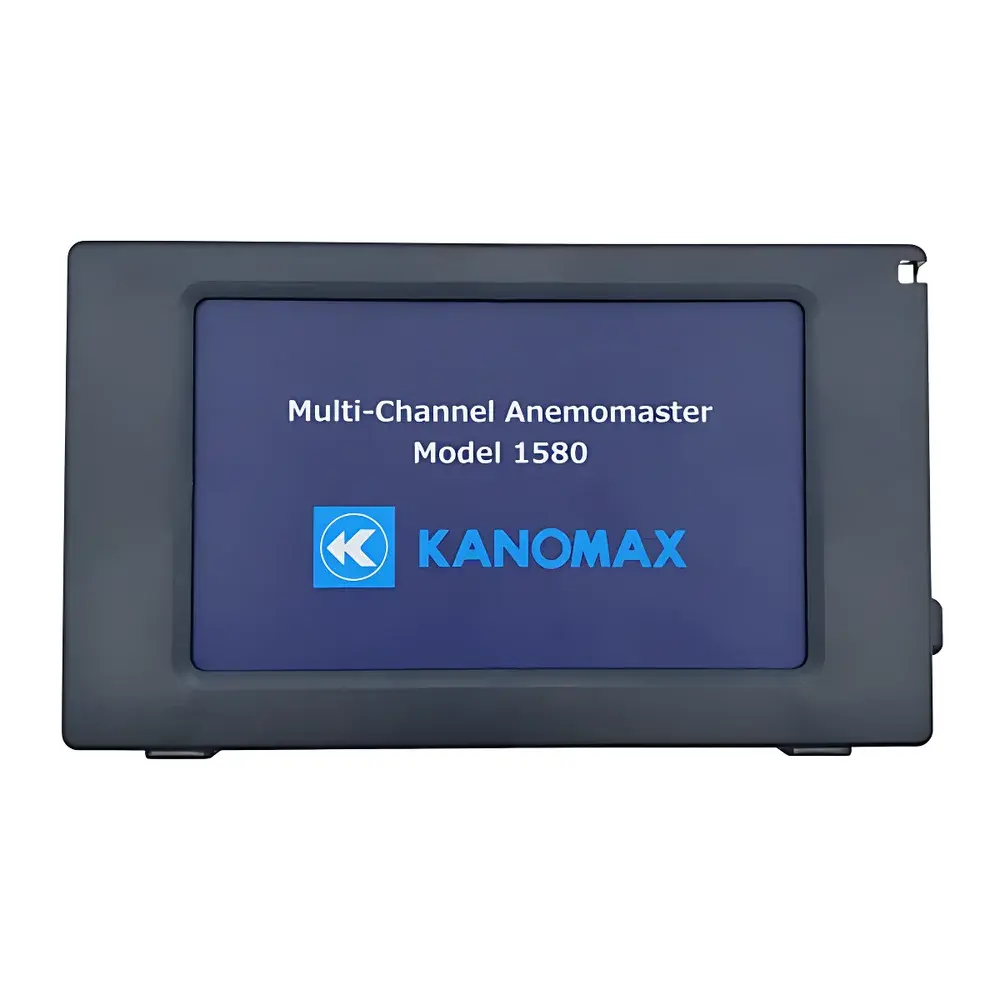
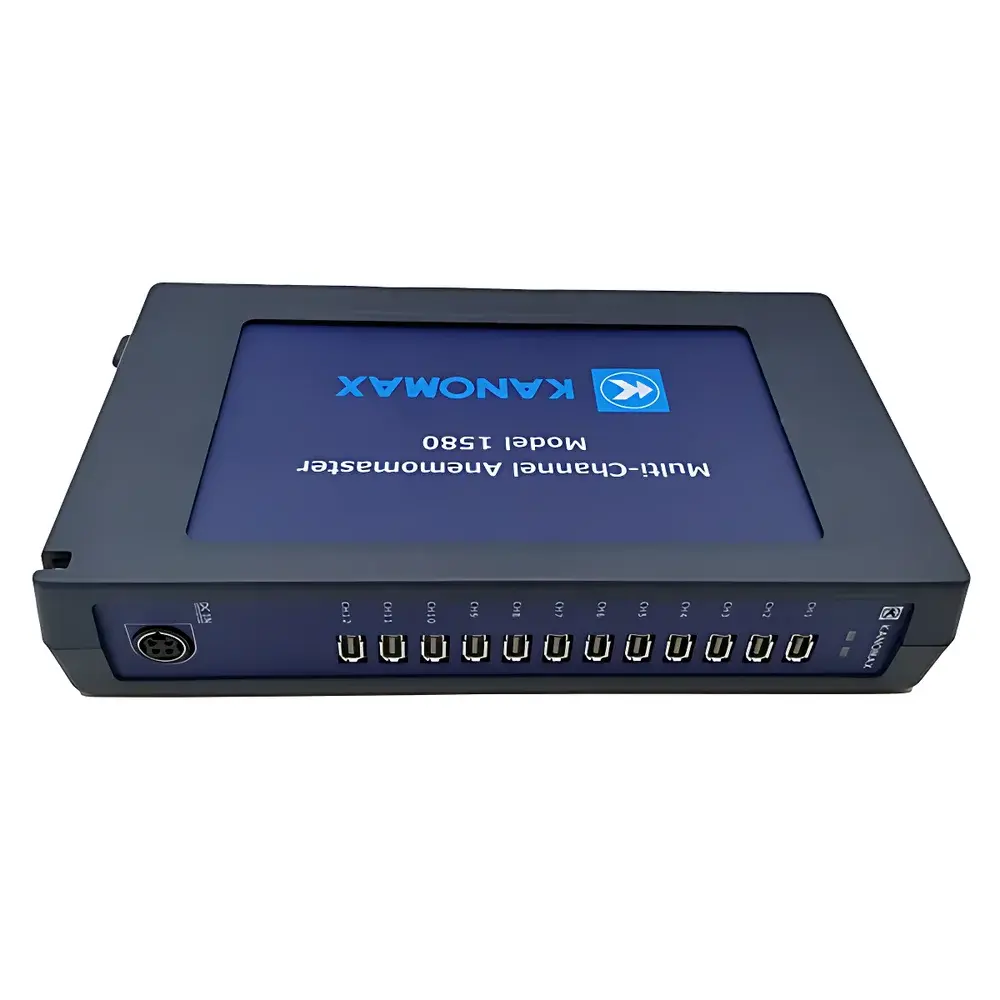
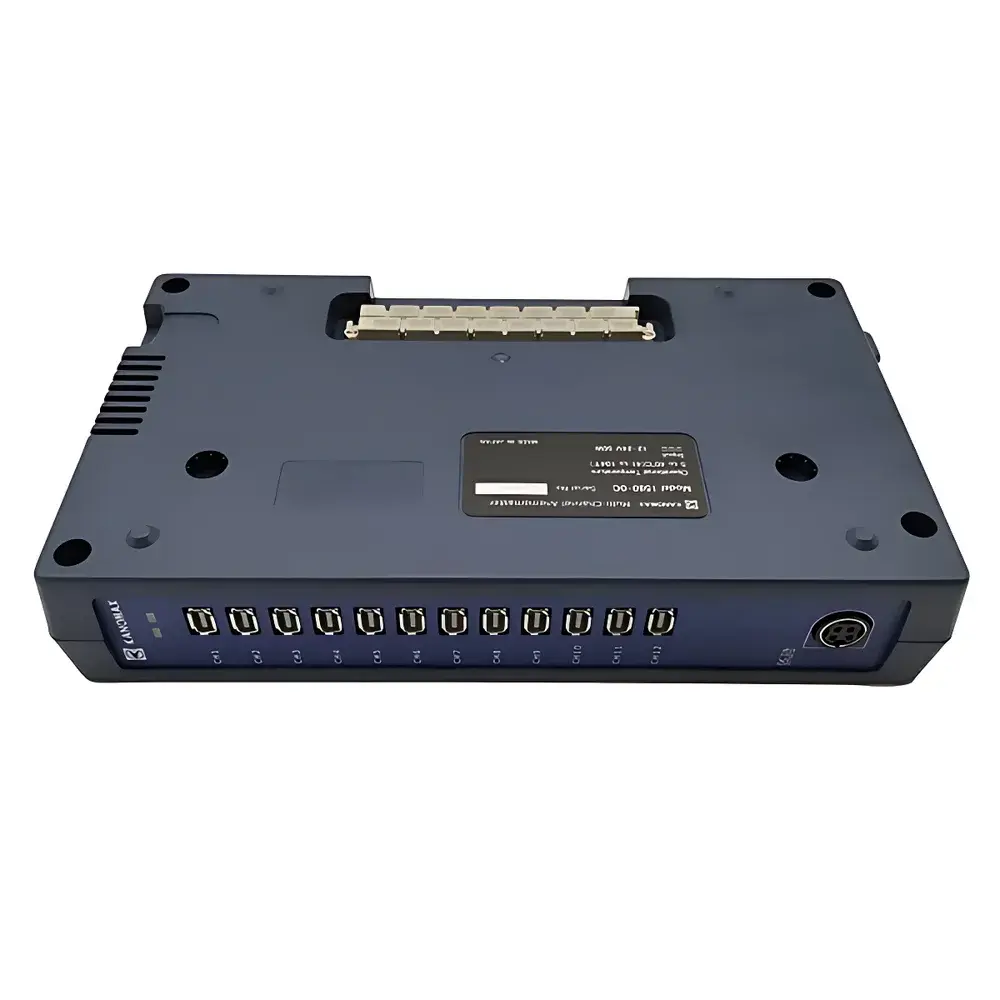
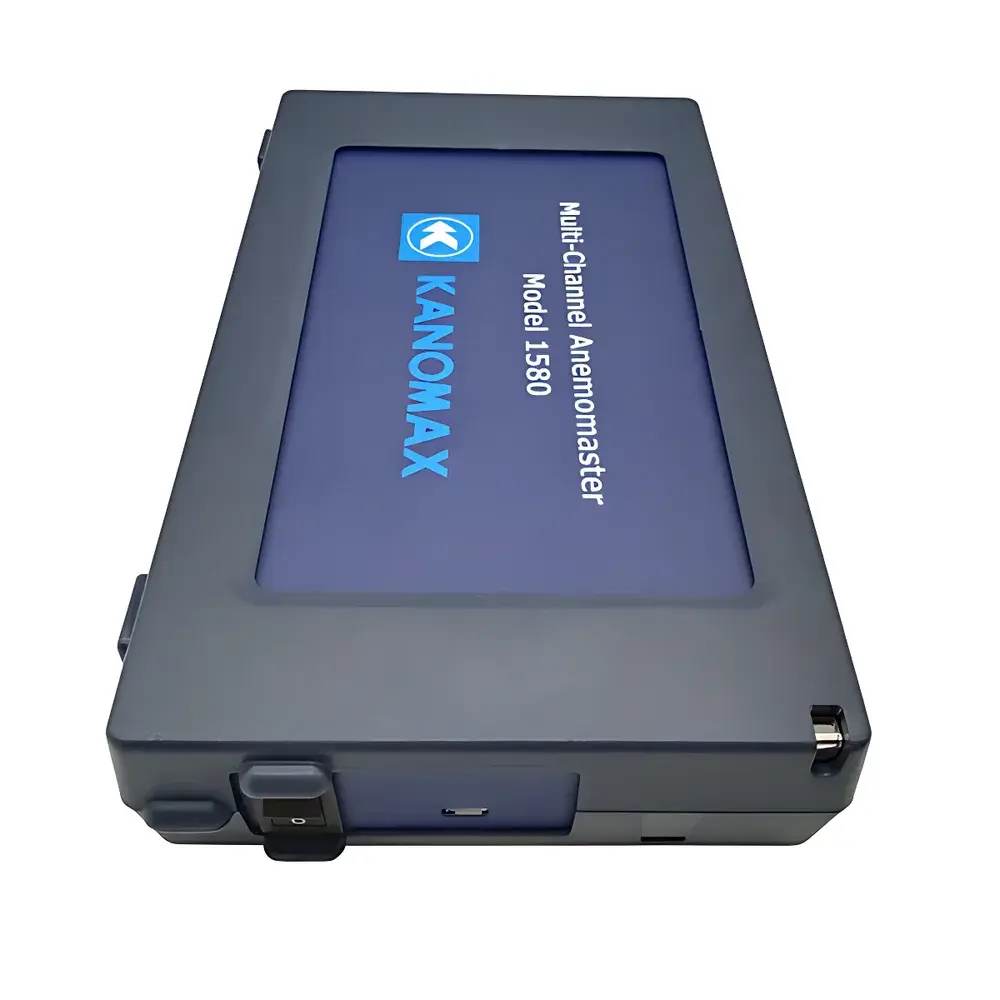
Kanomax Model 1580-0C 12-Channel Thermal Anemometer System
| Brand | Kanomax |
|---|---|
| Model | 1580-0C |
| Instrument Type | Thermal Anemometer |
| Resolution | 0.01 m/s |
| Measurement Range | 0.01–50.0 m/s |
| Accuracy | ±2% of reading or ±0.02 m/s (whichever is greater) |
| Operating Temperature | 5–40 °C |
| Operating Humidity | 0–85% RH (non-condensing) |
| Channels | 12 simultaneous |
| Probe Compatibility | 15 interchangeable probe types |
| Power Supply | AC 100–240 V or DC 12–24 V |
| Dimensions (Unit) | 220 × 130 × 40 mm |
| Weight (Unit) | 0.6 kg |
| Communication | USB Micro-B, RS-485 serial |
| Software | Windows 10-compatible, multilingual (EN/JP/CN), real-time 144-channel data logging capability |
Overview
The Kanomax Model 1580-0C is a modular, high-density thermal anemometry platform engineered for precision multi-point environmental airflow characterization in controlled and industrial settings. Based on constant-temperature anemometry (CTA) principles, the system measures convective heat transfer from heated sensing elements to quantify air velocity with sub-centimeter-per-second resolution. Its 12-channel architecture supports synchronous acquisition of wind speed, temperature, and relative humidity—enabling spatial mapping of ventilation performance, cleanroom airflow uniformity, HVAC duct profiling, and laminar flow validation. Unlike single-point handheld instruments, the 1580-0C eliminates temporal drift artifacts by capturing correlated parameter sets across distributed locations at identical timestamps—a critical requirement for ISO 14644-3 airborne particle testing, ASHRAE 110 tracer gas studies, and GMP-compliant facility qualification.
Key Features
- Modular 12-channel main unit with hot-swap probe support—no recalibration required when switching between probe types.
- 15 standardized probe variants—including directional and omnidirectional thermal sensors—with mechanical interchangeability and automatic probe ID recognition via embedded EEPROM.
- Ultra-low-velocity capability: 0.01 m/s detection threshold, validated per ISO 16813 Annex B for low-turbulence environments.
- High-temperature probes rated to 120 °C (e.g., models 0976-03/13), enabling thermal stability testing in ovens, drying tunnels, and exhaust stacks.
- Compact probe footprints (minimum 3.2 mm diameter) for installation in confined geometries such as microchannel heat exchangers, semiconductor tool inlets, and medical device airflow paths.
- Dual power architecture: AC mains (100–240 V) or wide-range DC input (12–24 V) for mobile applications—including vehicle-mounted cabin airflow audits and portable clean booth verification.
- Integrated temperature compensation across all probe types, minimizing drift over operating range (5–40 °C ambient).
Sample Compatibility & Compliance
The 1580-0C accommodates heterogeneous probe configurations within a single acquisition cycle—e.g., six 0972-00 directional velocity probes + four 0976-15 combined velocity/temperature/humidity probes + two 0975-21 omnidirectional low-flow sensors. All probes comply with IEC 60751 Class B for Pt100 temperature sensing and meet NIST-traceable calibration requirements for ISO/IEC 17025-accredited laboratories. The system’s measurement uncertainty budget accounts for combined effects of sensor nonlinearity, self-heating error, and ambient thermal gradients—fully documented in the factory calibration certificate. For regulated environments, audit trails, user access control, and electronic signature support are implemented via optional software configuration aligned with FDA 21 CFR Part 11 and EU Annex 11 requirements.
Software & Data Management
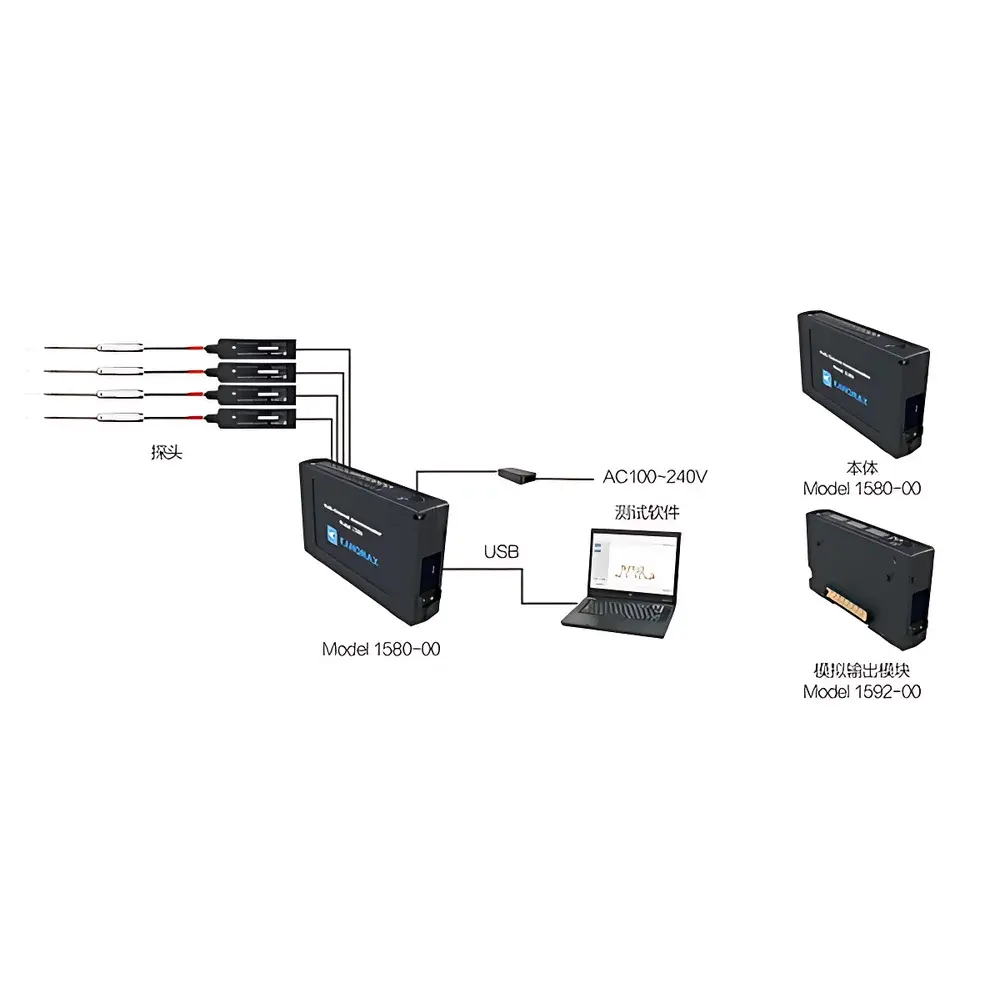
The bundled Windows 10 application (v3.x) provides native USB Micro-B and LAN (TCP/IP) connectivity, supporting up to 144 logical channels via cascaded 1580-0C and 1592-0C modules. Real-time visualization includes synchronized time-series plots, vector field overlays, statistical summaries (min/mean/max/std dev), and pass/fail thresholds against configurable limits. Data export formats include CSV, XLSX, and binary .kmd files with embedded metadata (probe model, serial number, calibration date, operator ID). Raw measurements retain full 16-bit ADC resolution; post-processing filters (moving average, median, derivative) are applied non-destructively. The software maintains immutable logs of all configuration changes, calibration events, and user actions—satisfying GLP/GMP documentation integrity standards.
Applications
- Cleanroom certification per ISO 14644-1/ISO 14644-3: simultaneous velocity uniformity mapping at multiple heights and locations.
- HVAC commissioning and balancing: duct traverse profiling with automated area-weighted averaging algorithms.
- Medical device airflow validation: ISO 10993-17 biocompatibility chamber monitoring under dynamic thermal loads.
- Automotive cabin climate R&D: multi-zone air distribution analysis during thermal soak and transient cooling cycles.
- Pharmaceutical isolator qualification: laminar airflow visualization with turbulence intensity calculation (Tu = σv/V̄).
- Academic aerodynamics labs: boundary layer studies using high-density probe arrays in wind tunnel test sections.
FAQ
What is the maximum number of physical probes supported per 1580-0C unit?
Each Model 1580-0C accepts up to 12 probes directly via its rear-panel serial bus interface.
Can the system log data without a connected PC?
No—the 1580-0C requires continuous host connection for data acquisition and storage; it has no internal memory or SD card slot.
Are calibration certificates provided with each probe?
Yes—each probe ships with a NIST-traceable calibration report valid for 12 months, including velocity, temperature, and RH (where applicable) uncertainties.
Is the software compatible with Windows 11?
The current release (v3.4.2) supports Windows 11 64-bit in compatibility mode; official native support is scheduled for Q3 2024.
How is channel synchronization achieved across multiple 1580-0C units?
Synchronization relies on hardware-triggered start commands sent over RS-485 daisy-chain topology, achieving inter-unit timing skew < 10 ms.
Related Products







