
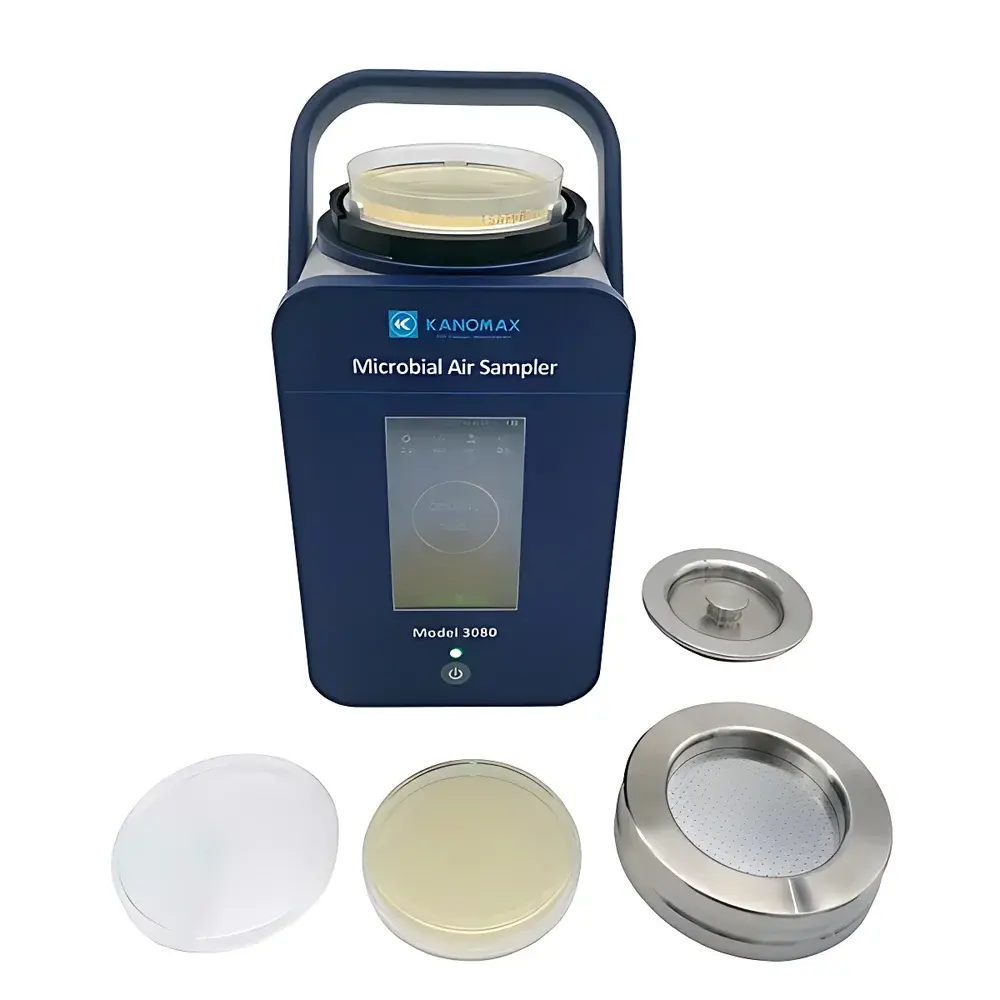
Kanomax Model 3080 Andersen-Principle Air Microbial Sampler
| Brand | Kanomax |
|---|---|
| Origin | Japan |
| Model | 3080 |
| Sampling Principle | Andersen Impaction |
| Flow Rate | 100 L/min |
| Flow Accuracy | ±2.5% |
| Operating Temperature | 0–40 °C |
| Operating Humidity | 0–90% RH (non-condensing) |
| Sampling Volume Range | 20–6000 L |
| Sampling Duration | Up to 7 h on battery |
| Display | 4.3-inch color touchscreen |
| Power | Rechargeable Li-ion battery + AC adapter (100–240 V) |
| Weight | 3.2 kg |
| Dimensions | 136 × 235 × 133 mm |
| Impactor Stages | 6-stage Andersen design |
| Impact Velocity | <20 m/s |
| Exhaust Filtration | ISO Class 3 HEPA filter |
| Culture Dish Compatibility | 90–100 mm and 55–84 mm Petri dishes |
| Data Storage | 10,000 internal records + USB export (CSV) |
| Communication | USB, RS-485 (Modbus RTU) |
| User Management | 64 editable users with multi-level permissions and audit trail |
| Remote Control | IR remote (supports up to 5 units simultaneously) |
| Language Support | English, Japanese, Chinese |
| Alarm System | Visual & audible alerts for flow deviation, low battery, door open, filter saturation |
Overview
The Kanomax Model 3080 is a precision-engineered, six-stage Andersen impactor-based air microbial sampler designed for quantitative assessment of viable airborne microorganisms in controlled and critical environments. It operates on the principle of inertial impaction: aerosol-laden air is drawn at a calibrated flow rate of 100 L/min through a series of precisely sized nozzles and collection stages, where particles are separated by aerodynamic size and deposited onto standard agar-filled Petri dishes. This enables differential enumeration of colony-forming units (CFUs) across discrete aerodynamic diameter ranges—typically 0.65–20 µm—providing granular insight into microbial particle size distribution. The instrument is engineered for compliance with international environmental monitoring standards including ISO 14698-1 (Biocontamination control), ISO 14644-1 (Cleanroom classification), and EU GMP Annex 1 (2022 revision), supporting risk-based environmental monitoring (EBM) strategies in regulated pharmaceutical and biotechnology facilities.
Key Features
- Six-stage Andersen impactor architecture with nozzle diameters optimized for reproducible particle separation and high collection efficiency across biologically relevant aerodynamic sizes.
- Stainless steel (AISI 316) sampling head—autoclavable, corrosion-resistant, and compatible with standard sterilization protocols (e.g., steam, hydrogen peroxide vapor).
- Integrated ISO Class 3 HEPA exhaust filter ensures operator and environment protection by retaining >99.999% of particles ≥0.3 µm, preventing re-aerosolization of collected microorganisms.
- High-resolution 4.3-inch color touchscreen interface with intuitive navigation, real-time flow monitoring, and dynamic status visualization—including LED indicators for operational state, alarm conditions, and battery level.
- Multi-level user permission system supporting up to 64 configurable accounts with role-based access control (RBAC), full audit trail logging (user ID, timestamp, action, parameter changes), and GLP/GMP-aligned data integrity safeguards.
- Flexible sampling configuration: programmable volume (20–6000 L), interval timing (10 s–1 h), delay start (0–23:59:59), and cycle count (2–300 repetitions or continuous mode).
- Onboard data storage for 10,000 complete sampling records; export via USB in CSV format with full metadata (date/time, location tag, operator ID, flow history, volume, status flags, and error logs).
Sample Compatibility & Compliance
The Model 3080 accommodates dual-diameter Petri dish formats—standard 90–100 mm and compact 55–84 mm plates—enabling compatibility with common microbiological media (e.g., TSA, SDA, Sabouraud Dextrose Agar). Its impact velocity (<20 m/s) and stage geometry conform to ASTM E1054-05 and ISO 14698-1 Annex B specifications for viable particle samplers. All firmware and calibration routines support ALCOA+ data integrity principles. The device meets electromagnetic compatibility (EMC) requirements per IEC 61326-1 and safety standards per IEC 61010-1. Optional integration with facility-wide environmental monitoring systems (EMS) is supported via Modbus RTU over RS-485, enabling centralized data aggregation and automated reporting for FDA 21 CFR Part 11-compliant workflows.
Software & Data Management
Data acquisition, review, and reporting are fully traceable and version-controlled. Each sampling event captures immutable metadata: operator credentials, geotagged location notes (user-editable), exact volumetric delivery (compensated for real-time flow drift), cycle history, and pass/fail status against preset thresholds. Audit logs record all configuration changes, user logins, and alarm acknowledgments with cryptographic timestamps. USB-exported CSV files retain hierarchical structure for direct import into LIMS or statistical analysis platforms (e.g., JMP, Minitab). Optional printer integration (via USB) supports on-site hardcopy generation of QA-approved reports compliant with internal SOPs and regulatory inspection readiness requirements.
Applications
The Model 3080 is deployed across Grade A–D cleanrooms, isolators, RABS, biosafety cabinets, hospital operating theatres, food production lines, museum climate-controlled vaults, and agricultural biocontainment facilities. It supports routine environmental monitoring (EM), media fill investigations, aseptic process validation, HVAC system qualification (e.g., airflow visualization + microbial correlation), and root cause analysis during out-of-specification (OOS) microbial events. Its portability (3.2 kg), extended battery life (7 h), and ruggedized enclosure make it suitable for both static and dynamic monitoring scenarios—including manned and unmanned operations under ISO 14644-2 surveillance protocols.
FAQ
What is the maximum allowable sampling volume per cycle?
The instrument supports single-cycle volumes from 20 L to 6000 L, adjustable in 1-L increments.
Does the Model 3080 provide real-time flow compensation?
Yes—integrated thermal mass flow sensing continuously monitors and logs actual flow rate throughout sampling, enabling post-hoc volume correction if deviations occur.
Can the device be integrated into an existing EMS or SCADA platform?
Yes—via RS-485 Modbus RTU interface, supporting register-mapped read/write access to operational parameters, status registers, and historical data buffers.
Is the firmware validated for use in GMP-regulated environments?
Firmware version 2.1 and later include documented IQ/OQ protocols, change control records, and electronic signature support aligned with Annex 11 and 21 CFR Part 11 requirements.
What maintenance is required to ensure continued accuracy?
Annual recalibration against NIST-traceable flow standards is recommended; nozzle alignment verification and HEPA filter replacement (per usage hours or pressure drop threshold) are documented in the maintenance logbook included with each unit.







