
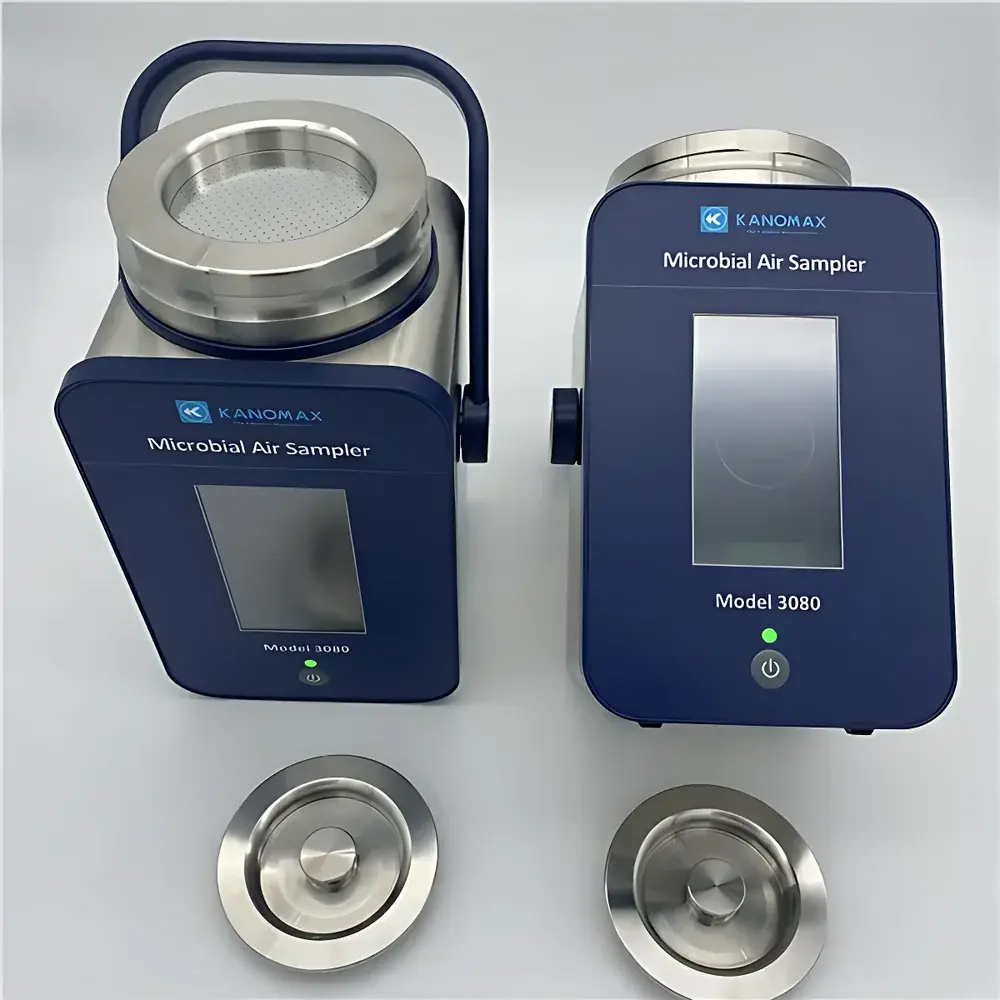
Kanomax Model 3080 Anderson Impactor Air Microbial Sampler
| Brand | Kanomax |
|---|---|
| Origin | Japan |
| Model | 3080 |
| Flow Rate | 100 L/min |
| Flow Accuracy | ±2.5% |
| Operating Temperature | 0–40 °C |
| Operating Humidity | 0–90% RH (non-condensing) |
| Battery Runtime | 7 h |
| Display | 4.3-inch color touchscreen |
| Data Storage | 10,000 internal records + USB export (CSV) |
| Communication | USB, RS485 (Modbus RTU) |
| Sample Volume Range | 20–6000 L |
| Sampling Interval | 10 s–1 h |
| Delay Time | 0 s–23 h 59 min 59 s |
| Sampling Cycles | 2–300 or continuous |
| Petri Dish Compatibility | 90–100 mm and 55–84 mm |
| Exhaust Filter Class | ISO Class 3 |
| Power Supply | Li-ion rechargeable battery + AC adapter (100–240 V) |
Overview
The Kanomax Model 3080 is a precision-engineered, portable Anderson impactor-based air microbial sampler designed for quantitative assessment of viable airborne microorganisms in controlled and critical environments. Utilizing the well-established inertial impaction principle—where aerosol particles are accelerated through calibrated nozzles onto nutrient agar surfaces—the Model 3080 ensures high collection efficiency across a broad aerodynamic particle size range (typically ≥0.6 µm), with validated performance aligned with ISO 14698-1 and EU GMP Annex 1 requirements for environmental monitoring. Its fixed 100 L/min volumetric flow rate is actively monitored and compensated via integrated thermal mass flow sensing, delivering consistent sampling kinetics essential for regulatory-grade data integrity. The device is widely deployed in pharmaceutical cleanrooms (ISO Class 5–8), aseptic processing suites, hospital isolation rooms, biosafety cabinets, and food production facilities where real-time microbiological risk assessment supports process validation and contamination control strategies.
Key Features
- Anderson-type 6-stage impactor head with stainless-steel construction—autoclavable at 121 °C for repeated sterility assurance between sampling events
- 4.3-inch full-color resistive touchscreen interface supporting multi-language operation (English, Japanese, Chinese) with intuitive workflow navigation
- Programmable sampling logic: single-shot, repetitive cycles (2–300), or continuous mode; configurable delay time (0 s–23 h 59 min 59 s) and interval timing (10 s–1 h)
- Multi-level user permission system with password protection for operator, supervisor, and administrator roles—enabling audit-ready access control per GLP/GMP guidelines
- On-device data logging of up to 10,000 complete sampling records—including date/time stamp, location tag, operator ID, sampled volume, cycle count, and status flags
- Integrated ISO Class 3 HEPA exhaust filtration to prevent cross-contamination during operation and ensure operator safety
- USB and RS485 (Modbus RTU) interfaces for seamless integration into facility-wide environmental monitoring systems (EMS) or LIMS platforms
- Rechargeable lithium-ion battery providing 7 hours of uninterrupted operation under nominal conditions (100 L/min, ambient 25 °C, 50% RH)
Sample Compatibility & Compliance
The Model 3080 accommodates standard Petri dishes ranging from 55–84 mm (e.g., contact plates) and 90–100 mm (standard agar plates), allowing flexibility in media selection (TSA, SDA, PCA, etc.) and incubation protocols. Its mechanical design conforms to ISO 14698-2 for calibration traceability, and operational parameters satisfy the performance criteria outlined in USP , ISO 14644-2, and PDA Technical Report No. 13. All firmware and data handling routines support ALCOA+ principles (Attributable, Legible, Contemporaneous, Original, Accurate), with optional electronic signature capability when interfaced with compliant LIMS or EMS software. The unit ships with factory-issued calibration documentation traceable to JIS Z 8000 standards.
Software & Data Management
Raw sampling data is stored internally in non-volatile memory and exportable via USB to external storage in comma-separated value (CSV) format—compatible with Excel, statistical analysis tools (e.g., Minitab, JMP), and regulated database systems. Each record includes timestamped metadata: sampling location (user-editable field), operator ID, total sampled volume, elapsed time, cycle number, alarm events, and battery status. Built-in operation logging captures all configuration changes, start/stop commands, and error codes—supporting 21 CFR Part 11 compliance when paired with validated third-party software that implements electronic signatures and audit trails. Optional Modbus RTU integration enables remote polling of real-time flow status and operational state for centralized dashboard monitoring.
Applications
The Kanomax Model 3080 serves as a core instrument for routine and investigative environmental monitoring across highly regulated sectors. In pharmaceutical manufacturing, it supports Grade A/B cleanroom qualification, media fill environmental challenge studies, and post-intervention recovery assessments. Clinical laboratories use it for airborne pathogen surveillance in operating theaters and immunocompromised patient wards. Food and beverage producers deploy it for raw material intake zone verification and HVAC system efficacy testing. Additional applications include biotechnology R&D containment validation, museum artifact preservation environment audits, and HVAC ductwork cleanliness verification in commercial buildings—wherever quantifiable, culture-based assessment of airborne bioburden informs risk-based decision-making.
FAQ
What is the recommended calibration frequency for the Model 3080?
Annual calibration against a NIST-traceable flow standard is recommended; more frequent verification (e.g., quarterly) is advised in high-use or regulated environments.
Can the impactor head be sterilized using ethylene oxide (EtO)?
No—only autoclaving (121 °C, 15–20 min) or dry heat (160 °C, 2 h) is approved per Kanomax specifications; EtO may compromise nozzle geometry and collection efficiency.
Does the device support direct connection to a networked LIMS?
Yes—via RS485 Modbus RTU, provided the LIMS supports this protocol; custom driver development may be required for proprietary LIMS platforms.
Is the battery replaceable by the end user?
Battery replacement requires authorized service center intervention to maintain IP rating and calibration integrity; field-swappable modules are not supported.
How is flow accuracy maintained over time and varying ambient conditions?
Thermal mass flow sensor compensation algorithms correct for temperature and pressure drift in real time, ensuring ±2.5% accuracy across the specified 0–40 °C / 0–90% RH operating envelope.







