
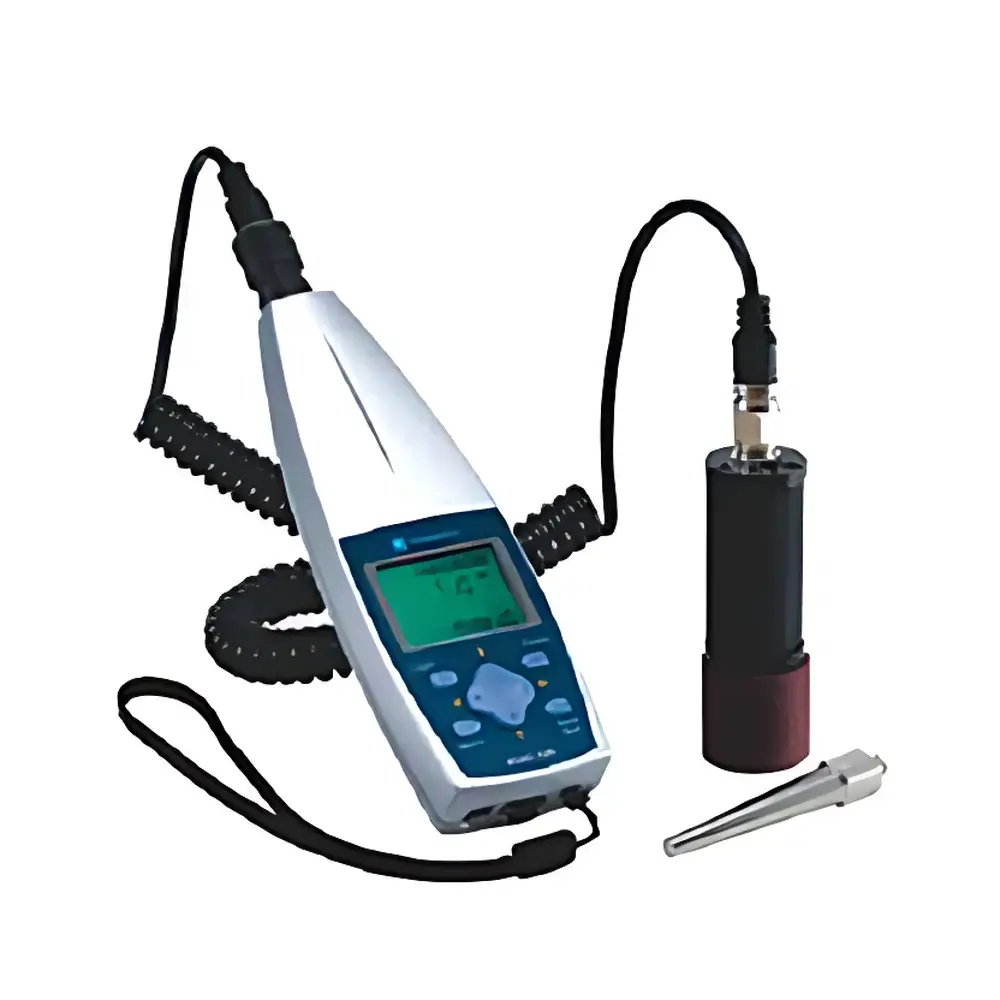
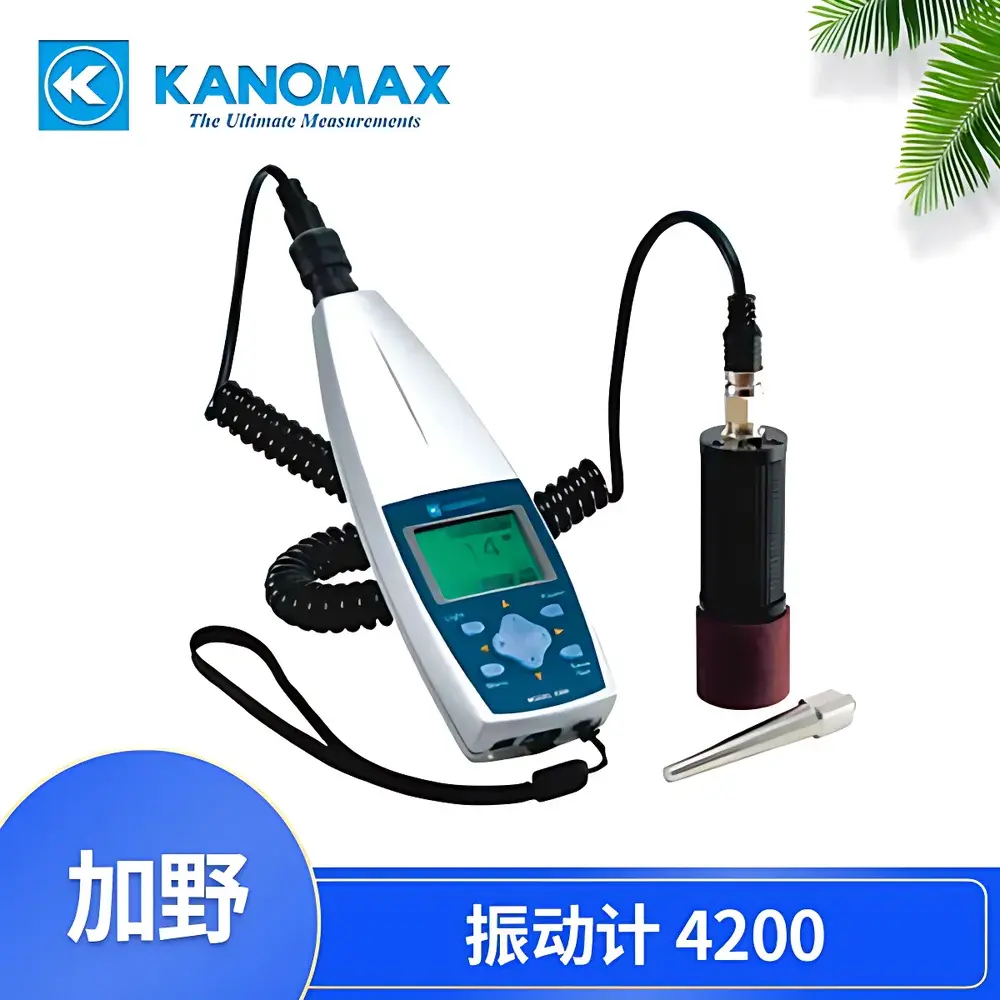
KANOMAX Model 3116 Hand-Arm Vibration Integrating Analyzer
| Brand | KANOMAX |
|---|---|
| Origin | Japan |
| Model | 3116 |
| Acceleration Range | 0.02–200 m/s² RMS |
| Velocity Range | 0.02–200 mm/s RMS |
| Displacement Range | 2–2000 μm EQp-p |
| Accuracy | ±5% |
| Frequency Range (Acceleration) | 3 Hz–10 kHz |
| Frequency Range (Velocity) | 10 Hz–1 kHz (compliant with JIS B 0907:1989) |
| Frequency Weighting | W<sub>h</sub> (ISO 5349-1 hand-arm vibration filter) |
| Output | AC output 1 Vrms (full scale), headphone output with volume control |
| Interface | RS-232C |
| Power Supply | Two AAA batteries or optional AC adapter |
| Dimensions | 145 mm (H) × 48 mm (W) × 23 mm (D) |
| Weight | Approx. 130 g |
Overview
The KANOMAX Model 3116 Hand-Arm Vibration Integrating Analyzer is a portable, battery-powered instrument engineered for precise measurement and evaluation of hand-transmitted vibration in occupational safety and industrial hygiene applications. Designed in strict accordance with ISO 5349-1:2001 and JIS B 0907:1989 standards, the device implements real-time frequency-weighted integration to compute vibration magnitude metrics—including A(8) (daily exposure action value), VDV (vibration dose value), and segmental RMS values—required for regulatory compliance and risk assessment under EU Directive 2002/44/EC and OSHA-aligned workplace evaluations. Its compact form factor (145 × 48 × 23 mm) and lightweight construction (≈130 g) enable extended field use without operator fatigue, while its integrated Wh digital filter ensures accurate application of the human biodynamic response curve across the 6.3–1250 Hz hand-arm transmission band.
Key Features
- Integrated tri-axial acceleration sensing with built-in Wh weighting filter compliant with ISO 5349-1:2001 and JIS B 0907:1989
- Simultaneous real-time calculation of A(8), VDV, and time-weighted RMS values per ISO 2631-1 and ISO 5349-2
- Dual-range analog output (1 Vrms full-scale AC) for connection to data loggers or oscilloscopes
- Headphone monitoring port with adjustable volume for audible verification of signal integrity during field calibration checks
- RS-232C serial interface supporting ASCII protocol for direct export of time-stamped measurement records to PC-based analysis software
- Low-power architecture enabling >20 hours of continuous operation on two AAA alkaline cells; compatible with optional AC adapter for benchtop use
- Magnetic mounting base and probe-compatible design facilitate stable coupling to rotating tools, grinders, sanders, and pneumatic equipment without mechanical decoupling artifacts
Sample Compatibility & Compliance
The Model 3116 is optimized for measuring hand-transmitted vibration from powered hand tools including angle grinders, impact wrenches, chipping hammers, concrete breakers, and chain saws. It accommodates standard 10–32 UNF threaded accelerometers (e.g., PCB Piezotronics 352C33) via its integrated magnetic base and probe holder. All vibration metrics comply with ISO 5349-1:2001 Annex B procedures for sensor placement, grip force control (20–30 N), and measurement duration (minimum 10 s per operating condition). The device meets CE marking requirements for electromagnetic compatibility (EN 61326-1) and carries conformity documentation traceable to JIS Z 8015:2012 (vibration meter calibration standards). Data acquisition workflows support GLP-compliant record retention when paired with validated third-party software.
Software & Data Management
Raw time-series acceleration data and integrated metrics are transmitted via RS-232C using a fixed 9600 baud, 8N1 protocol. KANOMAX provides a Windows-compatible terminal utility for configuration, real-time display, and CSV export. For regulated environments, the unit supports audit-trail-ready data capture when interfaced with validated systems compliant with FDA 21 CFR Part 11 (electronic signatures, user access controls, and immutable logs). Exported files include metadata fields: timestamp (UTC), sensor ID, tool identification, operator ID, measurement mode (A(8)/VDV/RMS), and environmental temperature/humidity if logged externally. No cloud connectivity or proprietary firmware updates are implemented—ensuring deterministic behavior and long-term validation stability.
Applications
- OHS professionals conducting daily exposure assessments for workers using vibrating hand tools in construction, metal fabrication, and shipyard maintenance
- Occupational hygienists performing baseline surveys and periodic re-evaluations required under national HSE frameworks (e.g., UK HSE L140, German TRGS 412)
- Tool manufacturers validating vibration emission levels per ISO 20653 and EN 62841 series standards prior to CE certification
- Research laboratories studying biomechanical coupling between grip posture, tool dynamics, and neural feedback pathways in hand-arm vibration syndrome (HAVS) etiology
- Preventive maintenance teams correlating spectral content (e.g., dominant 125–500 Hz bands) with bearing wear patterns in rotating equipment
FAQ
Does the Model 3116 support ISO 5349-2:2001 tool-specific measurement protocols?
Yes—the instrument’s embedded firmware applies the standardized tool classification matrix and automatically selects appropriate evaluation durations and averaging methods based on tool type (e.g., percussive vs. rotary) as defined in ISO 5349-2 Annex A.
Can the device store measurements internally without external logging?
No—the Model 3116 operates in real-time streaming mode only and requires continuous RS-232C connection or manual recording; it has no onboard memory.
Is calibration traceable to national metrology institutes?
Calibration certificates issued by KANOMAX-accredited service centers are traceable to NMIJ/AIST (Japan) and include uncertainty budgets compliant with ISO/IEC 17025:2017.
What is the recommended recalibration interval?
Annual calibration is advised per ISO 17025 requirements; however, field verification using a certified shaker system (e.g., Brüel & Kjær 4809) is recommended before each high-stakes survey.
Does the unit support custom frequency weighting filters beyond Wh?
No—only the ISO 5349-1 Wh filter is implemented; no user-defined or alternative weighting curves (e.g., Wk, Wb) are available in firmware.
Related Products







