
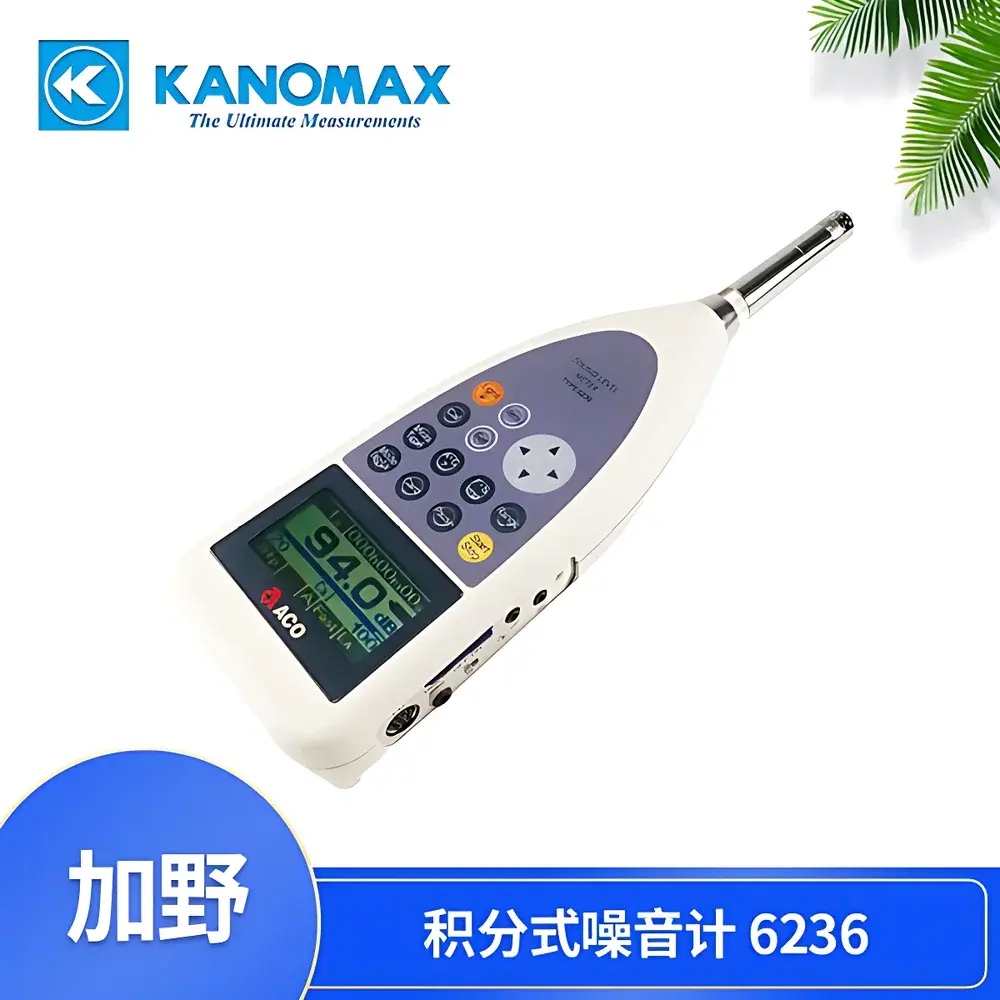
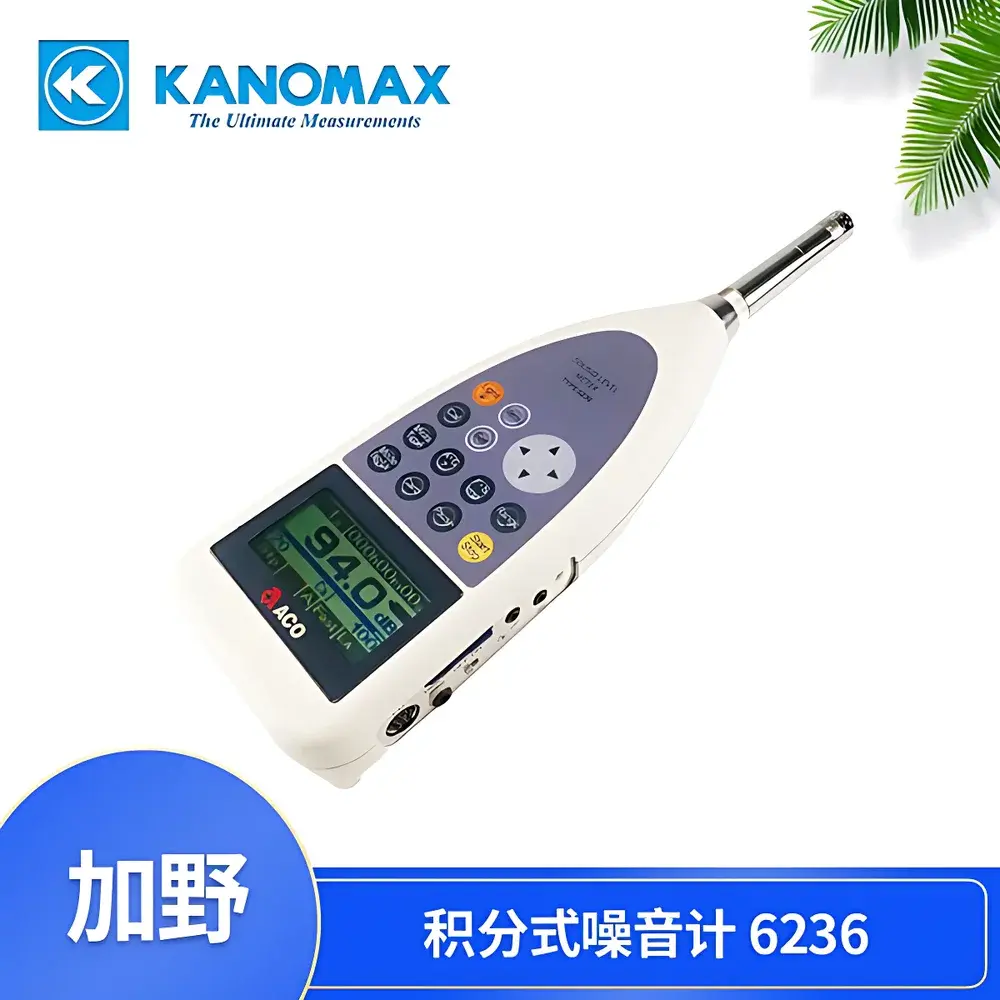
Kanomax Model 6236+ Integrating Sound Level Meter
| Brand | Kanomax |
|---|---|
| Origin | Japan |
| Model | 6236+ |
| Instrument Type | Handheld Integrating Sound Level Meter |
| Frequency Range | 20–8,000 Hz |
| Measurement Ranges | 28–130 dB(A), 30–130 dB(C), 38–130 dB(F) |
| Self-Noise | 0.1 dB |
| Measurement Accuracy | ±0.1 dB |
| Maximum Measurement Duration | 199 h 59 min 59 s |
Overview
The Kanomax Model 6236+ Integrating Sound Level Meter is a precision-engineered, type-approved instrument designed for compliant occupational and environmental noise assessment in industrial, manufacturing, and regulatory settings. Based on the principles of electret condenser microphone transduction and digital signal processing with real-time A-, C-, and F-weighting filters, the 6236+ delivers traceable, repeatable acoustic measurements aligned with international metrological standards. Its core functionality centers on time-integrated sound exposure evaluation—including equivalent continuous sound pressure level (Leq), maximum/minimum sound pressure level (Lmax/Lmin), peak sound pressure level (Lpeak), and time-history logging—enabling rigorous compliance with occupational health regulations such as OSHA 29 CFR 1910.95, EU Directive 2003/10/EC, and ISO 9612:2009 for noise exposure assessment.
Key Features
- IEC 61672-1:2013 Class 1 compliant acoustical performance, certified for high-accuracy field measurements in legally defensible contexts
- Triple-weighting capability: A-weighted (28–130 dB), C-weighted (30–130 dB), and Z-weighted (flat, 38–130 dB) frequency responses, supporting both hearing-risk evaluation and full-spectrum analysis
- Ultra-low self-noise floor of 0.1 dB re 20 µPa, ensuring reliable measurement at low-level emission sources without signal masking
- High-resolution backlit LCD with dynamic analog bar graph display for real-time visual feedback during transient or fluctuating noise events
- Integrated memory capable of storing up to 199 hours, 59 minutes, and 59 seconds of continuous time-series data with timestamped metadata
- Robust handheld ergonomics: 86 × 285 × 46 mm dimensions, ~450 g mass, and IP54-rated enclosure for operation in dusty, humid, or vibration-prone industrial environments
- Flexible power system: Operates on four AA alkaline batteries (typical 9-hour runtime) or optional AC adapter for extended stationary monitoring
Sample Compatibility & Compliance
The 6236+ is validated for use with Kanomax’s calibrated electret condenser microphone assemblies (e.g., Type 7146NL, sensitivity −28 dB re 1 V/Pa), which meet IEC 61094-4 requirements for free-field response. The instrument satisfies ANSI S1.4-1983 (R2020) and IEC 61672-1:2013 Class 1 specifications across its full operating range. It supports GLP-compliant data acquisition workflows through built-in audit trail functions, including operator ID tagging, calibration event logging, and tamper-evident file integrity checks—critical for facilities subject to FDA 21 CFR Part 11 or ISO/IEC 17025 accreditation. All measurement records are stored in non-volatile memory with UTC timestamping and can be exported via USB interface in CSV or proprietary binary format for post-processing in third-party analysis software.
Software & Data Management
Data retrieval and configuration are managed via Kanomax’s dedicated PC application (compatible with Windows 10/11), enabling batch export, spectral histogram generation, Leq trend plotting, and customizable report templates aligned with ISO 1996-2 or ISO 532-1 frameworks. The software enforces role-based access control, automatic calibration certificate import, and version-controlled firmware updates. Raw time-history datasets retain full 32-bit resolution and support FFT-based narrowband analysis when imported into MATLAB, LabVIEW, or Brüel & Kjær PULSE environments. Exported files include embedded metadata fields: measurement location ID, microphone serial number, calibration date, temperature/humidity readings (when paired with optional environmental sensor module), and user-defined notes.
Applications
- Ongoing noise mapping of production lines, CNC machining cells, compressor rooms, and HVAC systems per ISO 11201–11204 series
- Workplace noise exposure assessment for daily personal noise dose (Dose%) calculation and hearing conservation program documentation
- Pre- and post-engineering controls verification (e.g., enclosure installation, damping treatment, silencer retrofitting)
- Environmental noise surveys near factory perimeters, transportation corridors, or construction sites under local municipal ordinances
- Acoustic validation of product emissions (e.g., power tools, domestic appliances, medical devices) against CISPR, EN 55014, or ISO 3744 test protocols
- Research-grade noise characterization in university laboratories and national metrology institutes requiring Class 1 traceability
FAQ
What standards does the Kanomax 6236+ comply with for legal metrology?
It meets IEC 61672-1:2013 Class 1, ANSI S1.4-1983 (R2020), and JIS C 1509-1:2018, making it suitable for regulatory reporting in Japan, North America, and the EU.
Can the device perform octave or 1/3-octave band analysis?
No—the 6236+ is optimized for broadband integrating measurements; spectral analysis requires external FFT analyzers or Kanomax’s complementary Model 4431 analyzer platform.
Is calibration traceable to NMI standards?
Yes—factory calibration is traceable to the National Metrology Institute of Japan (NMIJ) via accredited calibration laboratories; users receive a UKAS- or A2LA-accredited certificate upon request.
How is data integrity maintained during long-term logging?
All logged files are written with cyclic redundancy checksums (CRC-32), auto-synchronized timestamps from internal RTC, and write-protected memory sectors to prevent corruption during power interruption.
Does the instrument support remote triggering or external sensor inputs?
It features a TTL-compatible trigger input for synchronized start/stop control but lacks analog voltage or digital bus interfaces for external sensor integration.







