
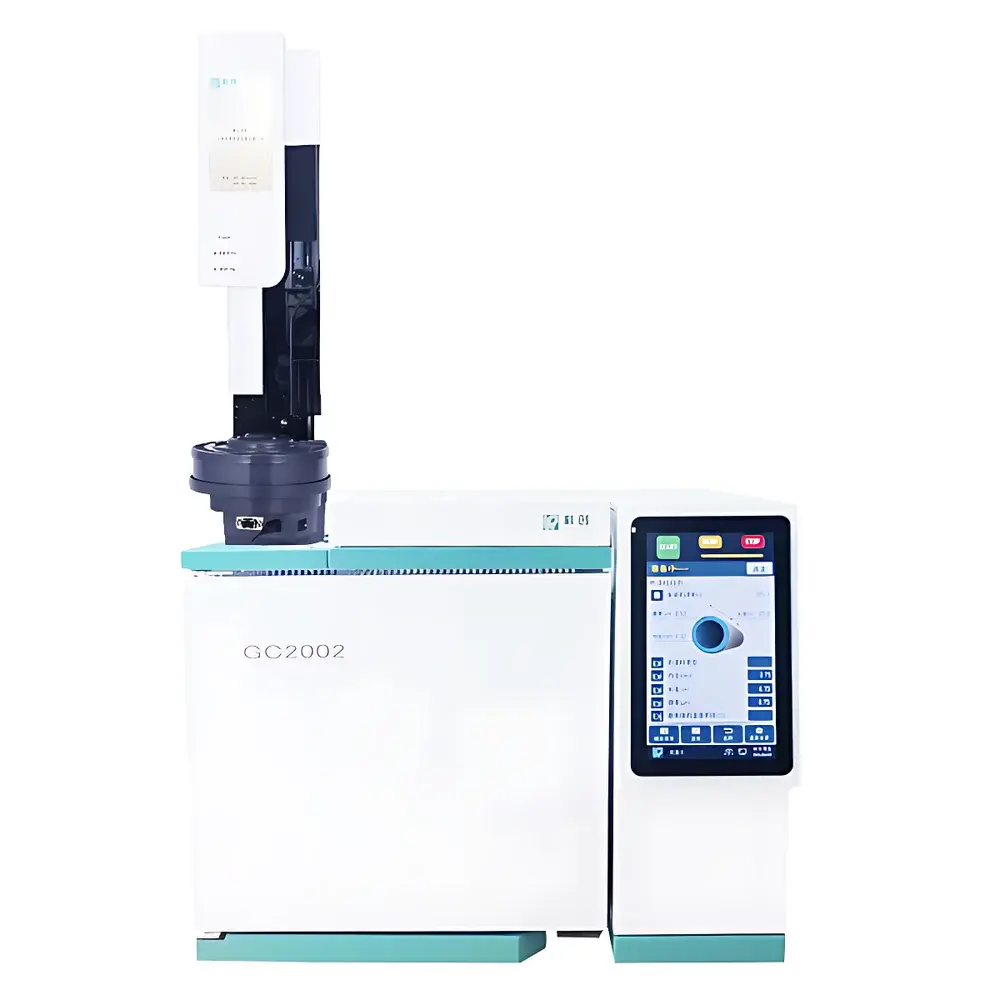
Kechuang GC2002 Series Network-Enabled Gas Chromatograph with Integrated EPC/EFC and Multi-Detector Support
| Brand | Kechuang |
|---|---|
| Origin | Shanghai, China |
| Manufacturer Type | Direct Manufacturer |
| Instrument Type | Online Gas Chromatograph |
| Model | GC2002 |
| Temperature Control Range | Ambient + 3 °C to 450 °C |
| Maximum Ramp Rate | 120 °C/min (adjustable in 0.1 °C/min increments) |
| Cooling Time | ≤5 min (350 °C → 50 °C) |
| Carrier Gas Flow Range | 0–100 mL/min |
| Carrier Gas Pressure Range | 0–100 psi (0–689 kPa) |
| Injector Temperature Max | 300 °C |
| Injector Pressure Setting Range | 0–100 psi |
| Total Injector Flow Setting Range | 0–1200 mL/min |
| Detection Limits | FID ≤3.0×10⁻¹² g/s (n-hexadecane), TCD ≥3500 mV·mL/mg, ECD ≤10 fg/mL (lindane), FPD ≤1.0 pg/s (P) / ≤10.0 pg/s (S) |
| Retention Time RSD | <0.008% |
| Peak Area RSD | <1.0% |
| EPC/EFC Precision | ±0.001 psi / ±0.001 mL/min |
| Programmable Temperature Steps | Up to 16 stages (extendable to unlimited via firmware) |
| External Event Programs | 8 channels |
| Data Interface | RJ45 Ethernet (TCP/IP), native digital signal transmission |
Overview
The Kechuang GC2002 Series is a network-enabled, high-stability gas chromatograph engineered for continuous, unattended operation in environmental monitoring laboratories and industrial QA/QC facilities. Built on a modular architecture, it employs capillary or packed column separation coupled with multiple detector configurations—including Flame Ionization (FID), Thermal Conductivity (TCD), Electron Capture (ECD), and Flame Photometric (FPD)—to deliver quantitative and qualitative analysis of volatile and semi-volatile organic compounds (VOCs/SVOCs). Its core measurement principle relies on differential partitioning of analytes between a mobile phase (inert carrier gas) and a stationary phase (column coating), with retention time serving as the primary identification parameter and peak area/height enabling concentration quantification per calibrated response factors. The system supports both isothermal and multi-stage programmed temperature vaporization (PTV) protocols, optimized for trace-level detection in complex matrices such as ambient air, stack emissions, soil headspace, and water extracts—fully aligned with EPA Methods 8021B, 8260D, ISO 16000-6, and EN 14662.
Key Features
- 10-channel independent temperature control system, including dual programmable column ovens with ±0.01 °C stability and ramp rates up to 120 °C/min (0.1 °C/min resolution)
- Integrated Ethernet interface (RJ45) supporting TCP/IP communication; single workstation can remotely manage up to 253 instruments with full bidirectional control and real-time data streaming
- Electronic Pressure and Flow Control (EPC/EFC) system with 24 independently configurable channels; supports constant-pressure, constant-flow, and multi-step (up to 8-stage) pressure/flow programming
- 10-inch capacitive touchscreen HMI with embedded chromatogram display, baseline monitoring, and local instrument configuration—no external PC required for basic operation
- Standard MS-compatible interface (GC-MS coupling port); optional hydrogen leak detection, variable-frequency column oven cooling motor, and auto-backdoor cooling (<5 min from 350 °C to 50 °C)
- Onboard fault diagnostics with real-time error logging, location-specific alerts, and automatic thermal shutdown if any zone exceeds user-defined limits
- 8-channel external event timer for automated valve switching, detector modulation, or sample introduction synchronization
Sample Compatibility & Compliance
The GC2002 accommodates liquid, gaseous, and solid-phase microextraction (SPME) samples via split/splitless, on-column, or PTV injectors. It is validated for use with nitrogen, helium, hydrogen, and argon carrier gases under regulated flow and pressure conditions. All temperature zones—including inlet, detector, and oven—are traceable to NIST-certified references and maintain ±0.1% thermal accuracy across ambient +3 °C to 450 °C. The system meets ISO/IEC 17025 requirements for method validation and supports GLP-compliant audit trails when operated with compliant chromatography data systems (CDS). Firmware includes built-in calibration verification routines for detector linearity (10⁴–10⁷ for FID), baseline noise (≤1.0×10⁻¹³ A for FID), and retention time reproducibility (RSD <0.008%). It is designed for integration into FDA 21 CFR Part 11 environments when paired with validated CDS software featuring electronic signatures and immutable audit logs.
Software & Data Management
The GC2002 ships with Kechuang ChromaControl™ v3.x—a Windows-based, fully integrated chromatography data system (CDS) that operates natively on the instrument’s embedded controller or as a standalone client. It supports simultaneous acquisition from up to four detectors on a single data channel, with flexible time-programmed detector switching and signal routing. Raw data is stored in ASTM E1319-compliant .CDF format, ensuring long-term readability and third-party compatibility. The software provides automated peak integration using valley-to-valley, tangent skim, or exponential curve fitting algorithms; customizable reporting templates conform to ISO 17025 Annex A.3 and EPA QA/G-5 guidelines. Remote access enables secure, role-based instrument monitoring via HTTPS, with TLS 1.2 encryption and session timeout enforcement. Audit trail records include user actions, method changes, calibration events, and system errors—retained for ≥18 months per internal storage policy.
Applications
The GC2002 is routinely deployed in regulatory environmental testing labs for VOC analysis in ambient air (TO-14A/TO-15), landfill gas (EPA Method 25), and wastewater effluents (Method 624). Its low detection limits and high dynamic range support pesticide residue screening in drinking water (EPA 508.1), PCB congener profiling in soil (EPA 8082A), and sulfur compound quantification in natural gas (ASTM D1945). In industrial settings, it performs hydrocarbon speciation in refinery streams (ASTM D1319), residual solvent analysis in pharmaceutical excipients (ICH Q2(R2)), and monomer purity assessment in polymer manufacturing. The dual-oven configuration allows parallel method development and routine analysis—e.g., one oven running a fast benzene/toluene/ethylbenzene/xylene (BTEX) assay while the other executes a slow-eluting PAH method—maximizing throughput without hardware duplication.
FAQ
Does the GC2002 support compliance with 21 CFR Part 11?
Yes—when used with validated ChromaControl™ CDS v3.x and configured with electronic signatures, audit trail logging, and secure user authentication.
Can the instrument operate unattended for extended periods?
Yes—its onboard memory retains method files and raw data during network outages; scheduled auto-reboot and watchdog timers ensure recovery from transient faults.
Is hydrogen carrier gas safe to use with this system?
Optional hydrogen leak detection and automatic shut-off valves are available; installation must comply with local hazardous gas handling codes (e.g., NFPA 55, IEC 60079-10-1).
What detector combinations are supported simultaneously?
FID + TCD, FID + ECD, or FID + FPD are standard; triple-detector configurations require optional signal multiplexing hardware.
How is column oven cooling performance verified?
Cooling rate is measured per ASTM E260 Annex A2 using calibrated thermocouples placed at three axial positions; typical results show 350 °C → 50 °C in 4.2–4.8 min with backdoor actuation.






