
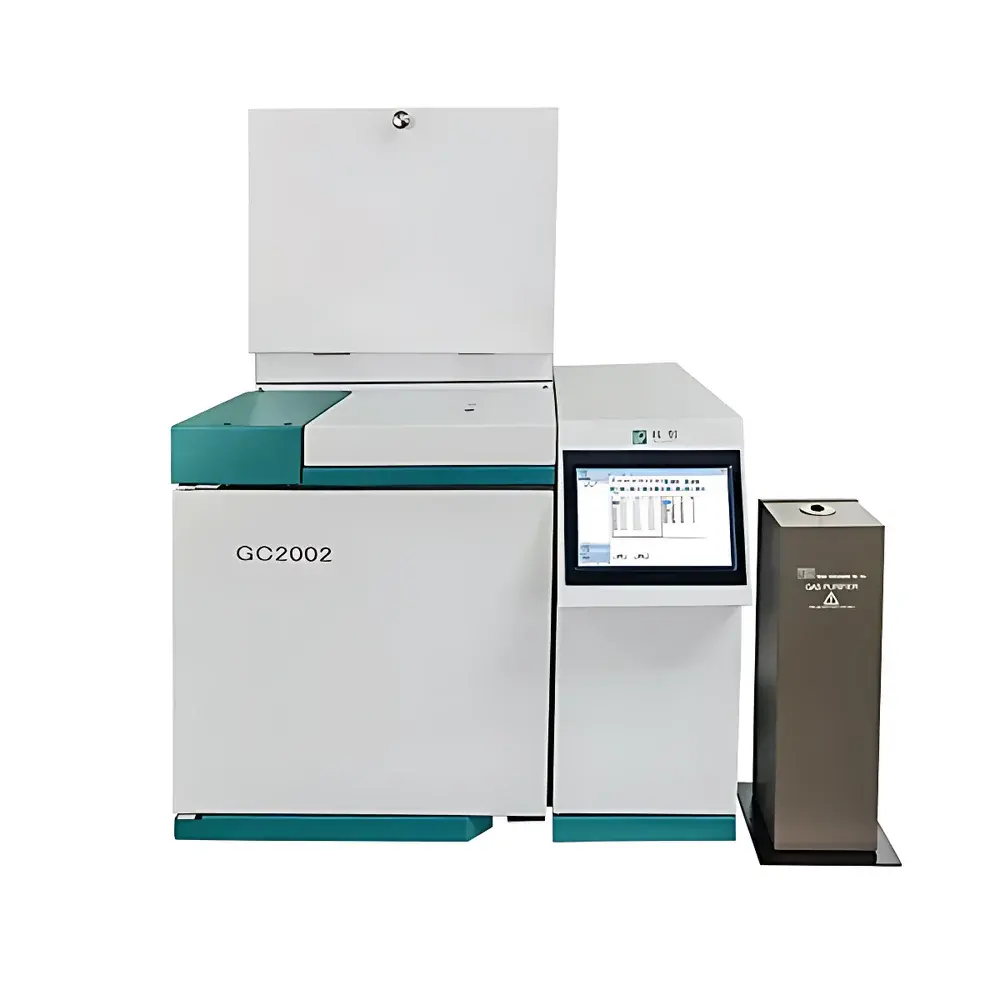
KeChuang GC2002N/PDHID- Helium Ionization Gas Chromatograph for Trace Impurity Analysis in High-Purity and Ultra-High-Purity Hydrogen
| [Brand | KeChuang |
|---|---|
| Origin | Shanghai, China |
| Manufacturer Type | Direct Manufacturer |
| Instrument Type | Laboratory Gas Chromatograph |
| Application | Dedicated to High-Purity Gas Analysis |
| Oven Temperature Range | 0–400 °C |
| Maximum Ramp Rate | 40 °C/min |
| Cooling Time (from 400 °C to 50 °C) | ≤4 min |
| Carrier Gas Flow Control Range | 0–500 mL/min |
| Carrier Gas Pressure Control Range | 0–0.4 MPa |
| Injector Maximum Operating Temperature | 300 °C |
| Injector Pressure Setting Range | 0–0.4 MPa |
| Injector Total Flow Setting Range | 0–500 mL/min |
| Detection Principle | Pulsed Discharge Helium Ionization Detection (PDHID) |
| Minimum Detectable Concentration (CO₂) | 0.026 µL/L |
| RSD of Retention Time (n=7) | ≤0.29% |
| RSD of Peak Area (n=7) | ≤6.19% |
Overview
The KeChuang GC2002N/PDHID- is a purpose-built laboratory gas chromatograph engineered for the precise, reliable, and trace-level quantification of permanent gases and light hydrocarbons in high-purity (5N) and ultra-high-purity (6N) hydrogen matrices. Unlike conventional thermal conductivity (TCD) or flame ionization (FID) detectors, this system employs pulsed discharge helium ionization detection (PDHID), a non-destructive, universal detection method offering exceptional sensitivity to all compounds—including H2, O2, N2, CH4, CO, CO2, and Ar—without requiring reactive carrier gases or catalytic conversion. The PDHID operates by generating metastable helium ions in a micro-discharge cell; analyte molecules entering the cell quench these ions, producing a current proportional to concentration. This principle enables sub-ppb (µL/L) detection limits and high reproducibility across multi-day analyses—critical for certifying hydrogen used in semiconductor manufacturing, fuel cell R&D, and high-energy physics applications where impurity-induced catalyst poisoning or dielectric breakdown must be rigorously excluded.
Key Features
- Optimized oven architecture with dual-zone temperature control and rapid thermal stabilization (≤4 min cooldown from 400 °C to 50 °C), enabling high-throughput analysis of complex gas mixtures without carryover.
- Independent, digitally controlled pressure and flow regulation at both inlet and detector ends—ensuring retention time stability and method transferability between instruments.
- High-temperature injector (up to 300 °C) with split/splitless capability and inert, deactivated flow paths to prevent adsorption or catalytic decomposition of polar or reactive impurities (e.g., CO, H2O).
- PDHID detector calibrated per ISO 6141 and ASTM D1945 protocols, delivering linear dynamic range >105 and baseline noise <100 fA (RMS), supporting quantitative accuracy per GB/T 3634.2–2011 for both 5N (≤1 µL/L) and 6N (≤0.1 µL/L) hydrogen specifications.
- Modular column selection support—including molecular sieve 5Å, Porapak Q, and fused-silica PLOT columns—configured for baseline separation of O2/Ar, N2/CH4, and CO/CO2 within a single 12-minute run.
- Embedded firmware with real-time diagnostics, leak detection alerts, and automatic valve sequencing—reducing operator dependency and minimizing downtime during GLP-compliant routine operation.
Sample Compatibility & Compliance
The GC2002N/PDHID- is validated for direct injection of compressed hydrogen samples ranging from 1–10 MPa, with optional pressure-reduction manifolds for integration into online sampling loops. It meets the analytical requirements defined in GB/T 3634.2–2011 for high-purity hydrogen certification and aligns with international standards including ISO 8573-5 (compressed air purity classes), ASTM D7165 (trace gas analysis in hydrogen fuel), and IEC 62282-3-100 (fuel cell grade hydrogen testing). All hardware components—including stainless-steel pneumatic lines, VCR fittings, and electropolished sample pathways—are certified oxygen-clean and passivated to eliminate surface adsorption artifacts. Data integrity complies with ALCOA+ principles; audit trails, electronic signatures, and user-access controls are configurable to meet FDA 21 CFR Part 11 readiness when paired with compliant LIMS or CDS software.
Software & Data Management
Controlled via KeChuang’s GC Navigator v3.x workstation software (Windows 10/11 compatible), the system supports method development, sequence scheduling, peak integration using valley-to-valley and tangent skim algorithms, and automated calibration curve generation (linear, quadratic, or weighted least-squares). Raw data files (.GCW) store full spectral metadata—including detector voltage, oven ramp profile, valve timing, and environmental sensor logs—for full traceability. Export options include CSV, PDF analytical reports, and XML formats compatible with LabWare LIMS and Thermo Fisher Chromeleon. Software validation documentation (IQ/OQ/PQ protocols) and 21 CFR Part 11 configuration guides are provided as standard deliverables for regulated laboratories operating under GMP or ISO/IEC 17025 frameworks.
Applications
- Quality control of hydrogen feedstock in semiconductor epitaxy processes, where O2 or H2O impurities >0.1 µL/L cause oxide defect formation on Si wafers.
- Release testing of hydrogen stored in composite cylinders per SAE J2579, verifying absence of hydrocarbon contaminants that compromise PEM fuel cell membrane durability.
- Process monitoring of hydrogen purification units (PSA, membrane separators), tracking breakthrough of N2 or CH4 to optimize regeneration cycles.
- Research-grade analysis of electrolyzer output gas, quantifying crossover products (O2, Cl2) and degradation markers (CO, formaldehyde) in alkaline or PEM systems.
- Reference material certification for national metrology institutes, supporting SI-traceable calibrations of hydrogen purity standards.
FAQ
What detection technology does the GC2002N/PDHID- use, and why is it preferred for hydrogen impurity analysis?
It uses pulsed discharge helium ionization detection (PDHID), which provides uniform, near-equimolar response factors across permanent gases and hydrocarbons—eliminating the need for compound-specific calibration and reducing uncertainty in multi-component hydrogen assays.
Can this instrument quantify argon in hydrogen, and how is interference from oxygen resolved?
Yes. With a properly configured 5Å molecular sieve column and optimized oven temperature program, Ar and O2 are baseline-resolved (resolution Rs > 1.5). Retention time repeatability (RSD ≤0.29%) ensures robust identification even at sub-ppb levels.
Is the system suitable for unattended overnight operation in a QC lab environment?
Yes. The instrument features hardware-based watchdog timers, auto-shutdown on pressure loss, and integrated UPS communication—enabling fully automated sequences of up to 99 samples with scheduled calibration checks and report generation.
Does the PDHID require helium supply purity certification, and what grade is recommended?
Helium carrier gas must meet ISO 8573-1 Class 1 (≤0.1 µm particulates, ≤0.01 mg/m³ moisture, ≤0.003 mg/m³ total hydrocarbons). Grade 5.7 (99.9997% pure) or higher is required to maintain detector stability and avoid background ion suppression.
How is method transfer supported between different GC2002N/PDHID- units?
All critical parameters—including pressure setpoints, flow profiles, oven ramps, and detector gain—are stored in portable .MTH method files. Hardware inter-unit variance is minimized through factory-applied flowmeter calibration certificates and column dimension verification protocols.





