
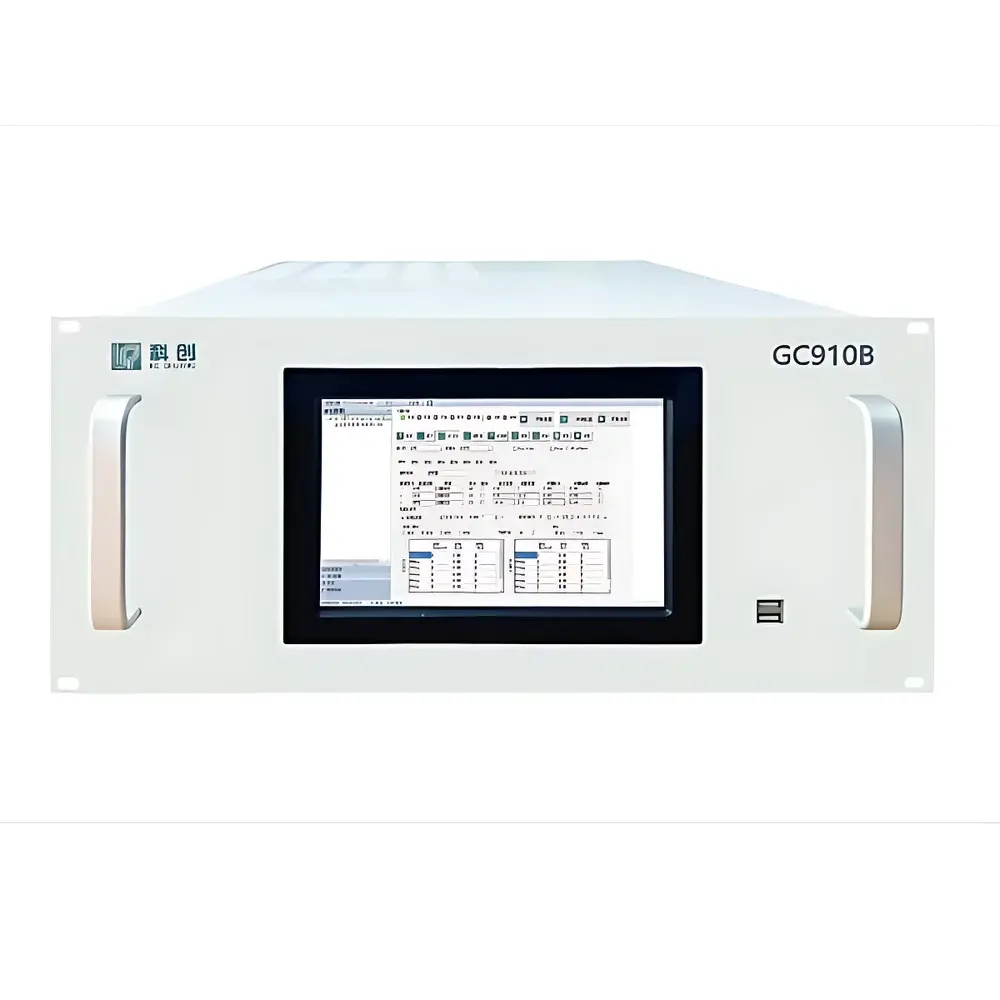
Kechuang GC910 Benchtop Gas Chromatograph with Integrated EPC/EFC and Dual-Column Oven Architecture
| Brand | Kechuang |
|---|---|
| Origin | Shanghai, China |
| Manufacturer Type | OEM Manufacturer |
| Instrument Type | Laboratory Gas Chromatograph |
| Model | GC910 |
| Price Range | USD 4,200–7,000 (FOB) |
| Temperature Control Range | Ambient + 3 °C to 450 °C |
| Maximum Ramp Rate | 120 °C/min |
| Cooling Time | ≤3.5 min (350 °C → 50 °C) |
| Carrier Gas Flow Range | 0–100 mL/min |
| Carrier Gas Pressure Range | 0–100 psi (0–689 kPa) |
| Injector Max Temp | 300 °C |
| Injector Pressure Setpoint Range | 0–100 psi |
| Total Injector Flow Setpoint Range | 0–1200 mL/min |
| Detector Options | TCD, FID, ECD, FPD |
| EPC/EFC Precision | ±0.001 psi / ±0.001 mL/min |
| Retention Time RSD | <0.008% |
| Peak Area RSD | <1.0% |
| Column Oven Volume | 165 × 135 × 92 mm |
| Dimensions (W×D×H) | 482 × 450/600 × 222 mm |
| Weight | ≤20 kg |
| Power | 220 V ±10%, 50 Hz ±5% |
Overview
The Kechuang GC910 is a high-integrity, benchtop gas chromatograph engineered for precision analysis in clinical diagnostics, environmental monitoring, and pharmaceutical quality control laboratories. Built on a dual-column oven architecture with independent programmable temperature zones, it supports simultaneous or sequential operation of two capillary or packed columns—enabling method development, column validation, and parallel sample screening without hardware reconfiguration. Its core separation principle relies on partitioning analytes between a mobile phase (inert carrier gas) and a stationary phase (capillary column coating), with retention governed by volatility, polarity, and intermolecular interactions. The instrument integrates fully digital electronic pressure and flow control (EPC/EFC) across up to 24 gas channels, ensuring reproducible carrier gas delivery under dynamic temperature gradients—a critical requirement for compliance with ISO 17025, USP , and FDA 21 CFR Part 11 analytical workflows.
Key Features
- Dual independently programmable column ovens (each with 64-stage temperature ramp capability, resolution 0.01 °C, accuracy ±0.1 °C), enabling true multi-method operation and rapid thermal equilibration.
- Embedded 8-inch industrial touchscreen HMI with real-time baseline visualization, local data capture, and direct instrument reverse control—eliminating dependency on external PCs during routine operation.
- High-fidelity EPC/EFC system delivering pressure control precision of ±0.001 psi and flow control precision of ±0.001 mL/min, supporting constant-pressure, constant-flow, and multi-step programmed pressure/flow profiles (up to 8 steps).
- Advanced thermal management: forced-air cooling with motorized rear door actuation achieves 350 °C → 50 °C cooldown in ≤3.5 minutes, minimizing cycle time between injections in high-throughput clinical assays.
- Modular detector support including TCD (detection limit ≥6000 mV·mL/mg), FID (≤3.0 × 10⁻¹² g/s for n-hexadecane), ECD (≤10 fg/mL for lindane), and FPD (≤1.0 pg/s for P, ≤10.0 pg/s for S), all with wide-range amplifiers to prevent solvent peak saturation.
- Network-centric architecture via RJ45 Ethernet interface; single workstation software can manage up to 253 instruments, supporting centralized audit trail logging, remote firmware updates, and hierarchical access control per GLP/GMP role definitions.
Sample Compatibility & Compliance
The GC910 accommodates liquid, gaseous, and headspace samples via split/splitless, on-column, or PTV injectors (configurable per application). It meets IEC 61010-1 safety requirements for laboratory equipment and complies with electromagnetic compatibility standards EN 61326-1. For regulated environments, its embedded event logging, user-access controls, electronic signatures, and full audit trail generation align with FDA 21 CFR Part 11 Annex 11 and ISO/IEC 17025:2017 clause 7.7. All temperature and pressure parameters are traceably calibrated against NIST-traceable references, and factory calibration certificates include uncertainty budgets per ISO/IEC 17025 Annex A.3.
Software & Data Management
The GC910 ships with Kechuang ChromaSuite™ v4.x—a validated chromatography data system (CDS) supporting 21 CFR Part 11-compliant user authentication, electronic signatures, and immutable audit trails. It enables cross-detector signal routing: any two detectors (e.g., FID + ECD) can be assigned to the same processing channel with independent acquisition timing, facilitating simultaneous quantification of orthogonal analyte classes. Raw data is stored in vendor-neutral ANDI/NetCDF format. Integration with LIMS via ASTM E1384-compliant HL7 or CSV export ensures seamless data handoff to enterprise QA/QC systems. Software validation packages (IQ/OQ/PQ protocols) and UAT documentation are available upon request.
Applications
The GC910 is routinely deployed in clinical toxicology labs for ethanol, methanol, and volatile organic compound (VOC) quantification in blood and urine per CLIA and CAP guidelines. In environmental testing, it supports EPA Method 8021B (halogenated hydrocarbons) and 8260D (VOCs in water). Pharmaceutical users apply it for residual solvent analysis per ICH Q2(R2) and USP , leveraging its low detection limits and robust retention time stability (<0.008% RSD). Its compact footprint (≤20 kg) and low power draw (≤2000 W) make it suitable for mobile labs, point-of-care diagnostic trailers, and ISO Class 5 cleanroom-adjacent QC benches.
FAQ
Does the GC910 support method transfer from legacy Agilent or Shimadzu systems?
Yes—ChromaSuite™ includes built-in retention time prediction algorithms and gradient translation tools compliant with ASTM D7217, enabling direct import of *.mtd and *.seq files with auto-adjustment of ramp rates and hold times.
Is the EPC/EFC system field-upgradable to support hydrogen carrier gas?
Yes—hydrogen-compatible EPC modules (certified to ISO 22866 for leak integrity) are available as optional field kits, including flame-out detection logic and automatic shutdown interlocks.
Can the instrument operate unattended for 72-hour batch runs?
Yes—the onboard scheduler supports up to 999 injection sequences with automated vial tray indexing, column bake-out cycles, and fault-recovery routines that resume analysis after power restoration.
What validation documentation is included with shipment?
Each unit ships with a Factory Acceptance Test (FAT) report, NIST-traceable calibration certificate for temperature and pressure sensors, and a complete set of IQ/OQ test scripts aligned with ISO/IEC 17025 Annex A.3.
Is remote cybersecurity hardening supported?
Yes—firmware v3.2+ includes TLS 1.2 encryption for web-based configuration, configurable IP whitelisting, and disabled default credentials per NIST SP 800-171 Rev. 2 requirements.
Related Products





