
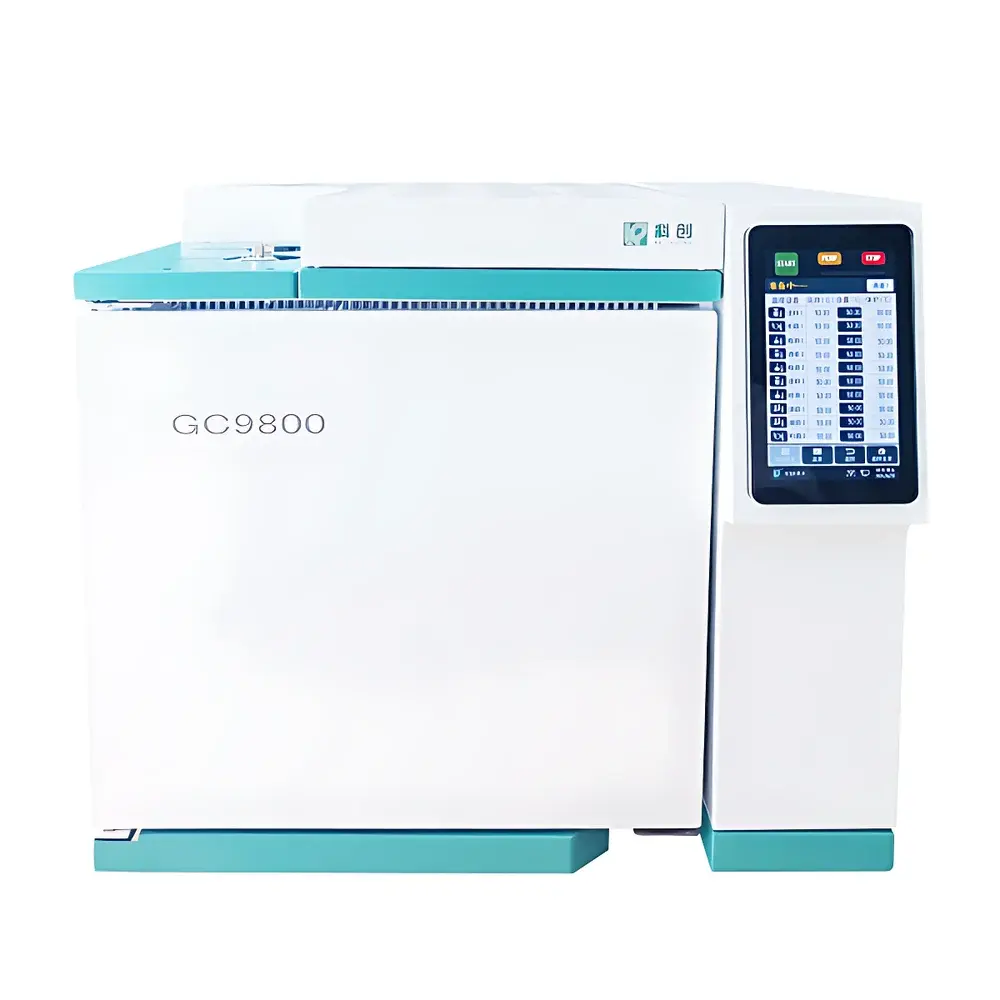
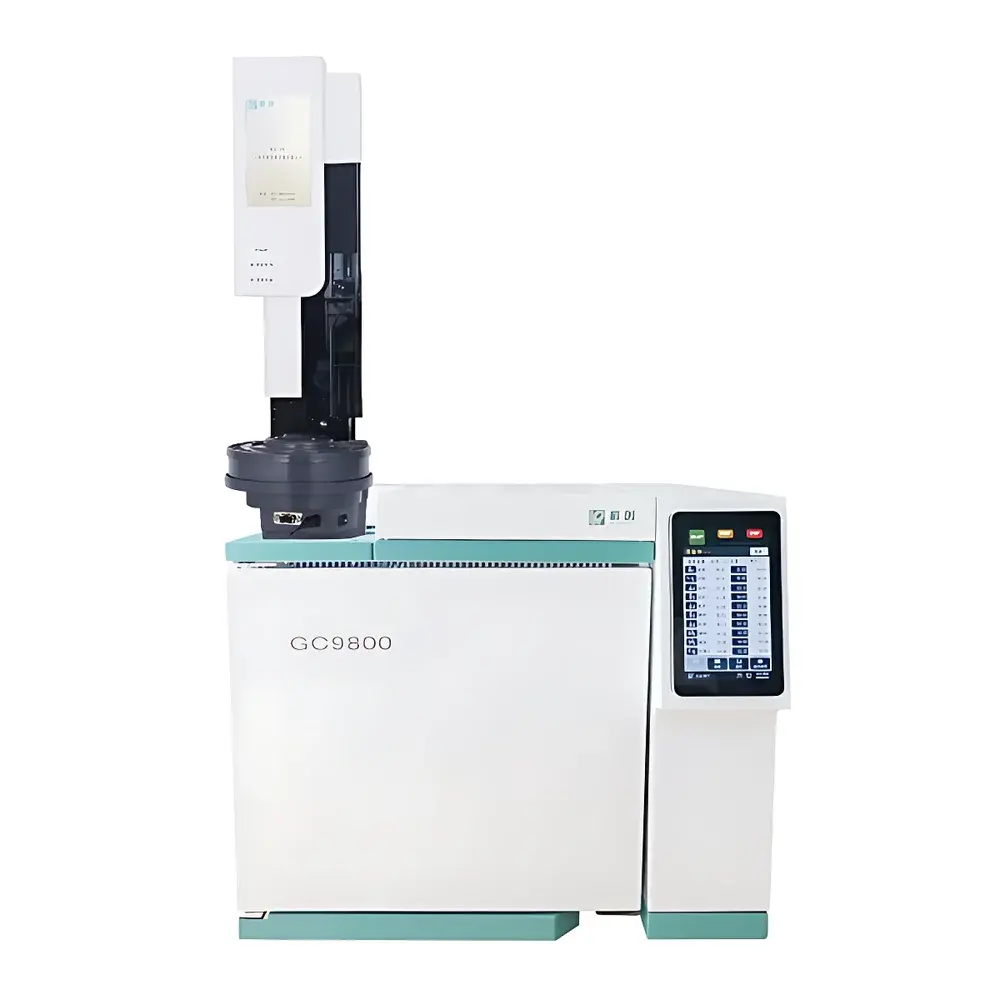
Kechuang GC9800 Network-Enabled Gas Chromatograph for Amine Analysis
| Brand | Kechuang |
|---|---|
| Origin | Shanghai, China |
| Manufacturer Type | Direct Manufacturer |
| Instrument Type | Laboratory Gas Chromatograph |
| Model | GC9800 (Network-Enabled) |
| Temperature Control Range | Ambient +3°C to 450°C |
| Maximum Ramp Rate | 0–40°C/min (adjustable in 0.1°C/min increments) |
| Cooling Rate | ≤5 min (350°C → 50°C with motorized back-opening door) |
| Carrier Gas Flow Range | 0–1200 mL/min |
| Carrier Gas Pressure Range | 0–970 kPa |
| Injector Temperature Range | 0–450°C |
| Injector Pressure Setting Range | 0–970 kPa |
| Total Injector Flow Setting Range | 5000–10,000 mV·mL/mg (benzene reference) |
| Detection Limits | TCD ≥6000 mV·mL/mg, FID ≤3.0×10⁻¹² g/s (n-hexadecane), ECD ≤10 fg/mL (lindane), FPD ≤1.0 pg/s (P), ≤10 pg/s (S) |
| Linearity | TCD 10⁵, FID 10⁷, ECD 10⁴, FPD 10⁴ |
| Retention Time RSD | <0.008%, Peak Area RSD: <1.0% |
| EPC/EFC Precision | ±0.001 psi (pressure), ±0.001 mL/min (flow) |
| Column Oven Capacity | 305 × 160 × 278 mm (W×D×H) |
| Dimensions (W×D×H) | 530 × 570 × 506 mm |
| Weight | ≤50 kg |
| Power Consumption | ≤3000 W |
| Input Power | 220 V ±10%, 50 Hz ±5% |
| Operating Environment | 5–35°C, RH ≤85% |
Overview
The Kechuang GC9800 Network-Enabled Gas Chromatograph is a high-performance, laboratory-grade analytical system engineered for precise and reliable separation and quantification of amine compounds in high-purity gas matrices. Designed around a robust dual-column oven architecture with independent temperature control, the instrument implements classical gas chromatographic principles—partitioning of analytes between a mobile phase (carrier gas) and stationary phase (capillary column)—to achieve high-resolution elution profiles under tightly regulated thermal and pneumatic conditions. Its application focus on amine analysis reflects rigorous optimization for polar, thermally labile, and adsorptive species commonly encountered in semiconductor-grade gases, specialty chemical synthesis streams, and pharmaceutical excipient purity testing. The system complies with foundational chromatographic performance criteria defined in ASTM D3606 (gasoline hydrocarbons), ISO 6416 (industrial gases), and USP (chromatography), supporting method validation in GLP and GMP-regulated environments.
Key Features
- 10-channel independent temperature control system, including two programmable column ovens with dual ramp capability and 0.01°C temperature resolution
- Integrated Ethernet interface (RJ45) enabling direct digital communication with host PC; supports up to 253 instruments per network segment for centralized monitoring and remote operation
- Electronic Pressure and Flow Control (EPC/EFC) system with 24-channel scalability, offering constant pressure, constant flow, or multi-step programmed pressure/flow profiles (up to 8 steps)
- 7-inch capacitive touchscreen HMI with real-time baseline visualization, spectral overlay, and embedded acquisition controls—no external hardware required for basic operation
- Standard mass spectrometer coupling port (GC-MS interface) and optional variable-frequency column oven cooling motor for rapid thermal equilibration (≤5 min from 350°C to 50°C)
- 16-stage (expandable to unlimited) programmable temperature ramping with event-triggered external device synchronization (8 user-defined time programs)
- Self-diagnostic firmware with real-time fault logging, location-specific error reporting, and automatic overtemperature shutdown across all thermal zones
Sample Compatibility & Compliance
The GC9800 is validated for analysis of primary, secondary, and tertiary aliphatic/aromatic amines—including methylamine, dimethylamine, trimethylamine, ethylenediamine, and aniline derivatives—in gas-phase samples with purity levels ≥99.999%. Its low-bleed injector design, inert flow path (siliconized stainless steel and fused silica tubing), and selectable detector configurations minimize adsorption, catalytic decomposition, and peak tailing. The system meets mechanical and electrical safety requirements per IEC 61010-1 and electromagnetic compatibility standards EN 61326-1. When operated with validated methods and audit-trail-enabled software, it satisfies data integrity expectations under FDA 21 CFR Part 11 for electronic records and signatures. Routine calibration and performance qualification follow protocols aligned with ISO/IEC 17025 for testing laboratories.
Software & Data Management
The GC9800 operates with Kechuang’s proprietary ChromaControl™ workstation—a Windows-based platform supporting full bidirectional instrument control, sequence scheduling, and post-run reprocessing. The software implements configurable signal routing: users may assign any two or more detectors (TCD, FID, ECD, FPD) to shared or discrete data channels, enabling simultaneous acquisition and comparative quantitation without hardware reconfiguration. All acquisition parameters—including temperature ramps, EPC setpoints, and detector gain—are stored as metadata within .cdf files compliant with AIA/ANDI standards. Audit trail functionality logs user actions, method modifications, and calibration events with timestamps and operator IDs. Raw data export supports CSV, TXT, and mzXML formats for third-party statistical analysis (e.g., PCA, PLS-DA) and LIMS integration via ODBC or REST API.
Applications
- Quality control of ammonia, monoethanolamine (MEA), and diethanolamine (DEA) in hydrogen fuel cell feedstock gases
- Purity assessment of amine catalysts used in polyurethane synthesis and CO₂ capture solvents
- Residual amine monitoring in pharmaceutical nitrogen purge streams per ICH Q5C guidelines
- Trace-level detection of triethylamine in semiconductor process gases (SEMI F57 specifications)
- Stability-indicating assays for amine-containing APIs subject to oxidative or hydrolytic degradation
- Environmental screening of volatile alkylamines in ambient air using cryo-trap preconcentration
FAQ
Does the GC9800 support compliance with 21 CFR Part 11 for regulated laboratories?
Yes—the ChromaControl™ workstation includes role-based access control, electronic signatures, and immutable audit trails meeting core technical requirements for electronic records.
Can the instrument operate unattended for extended periods?
Yes—its automated self-diagnostics, thermal runaway protection, and scheduled sequence execution enable overnight and weekend runs with minimal supervision.
What carrier gases are compatible with the EPC/EFC system?
Nitrogen, hydrogen, helium, and argon are fully supported; gas-specific viscosity compensation algorithms ensure accurate flow delivery across all media.
Is method transfer possible from legacy GC platforms?
Retention time indexing, retention index libraries, and standardized .cdf output facilitate cross-platform method portability with minimal re-optimization.
How is column bleed managed during high-temperature amine analysis?
The dual-column oven design isolates thermal stress from detector compartments, while low-bleed deactivation protocols and gradient elution reduce baseline drift during extended 400°C+ runs.





