
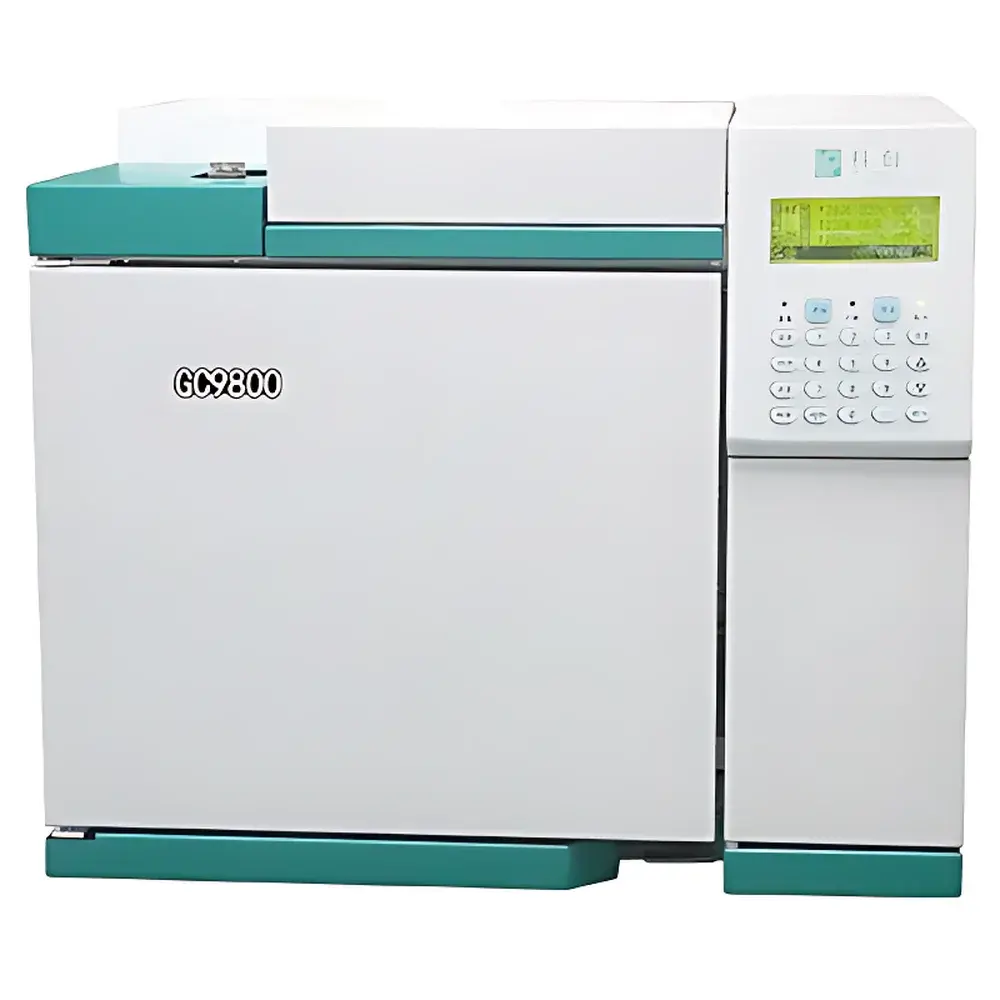
Kechuang GC9800HF Environmental Air Total Hydrocarbons and Non-Methane Hydrocarbons (NMHC) Gas Chromatograph
| Brand | Kechuang |
|---|---|
| Origin | Shanghai, China |
| Manufacturer Type | Direct Manufacturer |
| Instrument Type | Laboratory Gas Chromatograph |
| Application Field | Environmental Air Monitoring |
| Oven Temperature Range | Ambient +5°C to 400°C |
| Oven Ramp Rate | 0.1–40°C/min |
| Oven Cooling Rate | 300°C → 50°C in ≤4 min |
| Carrier Gas Flow Range & Control | 0–1200 mL/min |
| Carrier Gas Pressure Range & Control | 0–250 kPa |
| Injector Maximum Temperature | 400°C |
| Injector Pressure Setting Range | 0–250 kPa |
| Injector Total Flow Setting Range | 0–1200 mL/min |
| Detection Method | Flame Ionization Detection (FID) |
| Sample Introduction | Dual-loop 10-port valve with parallel-packed column configuration |
| Detection Limit (1 mL air sample) | 0.04 mg/m³ for both CH₄ and NMHC |
| Compliance Standards | HJ 604-2011, HJ/T 38-1999 |
Overview
The Kechuang GC9800HF is a dedicated laboratory gas chromatograph engineered for precise, regulatory-compliant quantification of total hydrocarbons (THC) and non-methane hydrocarbons (NMHC) in ambient air and stack emissions. It operates on the principle of separation by packed-column gas chromatography coupled with flame ionization detection (FID), optimized for volatile C₁–C₈ hydrocarbons. The instrument implements the oxygen-peak subtraction method per HJ 604-2011: nitrogen serves as carrier gas, enabling baseline resolution of O₂ and hydrocarbon peaks; methane elution is resolved first, followed by total hydrocarbon response, allowing automatic NMHC calculation as THC minus CH₄. Its dual-loop 10-port valve and parallel-packed column configuration permit simultaneous, single-injection analysis of both parameters—eliminating inter-run variability and improving throughput in high-volume environmental monitoring labs.
Key Features
- Integrated 5.7-inch color touchscreen interface with real-time temperature and pressure monitoring, supporting standalone operation or full PC-based control.
- Microprocessor-controlled oven with 8-stage programmable ramping, near-ambient temperature regulation (minimum setpoint = ambient +5°C), and automated back-door cooling (300°C → 50°C in ≤4 min).
- Seven independently controllable temperature zones—including injector, detector, and column oven—with over-temperature cutoff protection active per zone.
- Dual-packed column system (one for CH₄ separation, one for total hydrocarbon profiling) paired with a high-stability FID, calibrated for linear response across 10⁴ dynamic range.
- Network-enabled architecture via RJ45 Ethernet port, supporting remote instrument control, data acquisition, and audit-log transmission compliant with GLP/GMP traceability requirements.
- Self-diagnostic firmware that identifies and displays fault location (e.g., heater failure, pressure sensor drift, valve timing error) with descriptive error codes.
Sample Compatibility & Compliance
The GC9800HF accepts gaseous samples introduced via 100 mL glass syringes or aluminum-laminated gas bags with silicone septa. It is validated for use with certified reference standards including methane-in-nitrogen (10 ppmv) and hydrocarbon-free synthetic air (O₂ = 20.04% v/v). All hardware and software workflows adhere strictly to HJ 604-2011 (ambient air THC) and HJ/T 38-1999 (stack NMHC), with built-in correction algorithms for oxygen interference and methane subtraction. Data integrity safeguards include electronic signature support, time-stamped audit trails, and export-ready CSV/ASCII outputs compatible with LIMS integration. The system meets general requirements for ISO/IEC 17025-accredited environmental testing laboratories.
Software & Data Management
The embedded HL-3000 NMHC-specific chromatography workstation provides automated peak identification using retention time windows and amplitude thresholds, multi-channel chromatogram overlay, and batch-mode NMHC calculation per regulatory formula. It supports intelligent baseline correction, adaptive noise filtering, and auto-integration with manual override capability. Raw and processed data files are stored with immutable metadata (operator ID, injection time, calibration status, instrument configuration snapshot). Export functions include PDF report generation, spectral image export (PNG/TIFF), and structured data dumps compliant with ASTM E1394 and FDA 21 CFR Part 11 requirements for electronic records and signatures.
Applications
This system is deployed in municipal environmental monitoring stations, third-party testing laboratories, and industrial compliance units conducting routine air quality surveillance. Typical use cases include: ambient air monitoring near petrochemical facilities, landfill gas characterization, fugitive emission screening at refineries, indoor air quality assessment per GB/T 18883-2002, and verification testing under GB 50325-2010 for civil construction projects. Its robustness in field-deployable lab settings—coupled with low maintenance demands and minimal consumables—makes it suitable for long-term unattended operation in regional air quality networks.
FAQ
What carrier gas is required for NMHC analysis per HJ 604-2011?
Nitrogen with purity ≥99.999% is mandatory to resolve the oxygen peak and enable accurate subtraction-based NMHC calculation.
Can the GC9800HF quantify individual VOCs beyond NMHC?
No—it is purpose-built for summed hydrocarbon response; speciated VOC analysis requires capillary columns and different detector configurations (e.g., PID or MS).
Is the HL-3000 workstation compliant with 21 CFR Part 11?
Yes—user authentication, electronic signatures, and audit-trail logging are enabled and configurable per laboratory SOPs.
What is the minimum detectable concentration for NMHC using a 1 mL sample loop?
0.04 mg/m³, verified using certified methane standard and hydrocarbon-free air under defined GC conditions (column type, flow rate, detector settings).
Does the system support remote diagnostics and firmware updates?
Yes—via secure Ethernet connection; diagnostic logs and configuration snapshots can be retrieved remotely for technical support escalation.
Related Products





