
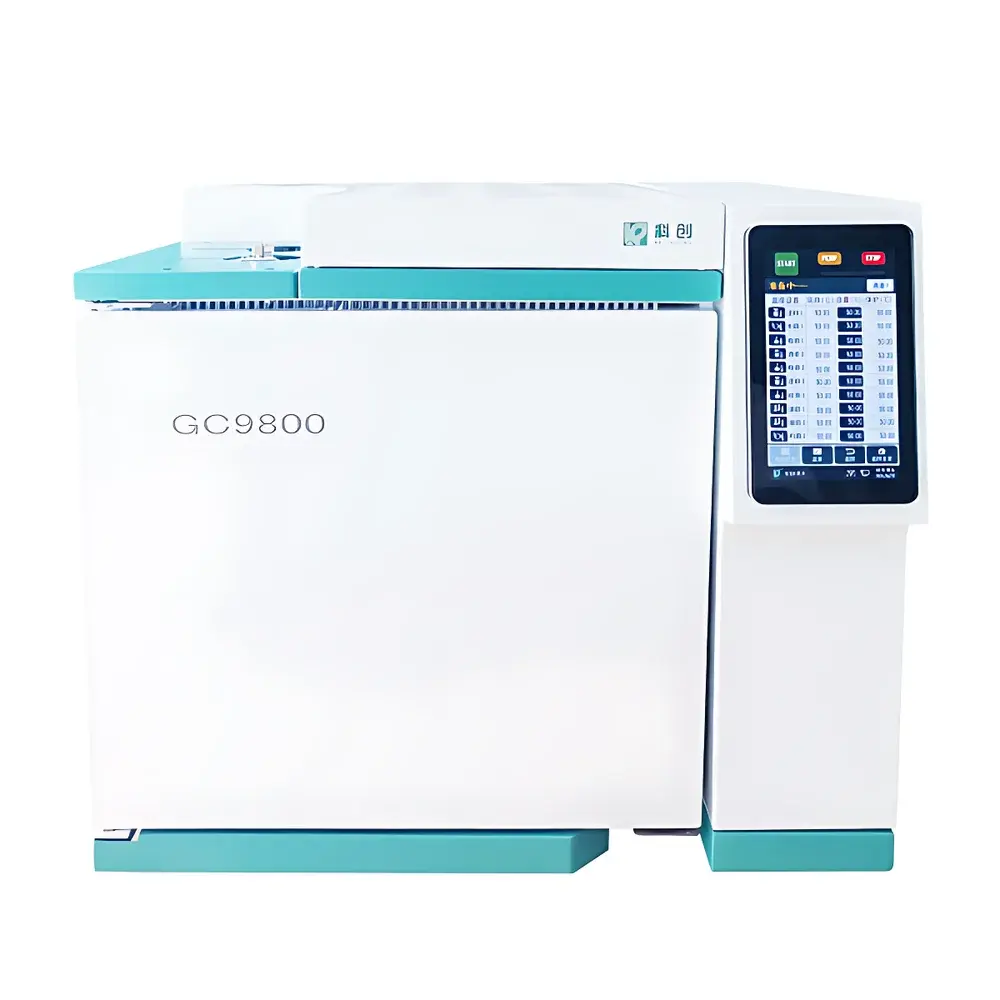
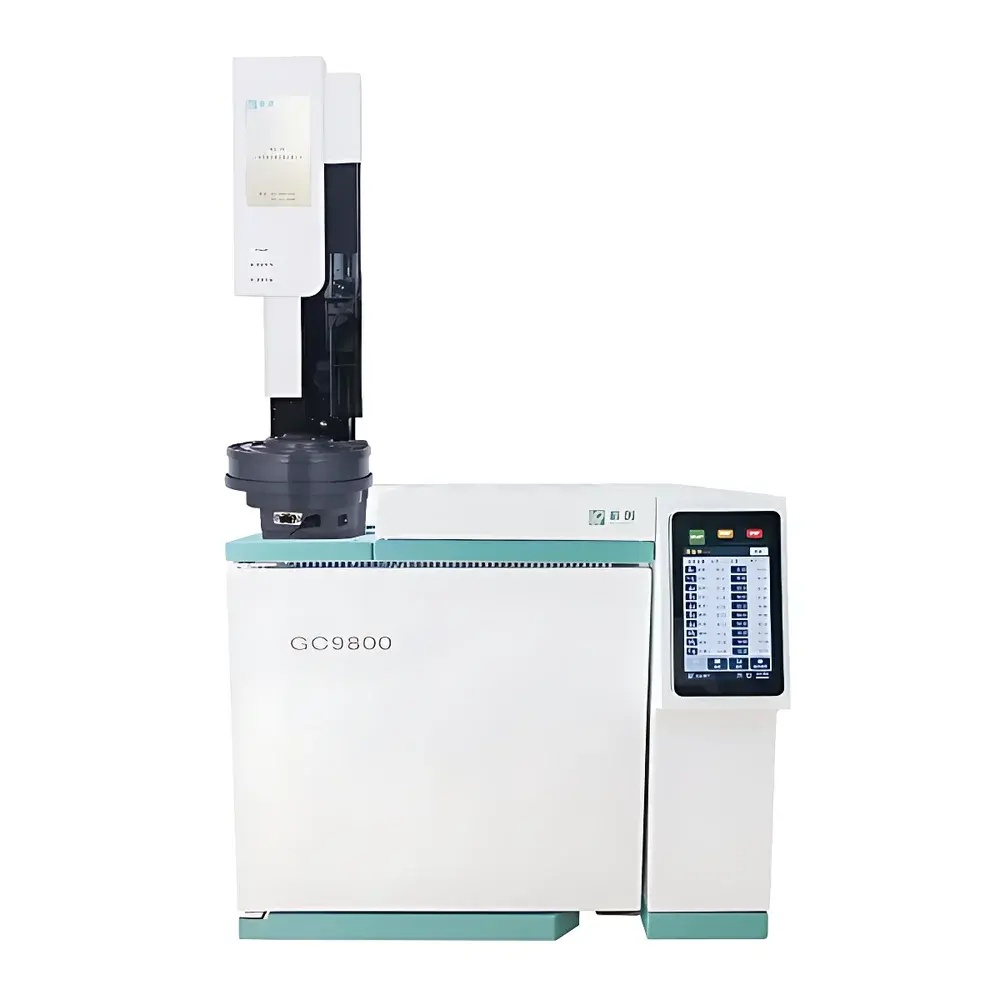
Kechuang GC9800N Laboratory Gas Chromatograph for Solvent Residue Analysis in Flexible Packaging Films
| Brand | Kechuang |
|---|---|
| Origin | Shanghai, China |
| Manufacturer Type | Direct Manufacturer |
| Instrument Type | Laboratory Gas Chromatograph |
| Model | GC9800N |
| Temperature Control Range | Ambient + 3 °C to 450 °C |
| Oven Ramp Rate | 0.1–40 °C/min (adjustable in 0.1 °C increments) |
| Maximum Ramp Rate | >120 °C/min |
| Cooling Time | ≤5 min (350 °C → 50 °C, with motorized backdoor) |
| Carrier Gas Flow Range | 0–100 mL/min |
| Carrier Gas Pressure Range | 0–250 kPa |
| Injector Max Temp | 300 °C |
| Injector Pressure Setpoint Range | 0–250 kPa |
| Total Injector Flow Setpoint Range | 0–1200 mL/min |
| EPC/EFC Precision | ±0.001 psi (pressure), ±0.001 mL/min (flow) |
| Retention Time RSD | <0.008% |
| Peak Area RSD | <1.0% |
Overview
The Kechuang GC9800N is a high-performance, laboratory-grade gas chromatograph engineered specifically for quantitative analysis of residual solvents—such as benzene, toluene, ethyl acetate, isopropanol, and xylene—in multilayer flexible packaging films used across food, pharmaceutical, and consumer goods supply chains. It operates on the fundamental principle of separation based on differential partitioning of volatile analytes between a mobile phase (inert carrier gas) and a stationary phase (capillary column), followed by selective detection using thermally or ionization-based transducers. Designed for compliance-critical environments, the system supports method validation per ISO 11843, ASTM D6727, and USP <467> residual solvents guidelines. Its dual-oven architecture enables independent thermal programming of primary and auxiliary columns, enhancing resolution of co-eluting solvent pairs commonly found in complex laminated film extracts. The instrument integrates seamlessly into GLP/GMP workflows through hardware-level audit trail support, electronic signature readiness, and full 21 CFR Part 11-compliant data governance when paired with validated software.
Key Features
- 10-channel independent temperature control system, including two programmable column ovens with 16-stage (expandable to unlimited-stage) ramp profiles and ±0.01 °C thermal stability.
- Embedded Ethernet (RJ45) interface enabling digital signal transmission, remote instrument supervision, and centralized fleet management—up to 253 units controllable from a single workstation.
- Standard electronic pressure/flow control (EPC/EFC) with 0.001 psi pressure resolution and 0.001 mL/min flow resolution; supports constant-pressure, constant-flow, and multi-step programmed pressure/flow modes (up to 8 steps).
- 7-inch industrial-grade touchscreen HMI for real-time baseline monitoring, chromatogram visualization, and local method execution without PC dependency.
- MS-compatible interface pre-installed; optional variable-frequency cooling motor reduces oven cooldown time from 350 °C to 50 °C in ≤5 minutes via automated rear door actuation.
- Eight external event timing channels enable fully automated unattended operation—including valve switching, detector polarity reversal, and multi-sequence injection scheduling.
- Wide-dynamic-range detector amplifier modules prevent solvent peak saturation (no flattop distortion), critical for accurate quantitation of high-concentration residuals in headspace or direct-injection analyses.
Sample Compatibility & Compliance
The GC9800N accommodates standard 1/16″ stainless steel or fused-silica capillary columns (0.1–0.53 mm ID, up to 60 m length) and accepts all common injection techniques: split/splitless, on-column, and cold-on-column. It is validated for use with headspace autosamplers (e.g., Agilent 7697A, Thermo TriPlus HS) and thermal desorption units for low-level volatile organic compound (VOC) profiling. Regulatory alignment includes full traceability to ISO/IEC 17025:2017 calibration requirements, compatibility with FDA 21 CFR Part 11 electronic records frameworks, and built-in hardware diagnostics that log fault codes, sensor drift trends, and thermal excursion events with timestamps. All temperature and pressure parameters are NIST-traceable via onboard reference sensors calibrated against certified standards.
Software & Data Management
The GC9800N ships with Kechuang ChromaVision™ v3.x—a validated, Windows-based chromatography data system (CDS) featuring dual-mode acquisition: direct instrument control (reverse communication) and post-run reprocessing. Users may assign multiple detectors (TCD, FID, ECD, FPD) to shared or independent data channels, configure time-programmed detector switching, and apply real-time baseline correction algorithms. Audit trails record every parameter change, sequence start/stop, calibration event, and user login/logout with immutable timestamps and operator IDs. Raw data files (.KCD) are stored in vendor-neutral HDF5 format, supporting third-party import into LIMS platforms (e.g., LabWare, Thermo SampleManager) via ODBC or REST API. Electronic signatures comply with ALCOA+ principles (Attributable, Legible, Contemporaneous, Original, Accurate, Complete, Consistent, Enduring, Available).
Applications
Primary deployment focuses on QC/QA laboratories performing routine testing of residual solvents in BOPP, PET/AL/PE, CPP, and metallized polyester laminates per GB/T 10004–2008, ISO 10932, and EU Commission Regulation (EC) No 1935/2004. Additional use cases include: volatile impurity screening in adhesives and ink formulations; migration testing of packaging-to-food simulants (e.g., 10% ethanol, olive oil); forensic identification of solvent adulteration in counterfeit packaging; and environmental monitoring of VOC emissions during lamination and curing processes. The system’s robustness under variable ambient conditions (±0.1 °C oven deviation per 10 °C room fluctuation) ensures reproducibility across shifts and seasonal changes.
FAQ
Is the GC9800N compliant with USP <467> for residual solvent testing?
Yes—the instrument meets all instrumental performance criteria outlined in USP <467>, including system suitability testing (SST) for resolution, tailing factor, and repeatability, when operated with validated methods and certified reference standards.
Can the GC9800N be integrated into an existing LIMS environment?
Yes—it supports ASTM E1384-compliant data export, ODBC connectivity, and secure HTTPS-based API endpoints for bidirectional LIMS synchronization.
What detector configurations are factory-supported?
The base configuration includes TCD and FID; ECD and FPD are available as plug-and-play field-upgradable modules with dedicated power and gas routing.
Does the system support gradient temperature programming during a single run?
Yes—its dual-oven architecture allows asynchronous heating/cooling profiles, enabling advanced techniques such as heart-cutting or column-switching without manual intervention.
How is firmware updated and verified?
Firmware updates are delivered as digitally signed packages via USB or network; each update triggers automatic checksum verification and rollback capability if integrity checks fail.




