
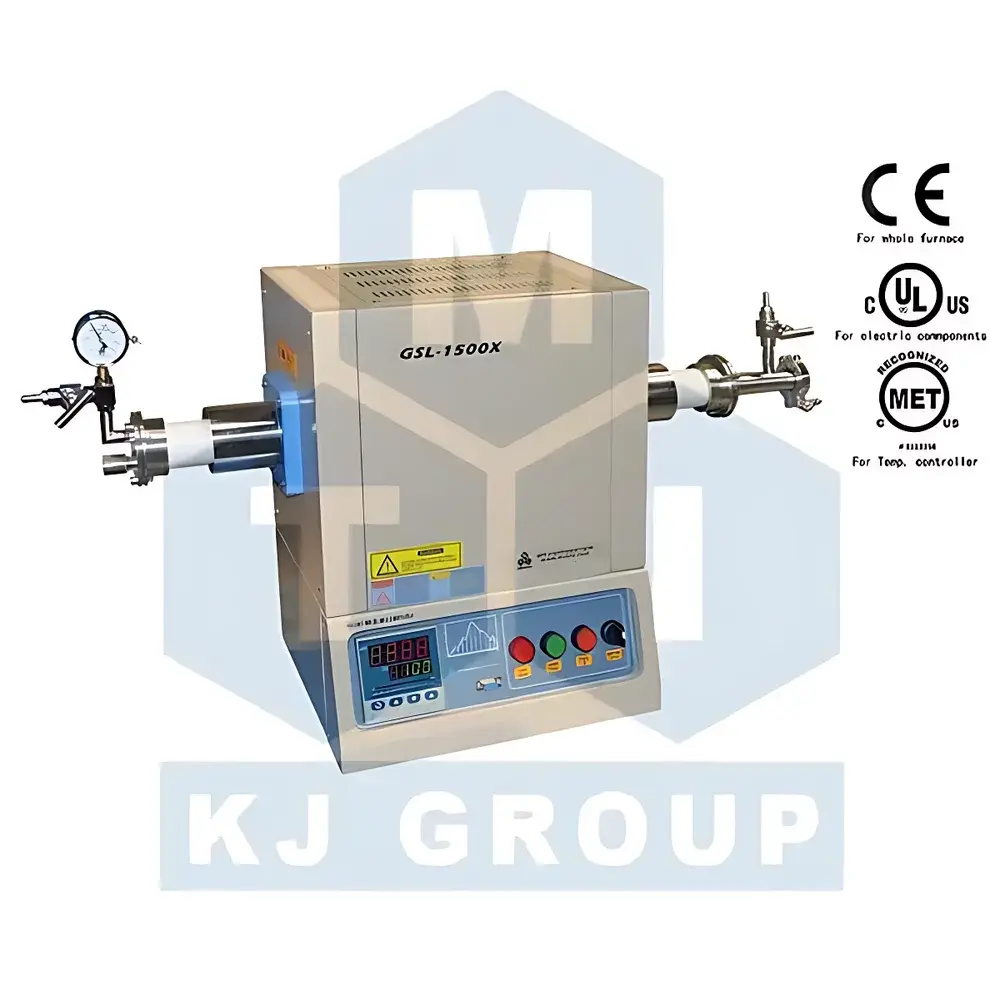
KEJING GSL-1500X-50 High-Temperature Horizontal Tube Furnace with Dual Vacuum Flanges
| Brand | KEJING |
|---|---|
| Model | GSL-1500X-50 |
| Maximum Operating Temperature | 1500 °C (short-term, ≤60 min) / 1400 °C (continuous) |
| Heating Zone Length | 152 mm |
| Uniform Temperature Zone Length | 50 mm |
| Tube Dimensions | 50.8 mm OD × 44.5 mm ID × 762 mm L (2" × 1.75" × 30") |
| Tube Material | High-Purity Alumina (Al₂O₃), rated to 1650 °C |
| Heating Elements | Four 1600 °C-rated SiC rods |
| Power Supply | 220 V AC, 50/60 Hz |
| Rated Power | 2.5 kW |
| Control System | 30-Stage PID Programmable Controller with ±1.0 °C accuracy |
| Cooling | Forced-air dual-shell housing |
| Vacuum Interface | Two KF40-compatible stainless steel flanges with integrated mechanical pressure gauges and stainless steel shut-off valves |
| Certifications | CE, UL/MET/CSA compliant (>24 V components), optional TÜV or CSA single-unit certification available |
Overview
The KEJING GSL-1500X-50 is a precision-engineered horizontal tube furnace designed for controlled high-temperature thermal processing under inert, reducing, or vacuum atmospheres. Built around a high-purity alumina (99.8% Al₂O₃) tube—capable of sustained operation up to 1400 °C and short-term excursions to 1500 °C—the system integrates robust thermal insulation, accurate programmable temperature control, and standardized vacuum interfacing. Its core architecture follows the principles of axial conduction-limited heating and radial thermal symmetry, ensuring reproducible thermal profiles across the 50 mm uniform zone. The furnace is widely deployed in academic research labs, materials science R&D facilities, and industrial process development environments where precise thermal history control is critical—for applications including solid-state synthesis, annealing of thin films, catalyst activation, ceramic sintering, and precursor decomposition studies. All electrical components exceeding 24 V meet UL, MET, and CSA safety standards; CE marking confirms compliance with EU Machinery Directive 2006/42/EC and Low Voltage Directive 2014/35/EU.
Key Features
- Dual-layer insulated shell with integrated forced-air cooling system minimizes external surface temperature rise and improves energy efficiency.
- High-density polycrystalline alumina fiber furnace lining, coated with U.S.-sourced 1750 °C-rated alumina reflective coating, enhances radiant heat retention and extends service life.
- Four 1600 °C-rated silicon carbide (SiC) heating elements arranged symmetrically ensure uniform axial heating and long-term stability under repeated thermal cycling.
- Two pre-assembled KF40 stainless steel vacuum flanges include calibrated mechanical pressure gauges and leak-tight stainless steel isolation valves—ready for immediate integration into vacuum or gas-dynamic systems.
- 30-segment programmable PID controller supports complex ramp-hold-cool sequences with ±1.0 °C thermal accuracy and built-in over-temperature and thermocouple failure protection.
- Standard alumina tube plugs included to suppress radiative heat loss during operation; recommended placement prior to heating cycle initiation.
Sample Compatibility & Compliance
The GSL-1500X-50 accommodates samples in crucibles, boats, or directly on quartz/alumina substrates placed inside the 44.5 mm inner diameter tube. Compatible sample geometries include powders, pellets, fibers, thin films on wafers, and small-volume liquid precursors (in sealed ampoules). For vacuum operation, the system achieves ≤1×10⁻² Torr using a standard two-stage rotary vane pump; optional high-vacuum configurations (e.g., turbomolecular + backing pump) support pressures down to <1×10⁻⁵ Torr. Optional accessories—including KF25 adapters, stainless steel bellows, Pirani-based digital vacuum gauges (range: 3.8×10⁵ to 1125 Torr), and hinge-type flanges—enable rapid reconfiguration for GLP-compliant workflows. All vacuum components comply with ISO 286-2 (geometric tolerances) and ASTM F2520 (vacuum flange testing protocols).
Software & Data Management
Temperature profiling and real-time monitoring are supported via the optional MTS-02 PC-based control software, pre-installed and factory-validated. MTS-02 enables remote setpoint adjustment, data logging at user-defined intervals (down to 1 s resolution), CSV export, and alarm-triggered event capture. The software architecture supports audit trails, user access levels, and electronic signature functionality—facilitating alignment with FDA 21 CFR Part 11 requirements when deployed in regulated quality control laboratories. Raw thermocouple voltage outputs (Type S) are digitized at 16-bit resolution, and all control parameters are stored non-volatile memory with timestamped change logs.
Applications
- Solid-state reaction synthesis of oxides, nitrides, and intermetallic compounds.
- Controlled-atmosphere annealing of perovskite solar cell precursors and battery cathode materials (e.g., NMC, LFP).
- Thermal gravimetric analysis (TGA) coupling via optional mass flow controllers and quadrupole residual gas analyzers.
- Low-pressure chemical vapor deposition (LPCVD) process development using inline gas injection manifolds.
- Calibration of high-temperature reference materials per ISO/IEC 17025-accredited procedures.
FAQ
What is the maximum continuous operating temperature?
The furnace is rated for continuous operation at 1400 °C. Short-term exposure to 1500 °C is permissible for durations ≤60 minutes per cycle.
Is the tube replaceable, and what is its expected service life?
Yes—the high-purity alumina tube is a consumable component. Under proper thermal cycling (≤10 °C/min ramp rate) and absence of thermal shock or corrosive vapors, typical service life exceeds 12 months at 1400 °C continuous use.
Can this furnace be integrated into an automated process line?
Yes—RS485 Modbus RTU communication interface is standard; optional Ethernet/IP or Profibus-DP modules support PLC-level integration in industrial settings.
Does the system meet GMP/GLP documentation requirements?
With MTS-02 software enabled and configured with electronic signatures and audit trail logging, the system satisfies core data integrity requirements of GLP (OECD Principles) and GMP Annex 11, subject to site-specific validation protocols.
What vacuum accessories are recommended for achieving ≤1×10⁻⁵ Torr?
A turbo-molecular pump (e.g., Pfeiffer HiPace 80) backed by a dry scroll pump, coupled with a cold trap and KF40-to-KF25 transition fittings, is recommended for high-vacuum applications requiring base pressures below 1×10⁻⁵ Torr.



