
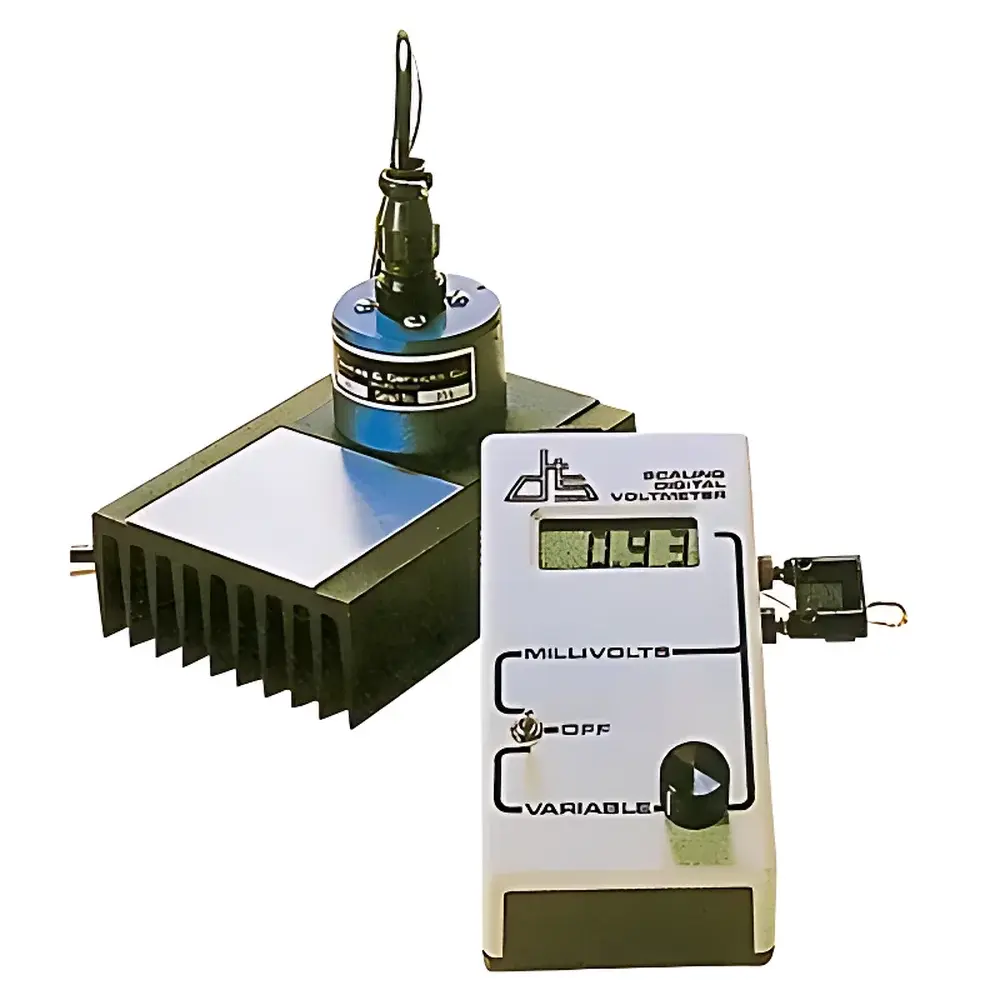
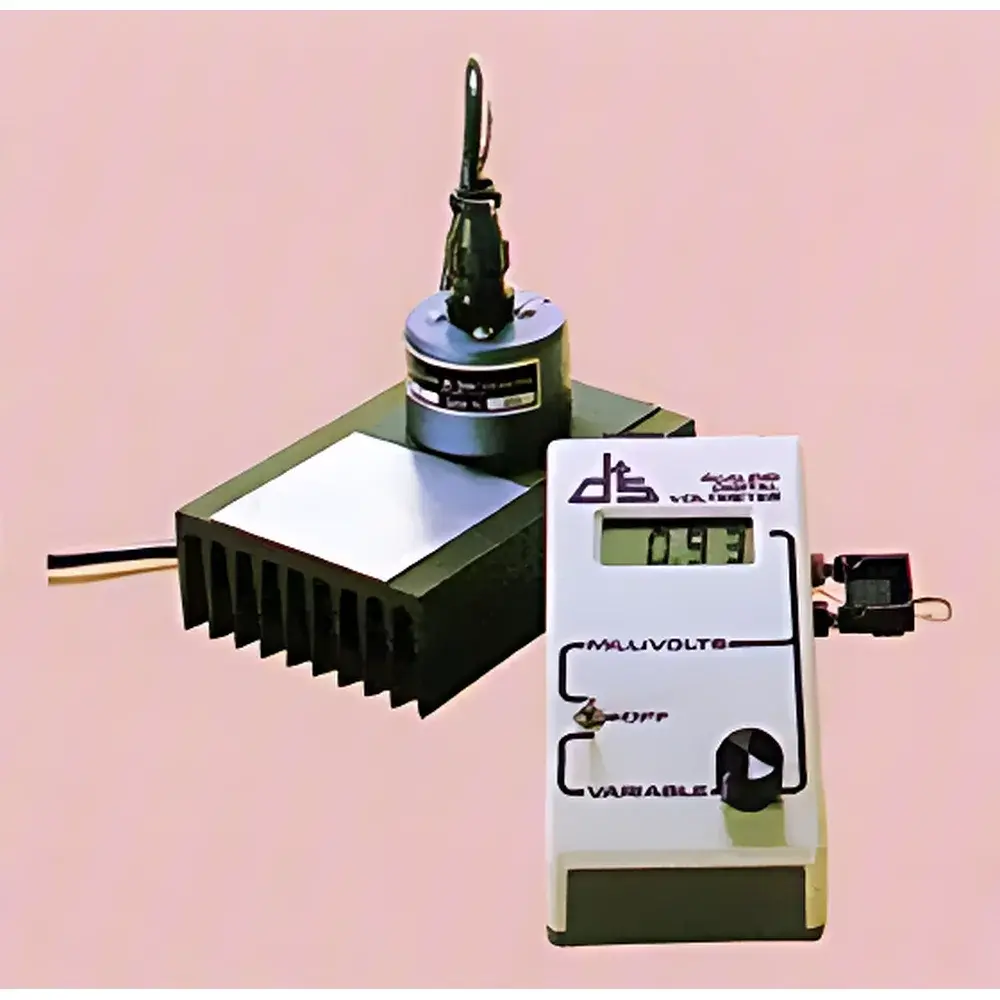
KEM D&S AERD Portable Hemispherical Emittance Meter
| Brand | Kyoto Electronics Manufacturing (KEM) |
|---|---|
| Origin | Japan |
| Manufacturer | Yes |
| Import Status | Imported |
| Model | D&S AERD |
| Pricing | Upon Request |
| Measurement Principle | Thermopile-based differential temperature method per ASTM C1371 |
| Wavelength Range | 3–30 µm |
| Emissivity Range | 0.01–1.00 |
| Repeatability | ±0.01 emittance units |
| Response Time | ~10 s |
| Display Accuracy | ±0.3% of reading |
| Operating Temperature | −10 to +40 °C |
| Dimensions (H×W×D) | 51 × 80 × 152 mm |
| Weight | ~370 g |
| Detector Output | ~2.5 mV |
| Power Supply | DC 9 V (host), AC 100–240 V (charger) |
Overview
The KEM D&S AERD Portable Hemispherical Emittance Meter is a precision field-deployable instrument engineered for rapid, non-contact determination of hemispherical emittance (εh) of solid surfaces at near-ambient temperatures. It operates on the thermoelectric principle: a calibrated thermopile detector is heated to a stable reference temperature, establishing a controlled thermal gradient between the detector and the sample surface. The resulting thermoelectric voltage—proportional to the net radiative heat exchange—is linearly correlated with the sample’s hemispherical emittance relative to a blackbody at identical temperature. This physical basis ensures traceability to first-principles radiometry without requiring spectral integration or emissivity assumptions. Designed in strict conformance with ASTM C1371–15(2022), the instrument delivers quantitative emittance values across the mid- to far-infrared band (3–30 µm), where >90% of room-temperature thermal radiation is emitted. Its compact architecture enables on-site validation of thermal control coatings, building envelope materials, and aerospace thermal management surfaces without laboratory infrastructure.
Key Features
- Direct digital readout of hemispherical emittance from 0.01 to 1.00, with repeatability of ±0.01 emittance units under controlled ambient conditions
- Measurement cycle completed in approximately 15 seconds—optimized for high-throughput field screening and production line QC
- Integrated thermopile detector with broadband spectral response (3–30 µm), covering the dominant Planck wavelength region for surfaces at 20–40 °C
- Robust portable design: lightweight host unit (~370 g), compact footprint (80 × 152 × 51 mm), and dual-power operation (DC 9 V internal battery + AC 100–240 V charging)
- Factory-calibrated against NIST-traceable low- and high-emissivity reference standards; no user recalibration required for routine use
- Display accuracy maintained at ±0.3% of full-scale reading across operating temperature range (−10 to +40 °C)
Sample Compatibility & Compliance
The D&S AERD accommodates flat or gently curved solid surfaces—including painted metals, ceramic tiles, polymer films, concrete substrates, and thermal control coatings—with minimum diameter ≥25 mm and surface roughness < Ra 10 µm. It is explicitly validated for compliance with multiple international and national standards governing thermal radiative performance: ASTM C1371–15(2022) for portable emissometer methodology; ISO 10292 (Annex B) for comparative emittance assessment; GB/T 25261–2018 and GB/T 31389–2015 for reflective thermal insulation coatings in construction; JG/T 235–2014 and JC/T 1040–2020 for architectural coating evaluation; HG/T 4341–2012 for metallic substrate applications; and GJB 2502.3–2015 Method 2031 for spacecraft thermal control coating qualification. All measurements adhere to GLP-aligned documentation practices, supporting audit-ready reporting in regulated environments.
Software & Data Management
While the D&S AERD operates as a standalone instrument with real-time analog-to-digital conversion and local display, its output signal (~2.5 mV per emittance unit) is compatible with external data acquisition systems supporting 0–5 V analog input. Users may log sequential readings via third-party DAQ hardware (e.g., National Instruments USB-6009) and process data in MATLAB, Python (NumPy/Pandas), or Excel for statistical analysis, trend tracking, and SPC charting. Though no proprietary software is bundled, the instrument’s deterministic analog output enables seamless integration into LIMS or MES platforms compliant with FDA 21 CFR Part 11 when paired with validated acquisition firmware and electronic signature workflows.
Applications
- Quality assurance of solar-reflective roof coatings and cool wall systems in compliance with ENERGY STAR® and LEED® v4.1 MR Credit requirements
- In-process verification of thermal control coatings on satellite bus structures, radiator panels, and deployable booms per ECSS-Q-ST-70-08C
- R&D characterization of novel low-emissivity thin films (e.g., ITO, Ag-based multilayers) and metamaterial surfaces
- Field validation of fire-resistive cladding systems where emittance influences convective–radiative heat transfer balance
- Comparative testing of aged vs. weathered specimens to quantify degradation-induced emittance drift in outdoor exposure studies
- Teaching laboratories for undergraduate heat transfer and radiative properties courses, illustrating Kirchhoff’s law and gray-body approximations
FAQ
Does the D&S AERD require periodic recalibration?
No—factory calibration against certified reference standards is stable over the instrument’s service life. However, users should verify performance annually using supplied low- and high-emissivity check standards.
Can it measure curved or textured surfaces?
Yes, provided curvature radius exceeds 50 mm and surface roughness remains below Ra 10 µm; measurement uncertainty increases by ±0.02 for surfaces deviating beyond these limits.
Is the instrument suitable for high-temperature samples?
No—it is designed exclusively for near-room-temperature measurements (typically 10–40 °C ambient); elevated sample temperatures invalidate the thermopile differential assumption.
How does it differ from FTIR-based emissivity analyzers?
Unlike spectral instruments requiring integration across wavelength, the D&S AERD provides a single-value hemispherical emittance directly traceable to ASTM C1371, eliminating modeling dependencies and reducing operator training requirements.
What environmental conditions affect measurement accuracy?
Air drafts >0.5 m/s, ambient temperature fluctuations >1 °C/min, or relative humidity >85% may introduce drift; measurements should be performed in still-air, thermally stable environments.



