
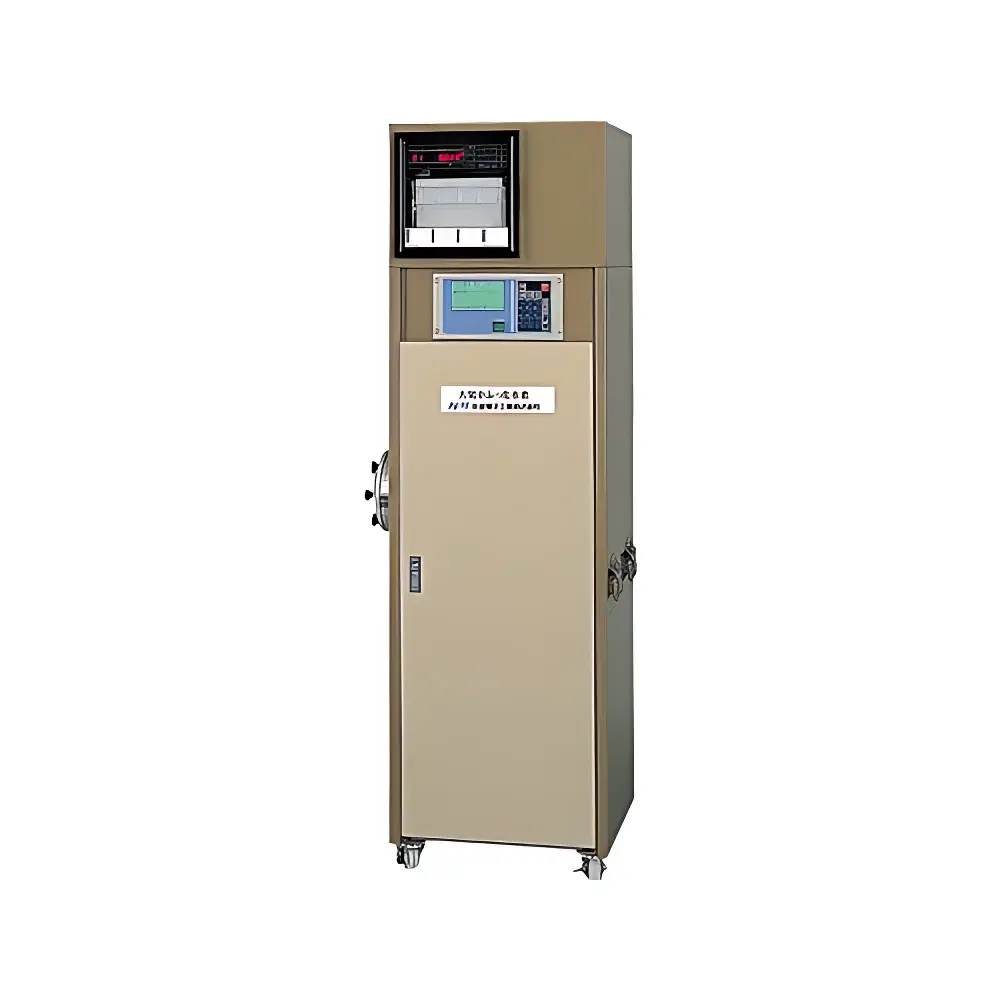
KEM HF-48 Continuous Atmospheric Fluoride Analyzer
| Brand | Kyoto Electronics Manufacturing (KEM) |
|---|---|
| Origin | Japan |
| Manufacturer Type | Original Equipment Manufacturer (OEM) |
| Product Origin | Imported |
| Model | HF-48 |
| Pricing | Upon Request |
Overview
The KEM HF-48 Continuous Atmospheric Fluoride Analyzer is a dedicated, laboratory-grade environmental monitoring instrument engineered for the real-time, unattended quantification of gaseous inorganic fluorides—primarily hydrogen fluoride (HF)—in ambient air. It operates on the principle of potentiometric detection using a dual-ion-selective electrode (ISE) configuration, enabling high-fidelity measurement at sub-ppb concentration levels. Unlike optical or colorimetric methods, the ISE-based approach provides direct electrochemical response to free fluoride ion activity in a conditioned gas stream, eliminating interferences from particulate-bound fluorides and ensuring specificity for bioavailable, respirable gaseous species. Designed and validated in strict accordance with JIS B 7958 (“Specifications for Automatic Analyzers of Fluorine Compounds in Ambient Air”), the HF-48 meets Japanese industrial standards for precision, stability, and environmental ruggedness—making it suitable for long-term deployment in regulatory monitoring networks, industrial fence-line surveillance, and occupational hygiene assessment.
Key Features
- Dual ion-selective electrode system optimized for trace-level HF detection (0–5 ppb), delivering enhanced signal-to-noise ratio and reduced susceptibility to electrode drift.
- Heated sample gas line (maintained at ≥60 °C) prevents condensation and adsorptive loss of reactive HF on tubing surfaces—a critical design element for maintaining quantitative recovery across variable humidity conditions.
- Integrated high-flow sampling module (20 L/min nominal flow rate) ensures representative volumetric integration over extended periods, improving statistical confidence in low-concentration measurements.
- Automated three-hour measurement cycle includes zero calibration, span verification, and electrode potential stabilization—executed without manual intervention.
- Robust stainless-steel and PFA-lined fluidic path minimizes chemical corrosion and surface memory effects during prolonged exposure to acidic HF gas streams.
- Front-panel LCD interface with real-time voltage readout, diagnostic status indicators, and local data logging (up to 30 days at 1-hr intervals).
Sample Compatibility & Compliance
The HF-48 is calibrated and validated exclusively for gaseous inorganic fluorides, with primary sensitivity to hydrogen fluoride (HF). It does not respond to organic fluorinated compounds (e.g., CFCs, HFCs), fluorosilanes, or particulate-phase fluorides (e.g., CaF₂, NaF aerosols) unless volatilized via thermal desorption upstream—an operation outside its standard configuration. The analyzer complies fully with JIS B 7958:2018 for performance specifications including repeatability (±2% RSD), zero drift (±3% FS/24 h), and span drift (±3% FS/24 h). While not certified to ISO 10156 or EPA Method TO-15 by default, its measurement traceability aligns with NIST-traceable fluoride reference standards when used with KEM-certified calibration gases and electrolyte solutions. Installation and operation conform to IEC 61000-6-2 (immunity) and IEC 61000-6-4 (emissions) for industrial environments.
Software & Data Management
Data output is provided via isolated 4–20 mA analog signal (user-configurable range: 0–5 ppb) and RS-232 serial interface supporting ASCII protocol (9600 bps, N-8-1). Optional KEM DataBridge software (Windows-based) enables remote configuration, real-time graphing, alarm threshold setting (e.g., >1.5 ppb trigger), and CSV export compliant with GLP audit requirements—including timestamped metadata, operator ID fields, and full calibration history. All measurement events—including automatic zero/span checks—are logged with hardware-timestamped entries, satisfying basic 21 CFR Part 11 readiness when deployed with user-established access controls and electronic signature workflows.
Applications
- Ambient air quality monitoring near aluminum smelters, phosphate fertilizer plants, semiconductor fabrication facilities, and fluoropolymer manufacturing sites.
- Fence-line compliance verification per local environmental ordinances requiring continuous HF reporting (e.g., Japan’s Air Pollution Control Act, Article 19).
- Occupational exposure assessment in confined industrial spaces where HF leakage poses acute inhalation risk.
- Method validation support for laboratories accredited to ISO/IEC 17025, serving as a reference analyzer for comparative studies against passive badge or impinger-based grab sampling.
- Long-term trend analysis of regional fluoride deposition, particularly in conjunction with meteorological data and particulate fluoride speciation (e.g., PM₂.₅-bound F⁻).
FAQ
What gases does the HF-48 detect?
The HF-48 is specifically designed for gaseous hydrogen fluoride (HF) and other volatile inorganic fluorides (e.g., SiF₄) that dissociate to release free F⁻ ions in the detection electrolyte. It does not measure organofluorines or solid-phase fluorides.
Is the instrument suitable for outdoor installation?
Yes—the enclosure meets IP54 rating, and optional climate-controlled enclosures (with internal heater/cooling and power conditioning) are available for unsheltered deployment across –10 °C to +50 °C ambient ranges.
How often is calibration required?
Daily zero and span verification is recommended for regulatory-grade operation; full multi-point calibration using NIST-traceable HF permeation tubes is advised every 30 days or after maintenance.
Can the HF-48 integrate with SCADA or central EMS platforms?
Yes—via Modbus RTU (optional firmware upgrade) or analog 4–20 mA output, enabling seamless integration into existing environmental management systems without proprietary gateways.
Does the system require consumables beyond electrolyte solution?
Yes—fluoride-selective electrodes have finite service life (~6–12 months under continuous operation); replacement electrodes, reference electrolyte, and calibration standards are the only recurring consumables.







