
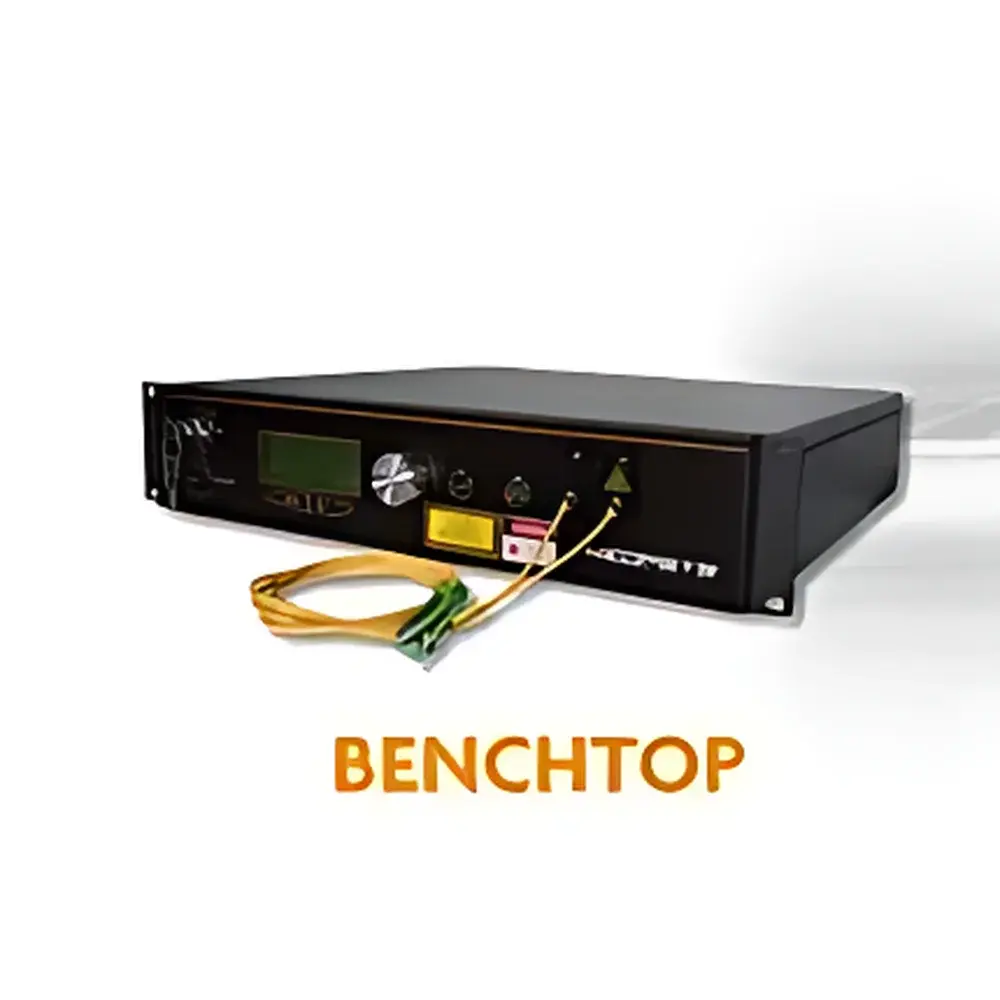
Keopsys CYFA-BO, CYFA-PB, CEFL-L-PB-HP, CEFA-C-WDM-LP & CTFA-PB Series Fiber Amplifiers
| Origin | France |
|---|---|
| Supplier Type | Authorized Distributor |
| Import Status | Imported |
| Operating Mode | CW or Pulsed |
| Core Technology | Solid-State Laser-Based Fiber Amplification |
| Wavelength Ranges | 1060–1090 nm (Yb), 1100–1120 nm (Yb), 1527–1566 nm (C-band), 1565–1605 nm (L-band), 1900–2000 nm (Tm) |
| Saturation Output Power | Up to +42 dBm (Yb), +33 dBm (L-band & Tm), +23 dBm (C-band LP) |
| Polarization | Free-running or Polarization-Maintaining (PM) |
| Integrated Pre-Amplifier | Yes (CYFA-PB, CEFL-L-PB-HP, CTFA-PB, CEFA-C-WDM-LP) |
| Input Power Range | –20 dBm to +20 dBm (model-dependent) |
Overview
The Keopsys CYFA-BO, CYFA-PB, CEFL-L-PB-HP, CEFA-C-WDM-LP, and CTFA-PB series represent a comprehensive portfolio of high-performance, OEM-grade fiber amplifiers engineered for precision optical amplification across key telecom and scientific wavelength bands. These amplifiers operate on the principle of stimulated emission in rare-earth-doped optical fibers—specifically ytterbium (Yb), erbium (Er), and thulium (Tm)—pumped by high-brightness laser diodes. Each model is designed for deterministic gain behavior, low noise figure, and stable output under varying input conditions. The architecture integrates optimized pump combiners, specialty doped fibers, and thermally stabilized pump drivers to ensure long-term reliability and repeatability in both laboratory and field-deployable environments. Unlike generic amplifier modules, Keopsys units are fully characterized per ITU-T G.663 and IEC 61290-2-1 standards for gain, noise figure, polarization-dependent loss (PDL), and output power stability—making them suitable for applications requiring traceable metrological integrity.
Key Features
- Multi-band coverage: Yb-doped amplifiers (1060–1090 nm and 1100–1120 nm), Er-doped C-band (1527–1566 nm) and L-band (1565–1605 nm), and Tm-doped 2 µm band (1900–2000 nm)
- Flexible polarization handling: Selectable free-running or polarization-maintaining (PM) configurations with extinction ratio >20 dB (PM variants)
- Integrated pre-amplification stage in CYFA-PB, CEFL-L-PB-HP, CTFA-PB, and CEFA-C-WDM-LP models—enabling operation with input powers as low as –20 dBm while maintaining >30 dB small-signal gain
- High saturation output power: Up to +42 dBm (158 mW) for Yb-based CW amplifiers; +33 dBm (2 W) for L-band and Tm-based units; +23 dBm (200 mW) for C-band low-power gain-flattened variants
- Gain flatness control: CEFA-C-WDM-LP offers ±0.5 dB gain uniformity over full C-band, compliant with DWDM channel spacing requirements (50 GHz / 100 GHz)
- Ruggedized hermetic packaging with integrated thermoelectric cooler (TEC) and analog/digital monitoring interfaces (RS-232, RS-485, or analog voltage outputs)
Sample Compatibility & Compliance
These amplifiers support standard single-mode (SMF-28), polarization-maintaining (PANDA or bow-tie), and large-mode-area (LMA) fiber pigtails with FC/APC, FC/PC, or custom connectors. All units comply with IEC 60825-1 (laser safety Class 1M or Class 4 depending on output configuration), RoHS 2015/863/EU, and CE marking directives. For regulated environments—including medical laser systems, aerospace photonics test benches, and GLP-compliant optical characterization labs—the amplifiers support optional firmware logging and hardware interlocks aligned with ISO 13485 design controls and FDA 21 CFR Part 11 audit trail requirements when integrated into validated instrument platforms.
Software & Data Management
Keopsys provides the KEOPSYS Control Suite—a Windows-based application enabling real-time monitoring of pump current, case temperature, output power, and gain via USB or serial interface. The suite supports automated sweep modes (wavelength, input power, bias current), data export in CSV/Excel format, and scriptable control via LabVIEW VIs and Python SDK (PySerial-compatible). For integration into automated test systems, all amplifiers feature analog monitor outputs (0–5 V proportional to output power) and TTL-compatible fault/status signals. Optional firmware upgrades enable enhanced diagnostics, including built-in optical power meter calibration traceability to NIST-traceable reference standards.
Applications
- High-power ultrafast laser seed amplification (e.g., chirped-pulse amplification chains at 1 µm and 2 µm)
- DWDM and CWDM optical network testing, including OSNR measurement and transmitter characterization
- Free-space optical communications (FSOC) ground station transmitters operating in L-band and 2 µm atmospheric transmission windows
- Mid-IR spectroscopy pump sources via difference-frequency generation (DFG) using Tm-amplified 1950 nm seeds
- Fiber sensor interrogation systems requiring stable, low-noise amplified spontaneous emission (ASE) or modulated signal amplification
- Quantum optics experiments demanding polarization-preserving amplification of weak coherent states
FAQ
What is the typical noise figure for the CEFL-L-PB-HP L-band amplifier?
The CEFL-L-PB-HP achieves a measured noise figure of ≤5.5 dB at 1580 nm under standard operating conditions (30 dB gain, +3 dBm input).
Can the CTFA-PB series be used with nanosecond pulsed seed sources?
Yes—the CTFA-PB supports pulse widths from 1 ns to CW, with peak power handling up to 1 kW (depending on repetition rate and duty cycle); consult the pulse derating curve in the datasheet.
Is remote firmware update supported?
Firmware updates require local USB connection and KEOPSYS Control Suite v3.2 or later; over-the-air (OTA) updates are not implemented for security and validation reasons.
Do these amplifiers include automatic power control (APC) loops?
All CW models feature closed-loop APC via internal photodiode feedback; pulsed variants operate in constant-current mode unless externally triggered with analog power modulation.
Are custom wavelength bands or connector types available?
Yes—Keopsys offers engineering customization for non-standard bands (e.g., extended C-band to 1530–1570 nm), specialty fiber pigtails (e.g., PM-1550, SM2000), and MIL-spec connectors upon request and NRE agreement.





