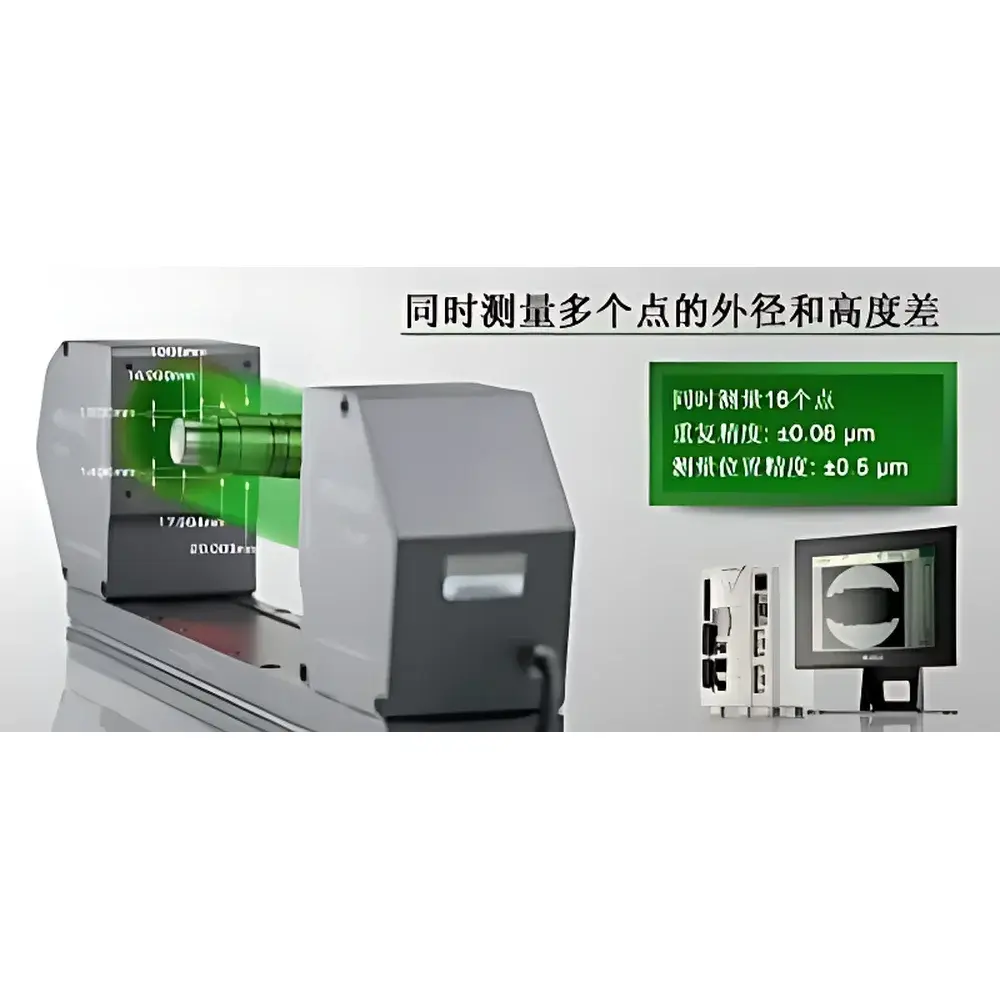
KEYENCE TM-3000 High-Speed 2D Dimensional Measurement System
| Origin | Japan |
|---|---|
| Manufacturer Type | Authorized Distributor |
| Origin Category | Imported |
| Model | TM-3000 |
| Pricing | Upon Request |
Overview
The KEYENCE TM-3000 is a high-precision, non-contact 2D dimensional measurement system engineered for real-time integration into industrial production lines. It employs a dual-wavelength far-field telecentric optical architecture combined with green LED-based collimated illumination to project uniform parallel light onto the target object. Dimensions—including outer diameter, height differential, positional offset, thickness, and angular deviation—are derived from high-contrast silhouette profiles captured by a high-resolution CMOS image sensor. Unlike conventional one-dimensional laser scanning systems that rely on mechanical translation and are constrained by stage positioning accuracy, the TM-3000 acquires full 2D spatial data in a single exposure—eliminating motion-induced error and enabling sub-pixel edge detection across up to 16 user-defined measurement points simultaneously. Its measurement stability is inherently decoupled from object-to-lens distance variation due to the W-type telecentric lens design, ensuring consistent magnification and traceable metrological performance under dynamic factory-floor conditions.
Key Features
- Single-shot 2D acquisition: Captures complete silhouette data across a defined field of view without scanning or mechanical movement.
- Simultaneous multi-point measurement: Supports up to 16 independent measurement items (e.g., diameters, gaps, angles, offsets) within one frame—reducing cycle time versus sequential probing methods.
- Dedicated 2D processing architecture: Integrates dual high-speed CPUs and an application-specific digital signal processor (DSP) optimized for real-time edge extraction, sub-pixel interpolation, and geometric computation.
- W-type telecentric optical path: Utilizes a dual-objective telecentric configuration with high-brightness green LED illumination to deliver uniform collimated light—minimizing perspective distortion and depth-of-field dependency.
- Robust industrial design: IP64-rated enclosure, vibration-resistant mounting interface, and EMI-hardened electronics for deployment adjacent to CNC machines, robotic cells, or press lines.
Sample Compatibility & Compliance
The TM-3000 accommodates opaque, translucent, and semi-reflective solid components commonly encountered in automotive, electronics, and precision metal fabrication—such as stamped parts, machined shafts, injection-molded housings, and rolled sheet materials. It does not require surface preparation, coating, or fiducial markers. The system complies with IEC 61326-1 (EMC for measurement equipment), IEC 61000-6-2 (immunity), and ISO 10360-2 (geometrical product specifications — acceptance and reverification tests for coordinate measuring systems). While not certified to ISO/IEC 17025, its measurement repeatability (≤ ±0.5 µm at 2σ, typical for calibrated setups) supports internal quality control workflows aligned with ISO 9001 and IATF 16949 requirements. Traceability is maintained via NIST-traceable calibration kits and documented uncertainty budgets per measurement point.
Software & Data Management
The TM-3000 operates with KEYENCE’s proprietary IM-8000 Series software platform, supporting both standalone operation and factory network integration via Ethernet/IP, Modbus TCP, or OPC UA. Measurement programs—including geometry definitions, pass/fail thresholds, and statistical process control (SPC) parameters—are stored in encrypted project files with version history. Audit trails record operator logins, program edits, calibration events, and result exports—meeting foundational requirements of FDA 21 CFR Part 11 for electronic records when deployed in regulated manufacturing environments. Raw image data and measurement logs can be exported in CSV, XML, or HDF5 formats; SPC charts (X̄–R, Cpk, Ppk) are generated in real time and exportable to MES/QMS platforms. Remote firmware updates and diagnostic reporting are supported over secure TLS connections.
Applications
- Multi-point outer diameter verification: Simultaneous measurement of multiple diameters on stepped shafts or bushings—eliminating repositioning delays inherent in single-point laser triangulation.
- In-situ deformation monitoring: Real-time tracking of part deflection or warpage during mechanical loading (e.g., tensile testing, bending fixtures), without removal from test apparatus.
- Thickness profiling of flexible webs: Single-sensor capture of roller-to-film gap and film thickness variation across width—avoiding dual-sensor misalignment and thermal drift errors.
- Positional offset and alignment validation: Rapid assessment of component centering, pitch deviation, or angular misalignment in assembly jigs or pick-and-place verification.
- High-throughput gaging in automated inspection stations: Integration with PLC-controlled conveyors for 100% inline inspection of discrete parts at rates exceeding 60 units/min.
FAQ
What is the typical measurement repeatability of the TM-3000 under controlled conditions?
Repeatability is typically ≤ ±0.5 µm (2σ) for edge-based features when using factory-calibrated optics and stable ambient temperature (±1°C/hour). Actual performance depends on object contrast, lighting uniformity, and environmental vibration.
Can the TM-3000 measure transparent or highly reflective materials?
It is optimized for opaque or diffusely scattering surfaces. Transparent materials require backlighting optimization and may need anti-reflection treatment; highly specular surfaces benefit from polarized illumination or matte spray—both outside standard configuration.
Is the system compatible with third-party vision software or custom machine learning pipelines?
Raw image data (12-bit grayscale TIFF) and coordinate lists are accessible via SDK; however, KEYENCE does not provide open API access to internal edge-detection algorithms or real-time video streams.
Does the TM-3000 support automated calibration routines?
Yes—integrated auto-calibration uses certified gauge blocks and step gauges; calibration certificates include expanded uncertainty (k=2) and are compliant with ISO/IEC 17025 documentation practices when performed by KEYENCE-certified service engineers.
How is measurement data synchronized with production line triggers?
Via hardware TTL input (rising-edge triggered) or software command over Ethernet; latency from trigger to result output is <15 ms under standard configuration.