
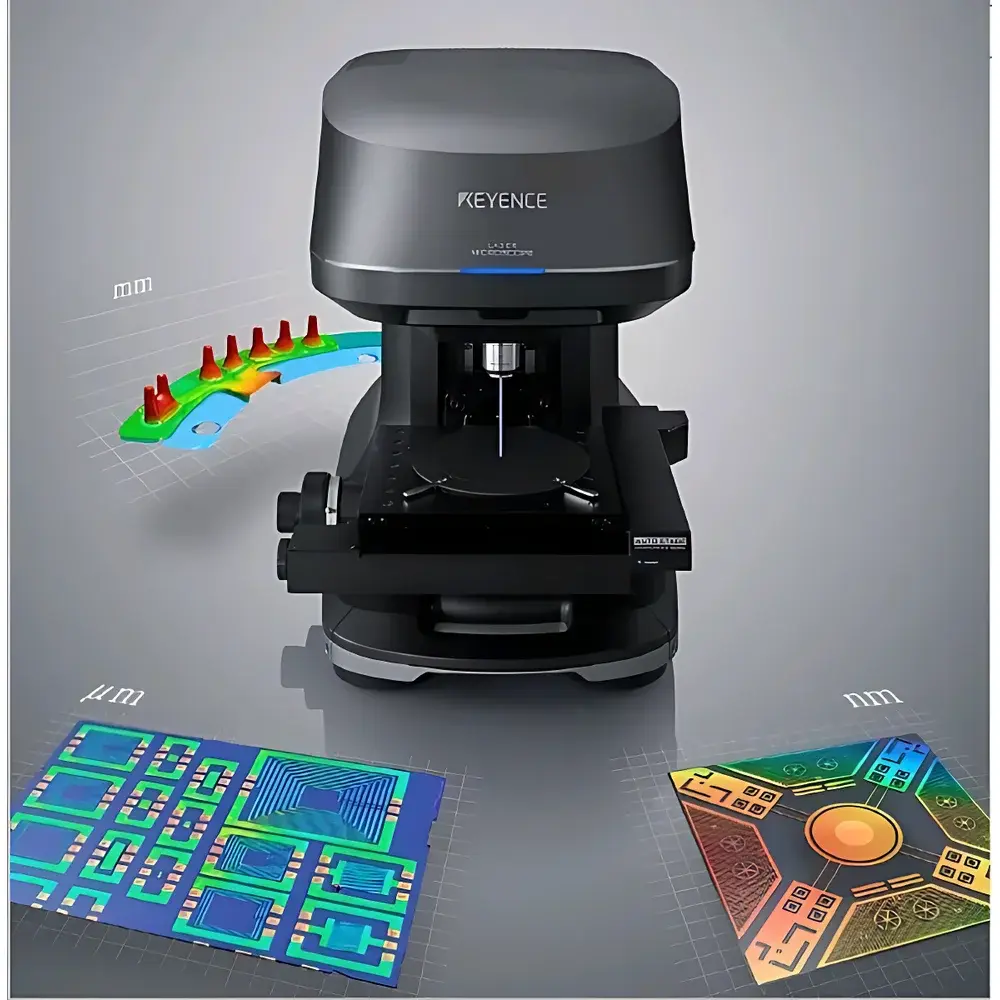
KEYENCE VK-X3000 Shape Measurement Laser Scanning Confocal Microscope
| Brand | KEYENCE |
|---|---|
| Origin | Japan |
| Manufacturer Type | Original Equipment Manufacturer (OEM) |
| Import Status | Imported |
| Model | VK-X |
| Resolution | 0.01 nm |
| Laser Sources | Semiconductor lasers at 404 nm and 661 nm |
| Detector | 16-bit photomultiplier tube (PMT) |
| Scanning Module | Point-source laser scanned via X-Y galvanometric optical system |
| Scanning Modes | Laser confocal, focus variation, white-light interferometry, spectral interferometry |
| Maximum Scan Speed | 125 Hz (area), 7900 Hz (line) |
| Objective Lenses | 2.5×, 5×, 10×, 20×, 50×, 100× |
| Illumination Source | Short-wavelength laser illumination |
| XY Stage Control | Motorized and manual operation |
Overview
The KEYENCE VK-X3000 is a high-precision, multi-modal shape measurement laser scanning confocal microscope engineered for quantitative 3D surface topography analysis across nanoscale to millimeter-scale dimensional ranges. Unlike conventional optical microscopes or single-principle profilometers, the VK-X3000 integrates three complementary optical measurement principles—laser confocal microscopy, focus variation, and white-light interferometry—within a unified platform. This tri-scan architecture enables robust, non-contact characterization of diverse surface geometries: from atomically smooth mirrors and transparent substrates (e.g., fused silica, sapphire wafers) to highly sloped, rough, or structured surfaces (e.g., MEMS devices, machined metal parts, textured polymers). The system operates on a point-scanning principle using dual-wavelength semiconductor lasers (404 nm UV-blue and 661 nm red), providing enhanced contrast for both reflective and semi-transparent materials. Its 0.01 nm vertical resolution—achieved through sub-pixel interpolation and thermal drift compensation—is traceable to NIST-traceable interferometric calibration standards and validated per ISO 25178-601 for areal surface texture metrology.
Key Features
- Tri-scan measurement engine: Seamlessly switches between laser confocal (optimal for steep slopes >70° and low-reflectivity surfaces), focus variation (ideal for medium-slope, heterogeneous reflectivity), and white-light interferometry (highest lateral resolution and repeatability on smooth, quasi-specular surfaces)
- Multi-magnification optical path: Interchangeable objective lenses (2.5×–100×) including apochromatic, long-working-distance (LWD), and interferometric objectives—enabling consistent calibration across magnifications without refocusing
- Non-destructive, diffraction-limited imaging: No sample coating, vacuum, or conductive treatment required; compatible with insulating, biological, and temperature-sensitive specimens
- Large-field-of-view capability: 50 mm × 50 mm maximum scan area with sub-micron stitching accuracy; supports full-part metrology of wafer-level components, camera modules, and precision mechanical assemblies
- Real-time depth profiling: Simultaneous acquisition of height, intensity, and fluorescence (with optional filter sets); 16-bit PMT detection ensures linear dynamic range >80 dB
- Thermally stabilized optomechanical platform: Active temperature control (±0.1°C) minimizes thermal drift during extended acquisitions (>30 min), critical for GLP-compliant surface finish validation
Sample Compatibility & Compliance
The VK-X3000 accommodates samples ranging from 1 nm RMS roughness to 50 mm total height variation. It measures transparent materials (glass, quartz, polymer films), highly reflective metals (Al, Cu, Au), anisotropic ceramics (SiC, Al₂O₃), and soft biomaterials (hydrogels, tissue sections) without physical contact. Surface slope tolerance exceeds ±85° in confocal mode. All measurement protocols adhere to international standards including ISO 25178-2 (areal surface texture parameters), ISO 4287 (profile-based roughness), ASTM E2923-22 (nanoscale dimensional metrology), and USP (surface characterization of pharmaceutical manufacturing equipment). Data integrity complies with FDA 21 CFR Part 11 requirements via audit-trail-enabled software with electronic signature support.
Software & Data Management
VK-X3000 is operated via KEYENCE’s proprietary VK Analyzer software—a Windows-based application supporting automated workflow scripting, multi-sample batch processing, and statistical process control (SPC) charting. Raw data is stored in vendor-neutral HDF5 format with embedded metadata (lens ID, laser power, scan speed, environmental conditions). Software includes ISO-compliant roughness parameter calculation (Sa, Sq, Sz, Sdr, etc.), cross-section extraction, volume estimation, defect classification (via threshold-based segmentation), and GD&T overlay (flatness, parallelism, step height). Export options include CSV, STEP AP214, and Metrology Markup Language (MML) for integration with enterprise MES/QMS platforms.
Applications
- Semiconductor manufacturing: Backside wafer warpage, CMP uniformity, TSV depth/coverage, and lithographic resist profile analysis
- MEMS & micro-optics: Mirror flatness verification, actuator displacement mapping, grating pitch and duty cycle quantification
- Medical device R&D: Surface texture of orthopedic implants (Ra, Rz, Rsk), stent strut edge radius, and hydrophilic coating homogeneity
- Precision optics: Lens mold surface fidelity, anti-reflective coating thickness uniformity (via spectral interferometry), and scratch/defect detection
- Automotive powertrain: Cylinder bore honing texture (Rpk, Rvk), valve seat surface integrity, and EV battery electrode coating roughness
FAQ
What surface materials can be measured without coating or vacuum?
All electrically insulating, non-volatile, and ambient-stable materials—including glass, silicon, polymers, ceramics, and biological tissues—are directly measurable in air without metallization or vacuum evacuation.
How does the system ensure traceability for ISO 25178 compliance?
Each instrument ships with NIST-traceable step-height and roughness reference standards; calibration certificates include uncertainty budgets per ISO/IEC 17025 and are updated automatically during routine verification.
Can the VK-X3000 perform automated pass/fail inspection against GD&T tolerances?
Yes—custom inspection templates with user-defined geometric tolerances (e.g., flatness ±0.5 µm over 10 mm²) generate real-time color-coded deviation maps and export Cpk/Ppk reports compliant with IATF 16949.
Is remote operation supported for lab-wide deployment?
The system supports secure remote access via TLS-encrypted VNC and RESTful API integration for scheduling, job queuing, and result retrieval within centralized laboratory information management systems (LIMS).




