KEYENCE VL-800 Series High-Precision 3D Laser Scanning Metrology System
| Brand | KEYENCE |
|---|---|
| Origin | Japan |
| Manufacturer Type | Original Equipment Manufacturer (OEM) |
| Import Status | Imported |
| Model | VL-800 Series |
| Measurement Speed | 8 seconds per scan |
| Scan Accuracy | ±2 µm |
| Point Cloud Resolution | 9 million points per scan |
| Maximum Scan Volume | W580 × D300 × H200 mm |
| Single-Scan Accuracy | ±2 µm |
| Operating System | Windows 10 Professional/Enterprise, Windows 11 Professional/Enterprise |
| Host Weight | 51.1 kg |
Overview
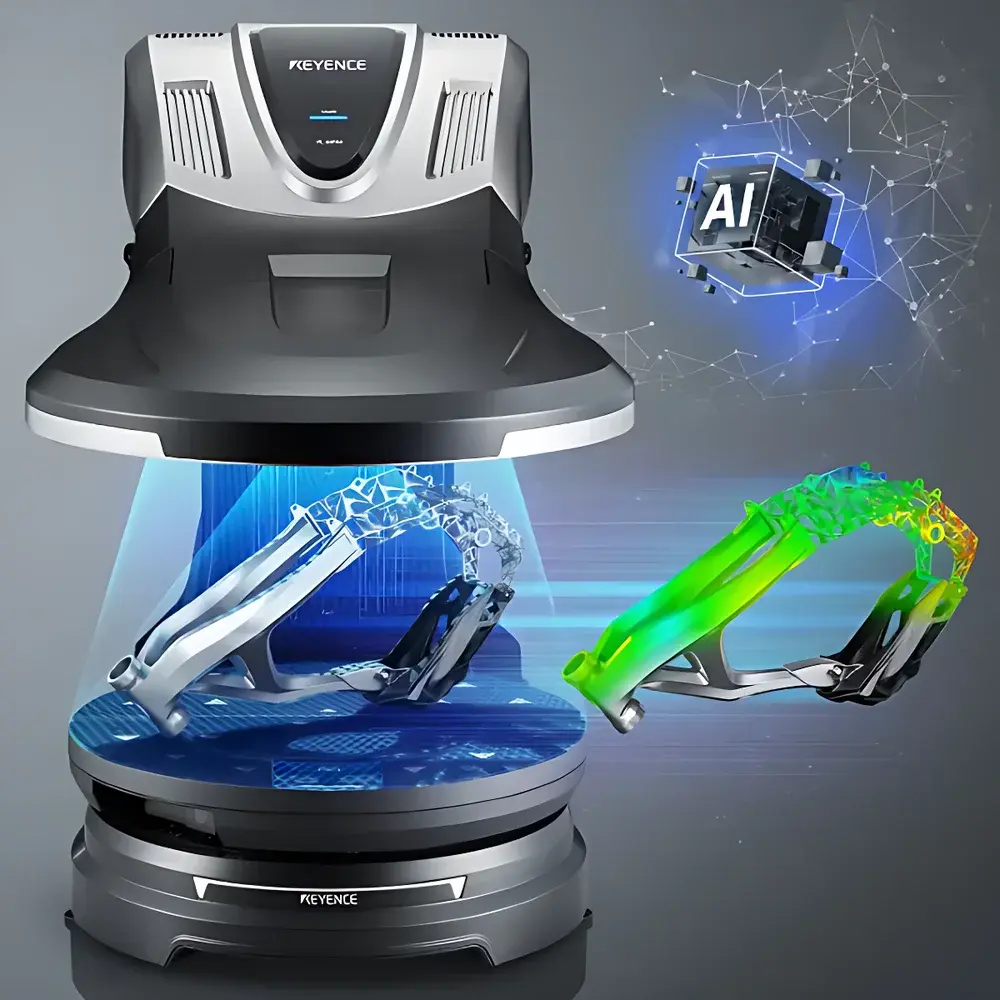
The KEYENCE VL-800 Series is a high-precision, turnkey 3D laser scanning metrology system engineered for non-contact, full-field geometric inspection and dimensional analysis in industrial quality control and R&D environments. Utilizing structured-light projection combined with high-resolution stereo vision and proprietary 3D-AI algorithms, the system captures dense, metrologically traceable point clouds without requiring manual alignment, target placement, or part repositioning. Its integrated optical-mechanical architecture eliminates external articulation arms or rotary stages—enabling true “place-and-scan” operation. Designed to meet the repeatability and uncertainty requirements of ISO 10360-8 (coordinate measuring machines) and ISO 17025-accredited calibration workflows, the VL-800 delivers traceable volumetric accuracy across its full working volume (W580 × D300 × H200 mm), with a certified single-scan spatial accuracy of ±2 µm and a point cloud density of up to 9 million points per acquisition.
Key Features
- True “Place-and-Scan” Operation: No fixtures, targets, or manual registration required—parts are positioned once and fully scanned from multiple angles via synchronized multi-view imaging.
- 3D-AI–Driven Measurement Planning: Embedded AI analyzes part geometry in real time and recommends optimal measurement strategies—including GD&T feature extraction, cross-section generation, and tolerance mapping—based on ISO 1101 and ASME Y14.5 standards.
- Automated Template-Based Repeatability: Completed measurement routines—including alignment, region-of-interest definition, and GD&T evaluation—are saved as reusable templates; AI automatically reproduces the full workflow for identical or similar parts.
- Integrated Reverse Engineering Pipeline: Raw point clouds are processed in situ into watertight, topology-aware polygonal meshes (STL/OBJ) and editable NURBS surfaces compatible with major CAD platforms (e.g., SolidWorks, Siemens NX, CATIA).
- Robust Environmental Tolerance: Engineered for shop-floor deployment with thermal drift compensation, vibration-resistant optical mounting, and IP52-rated enclosure compliance for dust and light splashing resistance.
Sample Compatibility & Compliance
The VL-800 accommodates a broad range of manufactured components—from machined metal housings and injection-molded plastic assemblies to cast aluminum brackets and precision-machined medical device components. Surface finish independence enables reliable capture of matte, glossy, anodized, or lightly textured surfaces without spray application. All measurements comply with ISO 15530-3 (calibration using calibrated workpieces) and support GLP/GMP audit trails when configured with optional user-access logging and electronic signature modules. The system meets CE marking requirements under the EU Machinery Directive 2006/42/EC and EMC Directive 2014/30/EU. Data integrity protocols align with FDA 21 CFR Part 11 for electronic records and signatures where enabled via enterprise OS configuration.
Software & Data Management
The embedded KEYENCE 3D-Master software runs natively on Windows 10/11 Professional or Enterprise editions and provides a unified interface for acquisition, alignment, GD&T evaluation (including position, flatness, cylindricity, profile, and runout), deviation color-mapping, and report generation. All data—including raw point clouds, mesh files, measurement logs, and annotated PDF reports—is stored in a vendor-neutral SQLite-based database with configurable backup policies and role-based access control. Audit trail functionality records operator ID, timestamp, parameter changes, and result approvals—supporting ISO/IEC 17025 documentation requirements. Export formats include STEP AP214, IGES, STL, OBJ, CSV, and XML-based GD&T exchange (QIF v3.0 compliant).
Applications
- First-article inspection and production line sampling for automotive powertrain components
- Dimensional validation of additive-manufactured aerospace brackets against nominal CAD
- Tool wear monitoring via periodic comparison of mold cavity scans
- Root-cause analysis of assembly interference or fit discrepancies in consumer electronics enclosures
- GD&T conformance verification for medical implant components under ISO 13485 quality management systems
- Rapid prototyping feedback loop: Scan → Deviation analysis → CAD correction → Rescan iteration
FAQ
Does the VL-800 require reflective targets or surface preparation?
No. The system uses multi-angle structured-light triangulation optimized for industrial surface finishes; no developer sprays, targets, or surface treatments are needed.
Can measurement templates be shared across multiple VL-800 units in a plant network?
Yes. Templates, CAD models, and inspection routines are stored in portable project files (.vlproj) and can be deployed across networked units via secure SMB shares or centralized repository integration.
Is the ±2 µm accuracy specified at full volume or at probe tip?
The ±2 µm spatial accuracy is validated across the entire usable measurement volume per ISO 10360-8 Annex C, using certified reference artifacts traceable to NMIJ/AIST.
What level of IT infrastructure is required for audit-compliant operation?
For full 21 CFR Part 11 or ISO 17025 compliance, domain-joined Windows Enterprise hosts with Group Policy–managed encryption, time synchronization (NTP), and centralized log forwarding are recommended.
How is traceability maintained for calibration and maintenance records?
All calibration events, firmware updates, and hardware service interventions are logged in the internal event journal with digital signatures and exported as tamper-evident PDF reports upon request.