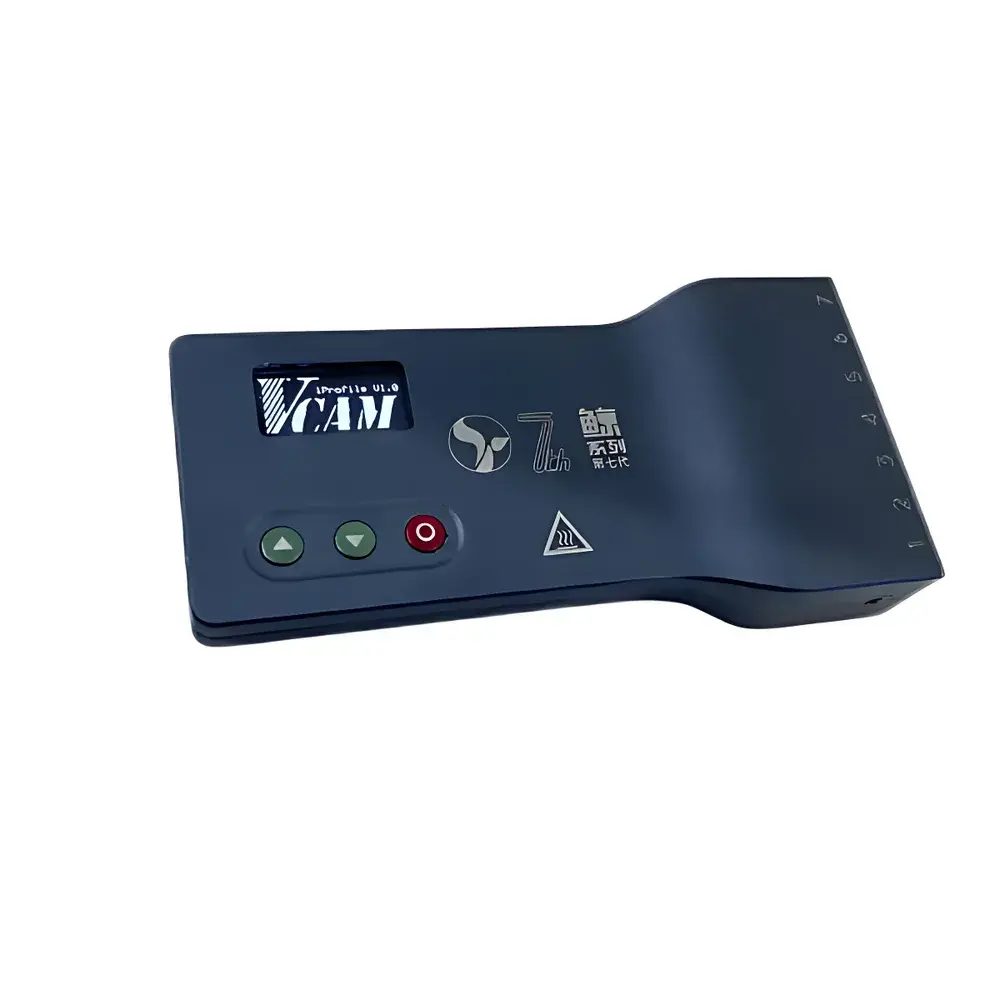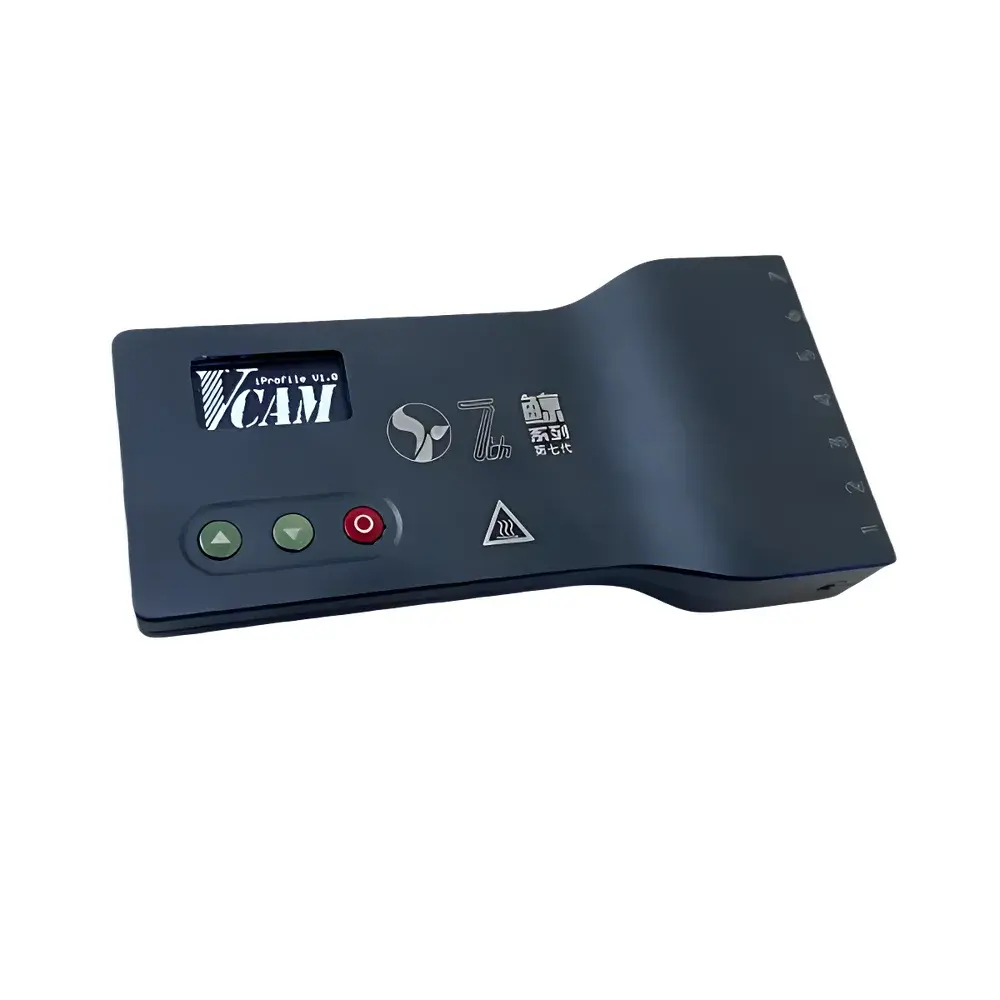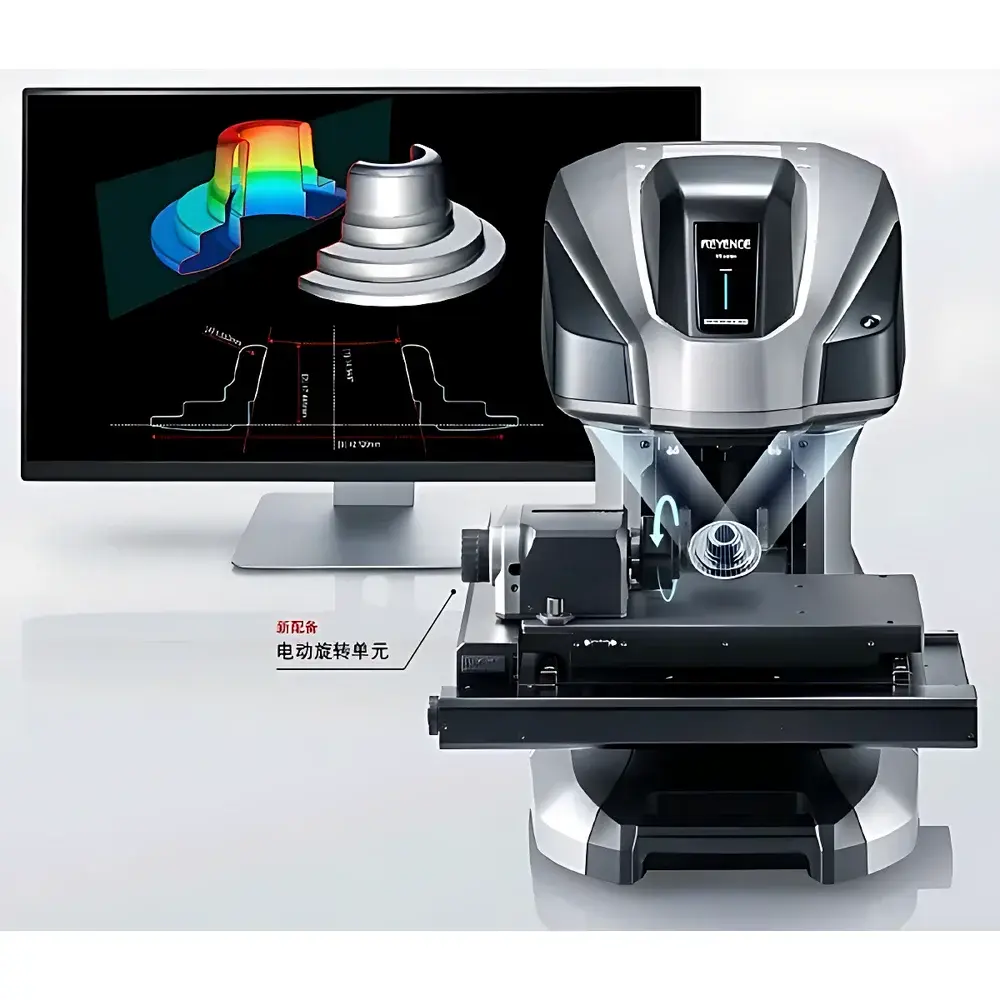
KEYENCE VR-6000 Series 3D Non-Contact Profilometer
| Brand | KEYENCE |
|---|---|
| Origin | Japan |
| Manufacturer Type | Original Equipment Manufacturer (OEM) |
| Product Category | Imported Instrument |
| Model | VR-6000 |
| Measurement Principle | Confocal Chromatic Aberration + High-Dynamic-Range (HDR) Optical Scanning |
| Vertical Resolution | 100 nm |
| Lateral Resolution | 100 nm |
| Product Type | Non-Contact 3D Profilometer / Surface Roughness & Form Measuring System |
Overview
The KEYENCE VR-6000 Series is a high-precision, non-contact 3D profilometer engineered for comprehensive surface topography analysis across R&D, quality assurance, and production environments. Unlike traditional stylus-based profilers or conventional optical interferometers, the VR-6000 employs a proprietary confocal chromatic aberration measurement principle combined with KEYENCE’s patented High-Dynamic-Range (HDR) scanning algorithm. This dual-technology architecture enables robust acquisition of height data from surfaces with extreme reflectivity variations—including highly glossy metals, matte polymers, transparent films, and low-reflectance ceramics—without requiring surface preparation, coating, or multiple exposure adjustments. The system delivers sub-micrometer vertical resolution (100 nm) and 100 nm lateral resolution over measurement fields up to 100 mm × 100 mm, capturing full-area 3D topography in a single scan. Its integrated motorized rotation stage allows automated multi-angle acquisition, eliminating occlusion-induced blind zones and enabling accurate cross-sectional reconstruction of complex geometries such as sidewalls, undercuts, recessed features, and stepped structures.
Key Features
- Non-contact, wear-free measurement ideal for soft, fragile, or coated surfaces
- Motorized 360° rotation stage with precise angular positioning (0.1° increment) for multi-view stitching and true 3D shape reconstruction
- HDR scanning algorithm dynamically optimizes illumination and sensor gain per pixel—extending effective dynamic range by up to 1000× compared to prior-generation systems (e.g., VR-5000)
- Simultaneous acquisition of height, roughness (Sa, Sq, Sz), form deviation, step height, volume, and angle metrics compliant with ISO 25178 and ISO 4287 standards
- Real-time color-mapped 3D visualization with adjustable lighting simulation for intuitive defect localization and morphology interpretation
- Integrated calibration verification via traceable NIST-traceable reference artifacts; supports periodic performance validation per ISO/IEC 17025 requirements
Sample Compatibility & Compliance
The VR-6000 accommodates samples ranging from 10 mm × 10 mm to 200 mm × 200 mm (with optional extended stage), with heights up to 150 mm. It measures reflective, semi-transparent, and diffusive surfaces without ambiguity—validated on electroplated copper traces, injection-molded polymer housings, sputtered thin-film wafers, and medical-grade stainless-steel implants. All measurement algorithms and reporting workflows comply with ISO 25178-2 (areal surface texture), ISO 4287 (profile-based roughness), and ASTM E2927-19 (non-contact 3D surface topography). Audit trails, user access control, and electronic signature support align with FDA 21 CFR Part 11 and EU Annex 11 for regulated pharmaceutical and medical device manufacturing environments.
Software & Data Management
VR-6000 operates on KEYENCE’s proprietary “SurfaceAnalyzer” software platform, which provides full GLP/GMP-compliant data handling. Features include automated report generation (PDF/Excel), customizable templates aligned with internal QA checklists or customer drawing callouts, CAD comparison overlay (GD&T tolerance band visualization), and version-controlled measurement program libraries. Raw point-cloud data (XYZI format) is exportable for third-party analysis in MATLAB, MountainsMap®, or PolyWorks. Software logs all operator actions, parameter changes, and calibration events with timestamps and user IDs—enabling full traceability during regulatory audits.
Applications
- Semiconductor & Electronics: Warpage analysis of PCB substrates, coplanarity verification of BGA solder bumps, and post-reflow deformation quantification using height-difference mapping
- Automotive & Precision Machining: Thickness uniformity assessment of stamped fuel tank components, wear profiling of roller bearing raceways, and undercut geometry validation in gear teeth
- Medical Devices & Pharma: Surface finish verification of laser-marked surgical instruments, dimensional stability testing of polymer syringe barrels, and blister-pack cavity depth inspection
- Consumer Electronics: Gloss consistency evaluation of anodized aluminum enclosures, micro-texture fidelity assessment of molded lens arrays, and adhesive bond-line thickness quantification
FAQ
Does the VR-6000 require sample coating or surface treatment before measurement?
No. The system is fully non-contact and optimized for bare, uncoated surfaces—including mirror-finish metals and transparent materials.
Can measurement data be exported for statistical process control (SPC) integration?
Yes. CSV and XML exports include full metadata (timestamp, operator ID, instrument serial number, calibration status) and are compatible with common SPC platforms including Minitab, InfinityQS, and custom MES interfaces.
Is the VR-6000 suitable for in-line or near-line deployment in production environments?
While designed primarily for lab-based metrology, its rapid scan times (<5 seconds for 1 mm² at full resolution), vibration-insensitive optical design, and IP52-rated enclosure enable stable operation in controlled factory-floor settings when installed on granite tables with active damping.
How is traceability maintained for calibration and measurement uncertainty?
Each unit ships with a UKAS-accredited calibration certificate. Users can perform on-site verification using NIST-traceable step-height and roughness standards; all verification results are stored within the software audit log alongside uncertainty budgets calculated per GUM (JCGM 100:2008).