
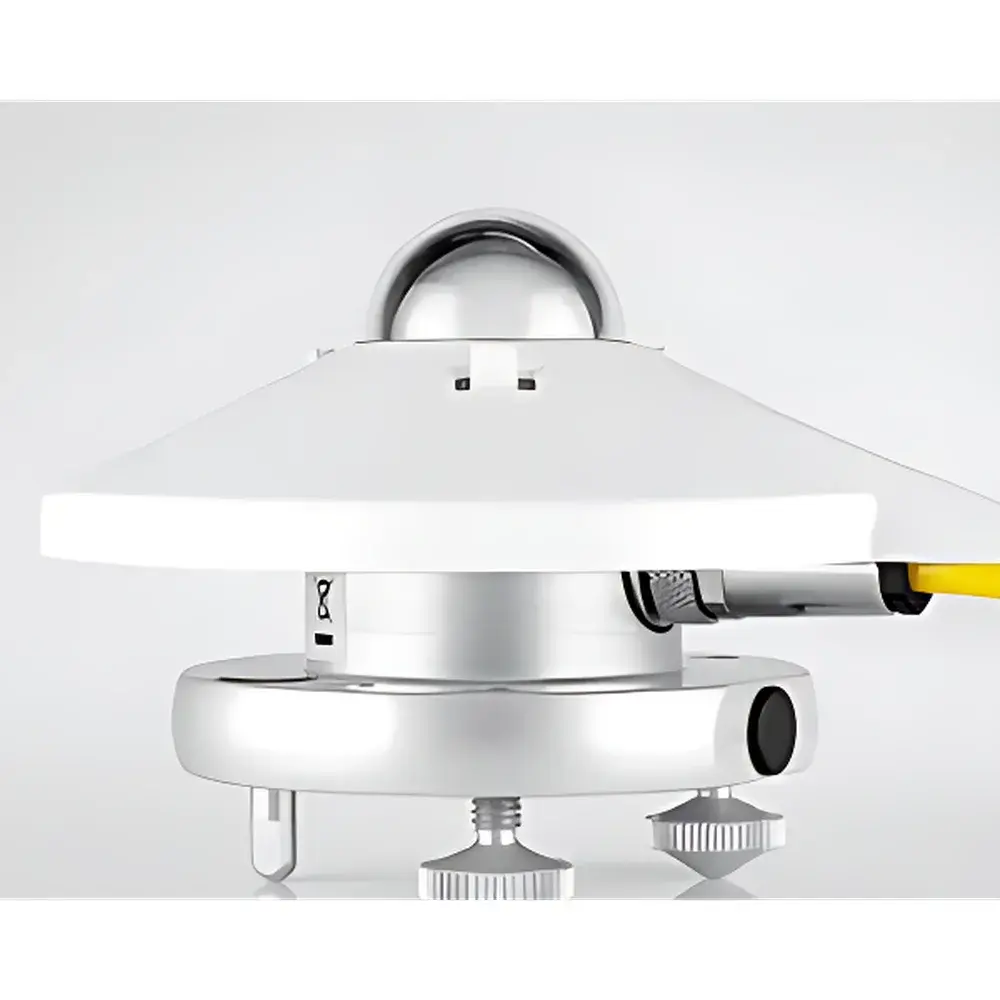
Kipp & Zonen CMP3 Pyranometer
| Brand | Kipp & Zonen |
|---|---|
| Origin | Netherlands |
| Model | CMP3 |
| Spectral Range | 300–2800 nm |
| Output Signal | 0–55 mV (passive, no power required) |
| Sensitivity | 10 µV/W/m² (typical), 5–20 µV/W/m² (range) |
| Response Time (95%) | <18 s |
| Zero Offset A (thermal) | <15 W/m² |
| Zero Offset B (nighttime cooling) | <5 W/m² |
| Directional Error (up to 80° zenith, 1000 W/m² beam) | <20 W/m² |
| Temperature Dependence of Sensitivity (−10 °C to +40 °C) | <4 % |
| Operating Temperature Range | −40 °C to +80 °C |
| Maximum Irradiance | 2000 W/m² |
| Field of View | 180° (2π steradian, hemispherical) |
| Calibration Compliance | ISO 9060:2018 Secondary Standard |
Overview
The Kipp & Zonen CMP3 Pyranometer is a thermopile-based broadband solar irradiance sensor engineered for continuous, high-stability measurement of global horizontal irradiance (GHI). It operates on the principle of thermal detection: incident solar radiation—spanning the full shortwave spectrum from 300 nm to 2800 nm—is absorbed by a blackened thermopile junction, generating a proportional millivolt-level voltage output via the Seebeck effect. As a passive device, it requires no external power supply, eliminating electrical noise and simplifying integration into remote or off-grid monitoring stations. Certified to ISO 9060:2018 Secondary Standard classification, the CMP3 delivers traceable, meteorologically robust performance suitable for climatological networks, PV system performance monitoring, agricultural microclimate studies, and environmental research applications where long-term data integrity is critical.
Key Features
- Thermopile detector with black-coated absorber and precision-ground quartz dome for uniform spectral transmission and minimal angular dependence
- Integrated white snap-on shade ring with built-in leveling bubble—enables rapid, repeatable field alignment without auxiliary tools
- Weatherproof M12 connector pre-terminated with 10 m shielded, twisted-pair cable (optional extended lengths and mounting masts available)
- Zero-power operation: outputs 0–55 mV DC signal directly proportional to irradiance (W/m²); compatible with most data loggers featuring millivolt input channels
- Extended operational envelope: functional across −40 °C to +80 °C ambient temperatures, with sensitivity drift <4 % over the −10 °C to +40 °C range relevant to most solar resource assessment conditions
- Annual stability better than ±1 % per year—validated under real-world exposure per IEC 61724-1 and WMO Guide to Meteorological Instruments and Methods of Observation
Sample Compatibility & Compliance
The CMP3 is designed exclusively for outdoor or indoor-over-glazing solar irradiance measurement under natural or simulated sunlight. Its hemispherical 180° field of view ensures full capture of direct beam and diffuse sky components incident on a horizontal plane. The instrument complies with ISO 9060:2018 Secondary Standard specifications for spectral response, directional error, temperature dependence, and zero offsets. It meets the minimum requirements for Class II pyranometers in solar energy applications per IEC 61724-1 (Photovoltaic system performance monitoring) and aligns with WMO No. 8 recommendations for surface radiation network instrumentation. While not intrinsically certified for hazardous locations or explosion-proof environments, its IP67-rated housing and stainless-steel construction ensure resilience in coastal, desert, and alpine deployments.
Software & Data Management
As an analog sensor, the CMP3 interfaces directly with industry-standard data acquisition systems—including Campbell Scientific CR series, Delta-T Devices DL2e, Onset HOBO UX120, and generic SCADA platforms—via calibrated millivolt input channels. Kipp & Zonen provides NIST-traceable calibration certificates with individual sensitivity factors (µV/W/m²) and temperature correction coefficients. When integrated into automated networks, raw mV readings are converted to W/m² using linear scaling; optional AMPBOX signal conditioner enables conversion to 4–20 mA or amplified 0–5 V outputs for long-cable runs or PLC interfacing. All calibration metadata—including date, reference standard (e.g., WRR or WSR), and uncertainty budget (<1.5 % k=2 at 1000 W/m²)—is documented to support GLP-compliant data auditing and ISO/IEC 17025 traceability workflows.
Applications
- Solar resource assessment for photovoltaic (PV) plant site selection and yield modeling
- Performance ratio (PR) and specific yield validation of operational utility-scale and distributed PV systems
- Climate monitoring within national meteorological networks (e.g., NOAA SURFRAD, BSRN)
- Agricultural evapotranspiration (ET₀) estimation using Penman-Monteith models
- Building energy modeling and daylight harvesting control system commissioning
- Albedo derivation when paired back-to-back with a second CMP3 (one upward-facing, one downward-facing) on a single mounting structure
FAQ
Does the CMP3 require power to operate?
No. It is a passive thermopile sensor and generates its own millivolt output in response to irradiance.
What is the recommended recalibration interval?
Kipp & Zonen recommends recalibration every two years for critical applications; annual verification against a reference pyranometer is advised for high-accuracy networks.
Can the CMP3 be used under glass or polycarbonate domes?
Yes, but spectral transmission losses and reflection artifacts must be quantified and corrected—especially below 350 nm and above 2500 nm—when installed beneath glazing.
Is the CMP3 compatible with Modbus or SDI-12 protocols?
Not natively. It requires an external analog-to-digital converter or signal conditioner (e.g., AMPBOX) to interface with digital communication buses.
How is cosine response error addressed in the CMP3 design?
Through optimized dome geometry, diffuser layer integration, and precise black absorber coating—resulting in directional error <20 W/m² up to 80° zenith angle at 1000 W/m² beam irradiance, per ISO 9060:2018 test protocol.







