
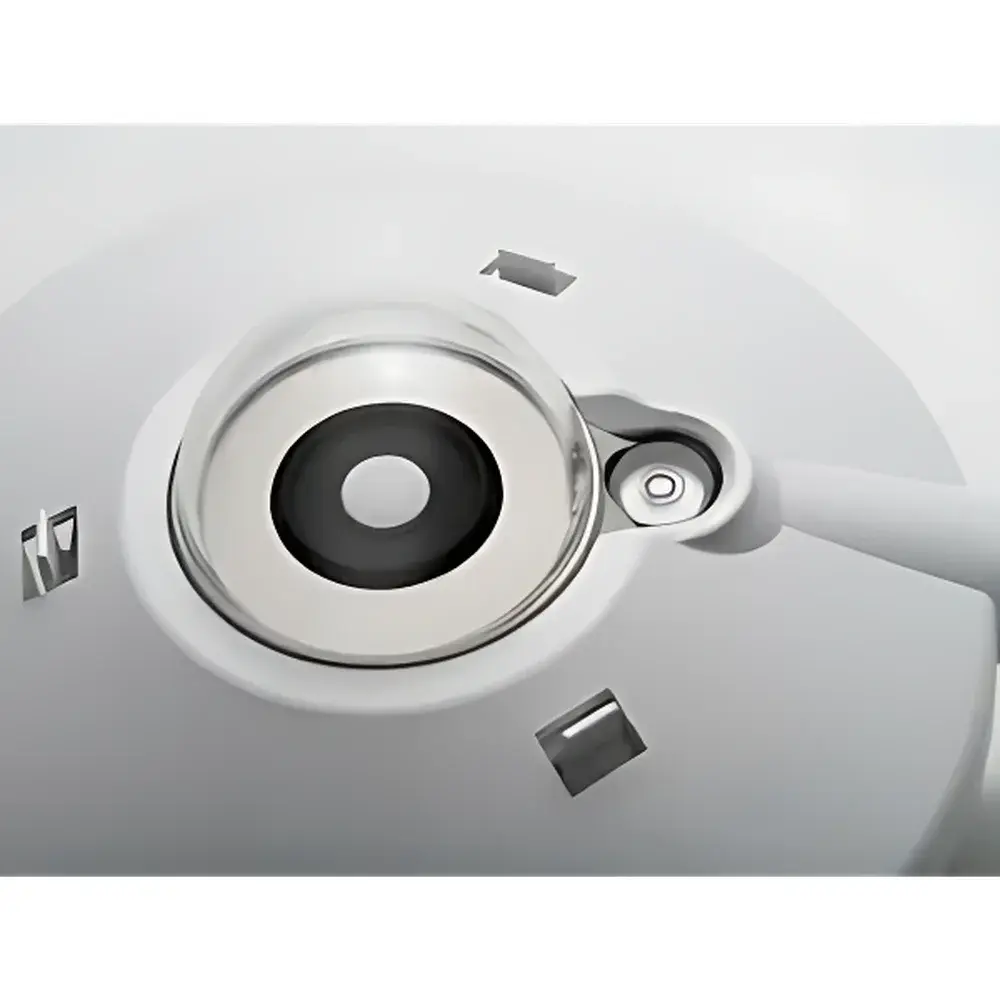
Kipp & Zonen SMP12 Pyranometer
| Brand | Kipp & Zonen |
|---|---|
| Origin | Netherlands |
| Model | SMP12 |
| Spectral Range (50% points) | 285–2750 nm |
| Response Time (63%) | < 0.15 s |
| Response Time (95%) | < 0.5 s |
| Zero-Offset (thermal offset, full range) | < 3 W/m² |
| Directional Response (1000 W/m² beam irradiance, up to 80° zenith angle) | < 10 W/m² |
| Temperature Dependence of Sensitivity (−10 °C to +40 °C) | < 1 % |
| Temperature Dependence of Sensitivity (−40 °C to +70 °C) | < 2 % |
| Output Interface | 2-wire RS-485 Modbus® RTU |
| Supply Voltage | 10–30 VDC |
| Surge Protection | Level 2 on power input, Level 3 on RS-485 lines |
| Internal Desiccant Lifetime | ≥10 years (sealed enclosure) |
| Integrated Tilt Sensor & Humidity Monitor | Yes |
| Calibration Coefficient Stored in Memory | Yes |
| Digital Irradiance Output | Direct in W/m² |
Overview
The Kipp & Zonen SMP12 Pyranometer is a Class A thermopile-based solar irradiance sensor engineered for high-accuracy, long-term measurement of global horizontal irradiance (GHI). It operates on the principle of thermal detection: incident solar radiation is absorbed by a blackened thermopile junction, generating a voltage proportional to the temperature gradient across the thermoelectric stack. This analog signal is converted internally to a digital irradiance value—calibrated and output directly in W/m²—eliminating external scaling or post-processing. Designed for unattended operation in utility-scale photovoltaic (PV) monitoring stations, research-grade meteorological networks, and solar resource assessment campaigns, the SMP12 integrates proven optical and thermal design heritage from the RaZON+ PH1 and PR1 series while introducing enhanced digital intelligence, robust electrical protection, and passive maintenance reduction strategies.
Key Features
- Class A performance per ISO 9060:2018 and IEC 61724-1:2021 standards—validated for spectral response, directional error, and temperature stability.
- Integrated dome heating system prevents dew, frost, and snow accumulation without mechanical moving parts or external controllers.
- Hermetically sealed housing with internal desiccant cartridge rated for ≥10 years of continuous operation without opening the enclosure.
- Dual embedded diagnostics: a tilt sensor enables remote verification of mounting alignment; an internal humidity sensor continuously monitors seal integrity and alerts users to potential ingress events (e.g., impact-induced microfractures).
- 2-wire RS-485 Modbus® RTU interface ensures noise-immune digital communication over distances up to 1,200 m—compatible with industrial SCADA, PLCs, and data loggers supporting standard Modbus register mapping.
- Wide DC supply range (10–30 VDC) simplifies integration into existing solar monitoring infrastructure, including battery-backed or MPPT-powered telemetry nodes.
- Comprehensive surge protection architecture: Level 2 (10 kA, 8/20 µs) on power input; Level 3 (20 kA, 8/20 µs) on RS-485 data lines—exceeding typical requirements for outdoor PV plant deployments.
Sample Compatibility & Compliance
The SMP12 is optimized for broadband solar irradiance measurement under natural atmospheric conditions, including variable cloud cover, aerosol loading, and low-angle sun positions. Its spectrally flat response (285–2750 nm at 50% transmission points) ensures accurate integration of both direct and diffuse components across the photosynthetically active and near-infrared bands relevant to PV yield modeling and atmospheric science. The instrument complies with ISO 9060:2018 (Class A), IEC 61724-1:2021 (Section 6.2 for GHI sensors), and ASTM E892–22 (Standard Test Method for Spectral Match of Solar Simulators). Calibration certificates are traceable to the World Radiometric Reference (WRR) maintained by PMOD/WRC, Davos. No analog output is provided—ensuring immunity to electromagnetic interference and eliminating drift-prone signal conditioning stages common in legacy systems.
Software & Data Management
SmartExplorer™ for Windows is a free, vendor-provided configuration and diagnostic utility supporting firmware updates, Modbus address assignment, communication parameter tuning (baud rate, parity), and real-time data logging. All calibration coefficients—including sensitivity (µV/(W/m²)), zero-offset correction terms, and temperature compensation polynomials—are stored permanently in non-volatile memory. When replacing or re-calibrating an SMP12 unit, no changes are required in upstream data acquisition systems: the new sensor automatically reports irradiance in W/m² using its embedded calibration, preserving continuity in time-series datasets critical for performance ratio (PR) analysis and bankability reporting. Data integrity is further reinforced by built-in CRC-16 error checking on all Modbus frames and timestamped diagnostic registers accessible via standard function codes.
Applications
- Performance monitoring of grid-connected photovoltaic power plants per IEC 61724-1 requirements.
- Long-term solar resource assessment for site feasibility studies and bankable energy yield predictions.
- Calibration reference for secondary standard pyranometers and pyrheliometers in field laboratories.
- Atmospheric transmittance studies requiring high temporal resolution (<0.5 s 95% response) and minimal zero-offset drift.
- Integration into automated weather stations (AWS) and IoT-enabled environmental monitoring platforms.
- Research applications in agrivoltaics, albedo measurement, and surface energy balance modeling.
FAQ
Does the SMP12 require periodic recalibration?
Yes—Kipp & Zonen recommends recalibration every two years for Class A compliance in commercial PV monitoring applications. Field recalibration intervals may be extended based on historical stability data and site-specific soiling conditions.
Can the SMP12 be used with existing analog data loggers?
No—the SMP12 provides digital output only via RS-485 Modbus RTU. Analog-capable systems require a protocol converter or upgrade to a Modbus-compatible logger.
Is the dome heater controllable externally?
No—the heating circuit is fully autonomous and activated automatically when ambient temperature falls below +5 °C and relative humidity exceeds 85 % RH.
How is the calibration coefficient applied in data processing?
The coefficient is applied internally within the sensor’s microcontroller; the Modbus register 40001 returns irradiance directly in W/m² without user-side scaling.
What mounting hardware is included?
The SMP12 ships with a universal leveling base and M6 threaded mounting stud compatible with standard solar tracker and pole-mount adapters.
Related Products







