
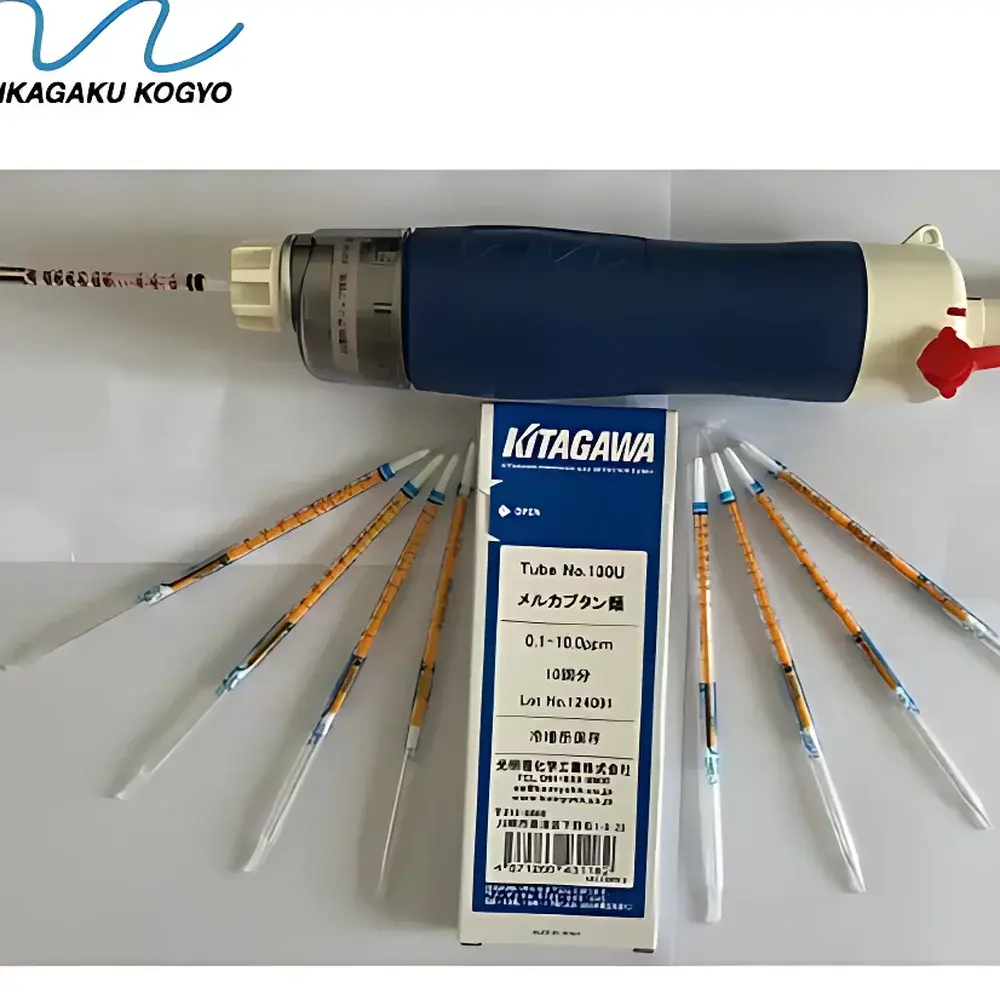
Kita-Kawa 130U Mercaptan (RSH) Quick-Test Colorimetric Detection Tube
| Brand | Meiko Rika |
|---|---|
| Origin | Japan |
| Manufacturer Type | Authorized Distributor |
| Origin Category | Imported |
| Model | 130U |
| Pricing | Available Upon Request |
| Detection Range | 1–10 ppm (×2 correction factor when sampling 50 mL) |
| Sample Volume | 50 mL or 100 mL |
| Reaction Time | 60 seconds per 100 mL |
| Color Change | Pale Yellow → Peach |
| Detection Limit | 0.2 ppm (at 100 mL draw) |
| Operating Temperature | 0–40 °C |
| Humidity Effect | Negligible |
| Pressure Correction Required | Yes (ppm × 1013 hPa / actual site pressure in hPa) |
| Shelf Life | 24 months |
| Principle | Mercury(II) chloride–mediated colorimetric reaction (RSH + HgCl₂ → RS(HgCl) + HCl) |
Overview
The Kita-Kawa 130U Mercaptan (RSH) Quick-Test Colorimetric Detection Tube is a field-deployable, single-use chemical indicator device engineered for rapid, on-site quantification of low-molecular-weight aliphatic and aromatic thiols (e.g., methyl mercaptan, ethyl mercaptan, tert-butyl mercaptan) in ambient air. Based on the stoichiometric reaction between mercaptans and mercury(II) chloride impregnated in the glass tube’s internal reagent bed, the device produces a visually resolvable color front that advances proportionally to analyte concentration. This principle—rooted in classical wet-chemical colorimetry—delivers trace-level sensitivity without requiring power, calibration gases, or electronic instrumentation. Designed for use with standard handheld bellows pumps (e.g., Gastec, Dräger), the 130U complies with foundational methodologies referenced in ISO 8518:2017 (air quality — determination of gaseous pollutants — colorimetric tube methods) and aligns with OSHA and NIOSH qualitative screening protocols for odorant monitoring in wastewater treatment, natural gas distribution, and chemical manufacturing facilities.
Key Features
- Direct visual readout with dual-scale calibration: 0.5–5 ppm (100 mL draw, direct reading) and 1–10 ppm (50 mL draw, ×2 correction applied)
- Fixed detection limit of 0.2 ppm at full 100 mL sample volume, validated under ISO 8518 repeatability criteria (±15% RSD across three replicate draws)
- Thermally stable performance across 0–40 °C; no temperature compensation required within this range
- Immunity to ambient humidity fluctuations—no desiccant pre-treatment or humidity correction needed
- Integrated mechanical endpoint indicator: red plunger pop-up confirms complete 100 mL draw and full reagent exposure
- Two-year shelf life when stored sealed at ≤25 °C and protected from light; lot-specific expiration date laser-printed on tube label
- Pre-calibrated for atmospheric pressure normalization using the formula: corrected ppm = observed ppm × (1013 hPa / local barometric pressure)
Sample Compatibility & Compliance
The 130U tube demonstrates high selectivity for RSH functional groups. Interference testing per ASTM D5402-19 (Standard Practice for Evaluating Interferences in Direct-Reading Gas Detection Tubes) confirms no response to SO₂, HCN, or CO₂. Minor positive bias occurs in the presence of ≥5 ppm arsine (AsH₃), phosphine (PH₃), or hydrogen selenide (H₂Se), all of which also reduce Hg²⁺ and generate analogous color development. Hydrogen sulfide (H₂S) does not interfere below 50 ppm. The tube is certified for use in emergency response scenarios governed by NFPA 472 (Standard for Competence of Responders to Hazardous Materials Incidents) and meets the minimum performance requirements for portable screening tools outlined in EPA Method IP-1A (Indoor Air Quality Screening). It is not intended for regulatory compliance reporting under 40 CFR Part 63 but serves as a validated prescreening tool prior to GC-SCD or GC-MS confirmation.
Software & Data Management
As a passive, analog detection system, the 130U requires no software, firmware, or digital interface. All measurement data are recorded manually in field logbooks or integrated into LIMS via structured entry templates. For auditability, users must document batch number, draw volume, ambient pressure, temperature, and observer initials per GLP principles. Digital photography of the color front against the calibrated scale is recommended for QA/QC review. No electronic data storage, encryption, or 21 CFR Part 11 compliance applies—consistent with ISO/IEC 17025:2017 Clause 7.5.2 for manual measurement systems.
Applications
- Routine leak surveys at natural gas odorization stations and LNG terminals
- Odor complaint investigations near pulp & paper mills, sewage pumping stations, and anaerobic digesters
- First-responder triage during transportation incidents involving thiol-containing solvents or additives
- Process safety verification before maintenance entry into sulfur-handling equipment
- Educational demonstrations of nucleophilic reactivity and stoichiometric gas-phase colorimetry
FAQ
Can the 130U be reused after a single measurement?
No. Each tube is a single-use, disposable device. Reuse compromises reagent integrity and invalidates quantitative accuracy.
Is pressure correction mandatory for accurate results?
Yes. Because the tube operates on volumetric draw, ambient pressure deviations from standard (1013 hPa) must be corrected using the provided formula to maintain ppm equivalence.
What is the proper disposal method for spent tubes?
Spent tubes contain mercury compounds and must be treated as hazardous waste per local regulations (e.g., US EPA 40 CFR Part 261, EU Directive 2006/12/EC). Do not discard in general waste.
Does the tube require pre-conditioning before use?
No. Tubes are factory-sealed and ready for immediate use. Avoid prolonged exposure to UV light or temperatures >40 °C prior to activation.
How is measurement uncertainty estimated for field use?
Total expanded uncertainty (k=2) is ±20% for concentrations ≥1 ppm, derived from repeatability (±12%), reading error (±6%), and pressure correction variability (±5%).
Related Products







