
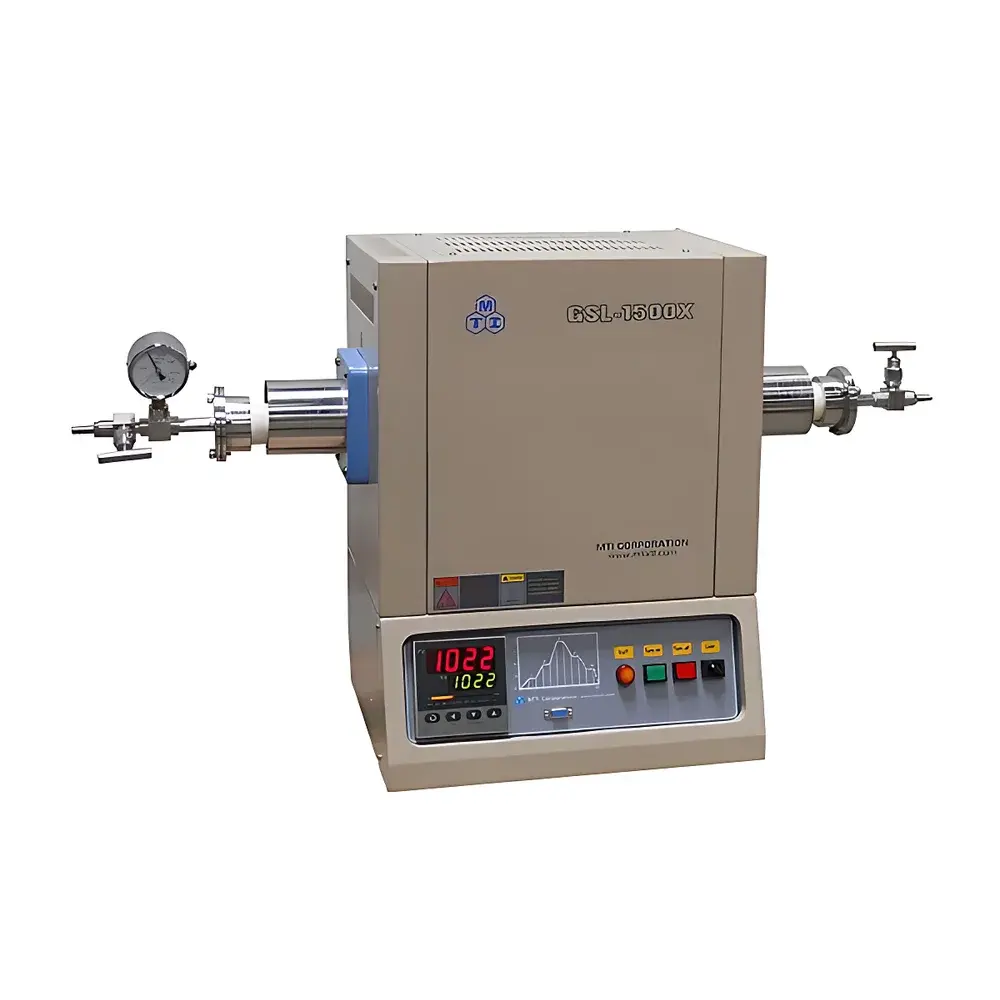
KJ GROUP GSL-1500X High-Temperature Vacuum Tube Furnace
| Brand | KJ GROUP |
|---|---|
| Origin | Liaoning, China |
| Manufacturer Type | Authorized Distributor |
| Origin Category | Domestic (China) |
| Model | GSL-1500X |
| Pricing | Upon Request |
| Power Supply | AC 220 V, 50/60 Hz, 2.5 kW |
| Tube Dimensions | OD 50 mm × ID 44 mm × L 762 mm |
| Heating Element | 1600 °C-rated SiC rods |
| Heating Zone Length | 152 mm |
| Uniform Temperature Zone | 50 mm |
| Max Operating Temperature | 1500 °C (≤1 h), 1400 °C continuous |
| Temperature Control Accuracy | ±1 °C |
| Programmable Ramp/Soak | 30-segment PID profile |
| Max Ramp Rate | 20 °C/min |
| Base Vacuum | 10⁻³ torr (mechanical pump), 10⁻⁵ torr (turbo-molecular pump) |
| Chamber Construction | Dual-layer steel housing with high-purity alumina fiber insulation |
| Internal Coating | US-imported alumina reflective coating |
| Safety Features | Over-temperature and thermocouple break alarms |
| Certification | CE-compliant |
| Dimensions (W×D×H) | 400 × 300 × 530 mm |
| Net Weight | 68 kg |
| Standard Accessories | One high-purity α-alumina tube, one pair of vacuum-tight flanges, four SiC heating rods, one K-type thermocouple, four alumina end plugs, one ceramic sample tongs |
Overview
The KJ GROUP GSL-1500X is a precision-engineered high-temperature vacuum tube furnace designed for controlled thermal processing in research laboratories and advanced materials development facilities. It operates on the principle of resistive heating via silicon carbide (SiC) elements within a sealed, evacuated quartz or high-purity alumina tube environment—enabling oxidation-sensitive synthesis, annealing, sintering, and chemical vapor deposition (CVD) under inert or reducing atmospheres. The furnace features a dual-layer stainless-steel housing with high-density alumina fiber insulation and an internal surface coated with US-sourced high-emissivity alumina to enhance radiative efficiency and thermal uniformity across the 152 mm heating zone. With a maximum rated temperature of 1500 °C (short-term) and stable continuous operation up to 1400 °C, the GSL-1500X meets stringent requirements for ceramic matrix composites, battery cathode precursors, quantum dot synthesis, and thin-film growth protocols.
Key Features
- Dual-shell construction with high-purity alumina fiber insulation and proprietary US-imported alumina reflective coating for improved thermal retention and energy efficiency
- 30-segment programmable PID temperature controller with ±1 °C accuracy and real-time ramp/soak profiling capability
- Two vacuum-tight CF-style flanges (standard configuration) compatible with KF25, ISO-KF, or custom double-ferrule gas inlet adaptations
- Integrated over-temperature protection and thermocouple failure detection with audible and visual alarm outputs
- CE-certified design compliant with EN 61000-6-3 (EMC) and EN 61000-6-4 (immunity) standards for laboratory integration
- Modular electrical architecture supporting optional PC-based remote monitoring via RS485/Modbus RTU interface (with add-on software kit)
Sample Compatibility & Compliance
The GSL-1500X accommodates cylindrical samples up to 44 mm in diameter and 600 mm in length within its 762 mm alumina tube. It supports crucibles made from graphite, tungsten, molybdenum, quartz, or high-purity alumina—subject to compatibility with process atmosphere and temperature limits. For CVD applications, the system integrates seamlessly with mass flow controllers (MFCs), pressure regulators, and exhaust scrubbers when configured with optional corrosion-resistant digital vacuum gauges and waveguide-compatible flanges. All operational parameters—including temperature setpoints, dwell times, and vacuum levels—are traceable and auditable per GLP/GMP documentation requirements. While not FDA 21 CFR Part 11–validated out-of-the-box, the furnace’s control log export functionality enables compliance-ready data archiving when paired with validated third-party LIMS or ELN platforms.
Software & Data Management
The standard controller includes non-volatile memory for storing up to 10 user-defined thermal profiles and automatic logging of actual vs. setpoint temperature at configurable intervals (1–60 s). Optional PC control software (sold separately) provides real-time graphical trending, CSV data export, alarm history review, and multi-furnace synchronization for parallel batch processing. Communication occurs via isolated RS485 using Modbus RTU protocol—ensuring noise immunity in electromagnetically dense lab environments. All logged datasets include timestamps, operator IDs (when integrated with network authentication), and checksum-verified integrity metadata suitable for regulatory submissions under ISO/IEC 17025 or ASTM E2911.
Applications
- Synthesis of transition metal oxides (e.g., LiCoO₂, NMC, LFP) under controlled oxygen partial pressure
- Graphitization and thermal reduction of graphene oxide and carbon nanotubes
- High-temperature annealing of optical waveguides and photonic crystal fibers
- Vacuum brazing of refractory metal assemblies (Mo, W, Ta) in semiconductor packaging R&D
- Thermal calibration of thermocouples and radiation pyrometers against NIST-traceable references
- Pre-sintering of YSZ electrolytes for solid oxide fuel cell (SOFC) stack development
FAQ
What vacuum level can the GSL-1500X achieve without optional pumping upgrades?
With the standard mechanical rotary vane pump, base pressure reaches ≤10⁻³ torr. For ultra-high vacuum (UHV) processes requiring ≤10⁻⁵ torr, a turbo-molecular pump station must be added as an accessory.
Is the alumina tube included rated for repeated thermal cycling to 1500 °C?
Yes—the supplied α-alumina tube (99.8% purity) is certified for ≥200 cycles at 1400 °C and ≥50 cycles at 1500 °C under slow ramp conditions (<10 °C/min) and controlled cooling rates.
Can the furnace be operated under positive pressure with reactive gases?
No. The standard configuration is rated for vacuum and inert/noble gas backfill only. Positive-pressure operation with corrosive or flammable gases requires custom pressure-rated flanges and safety interlocks—not provided by default.
Does the CE marking cover electromagnetic compatibility for shared lab infrastructure?
Yes—compliance with EN 61000-6-3 (emission) and EN 61000-6-4 (immunity) ensures co-location with sensitive instrumentation such as SEMs, XRD systems, and laser interferometers without signal interference.
How is temperature uniformity verified across the heating zone?
Uniformity is characterized per ASTM E220 using three calibrated K-type thermocouples placed axially at 0 mm, +25 mm, and −25 mm relative to the center of the 152 mm hot zone; typical deviation is ≤±3 °C at 1400 °C.



