
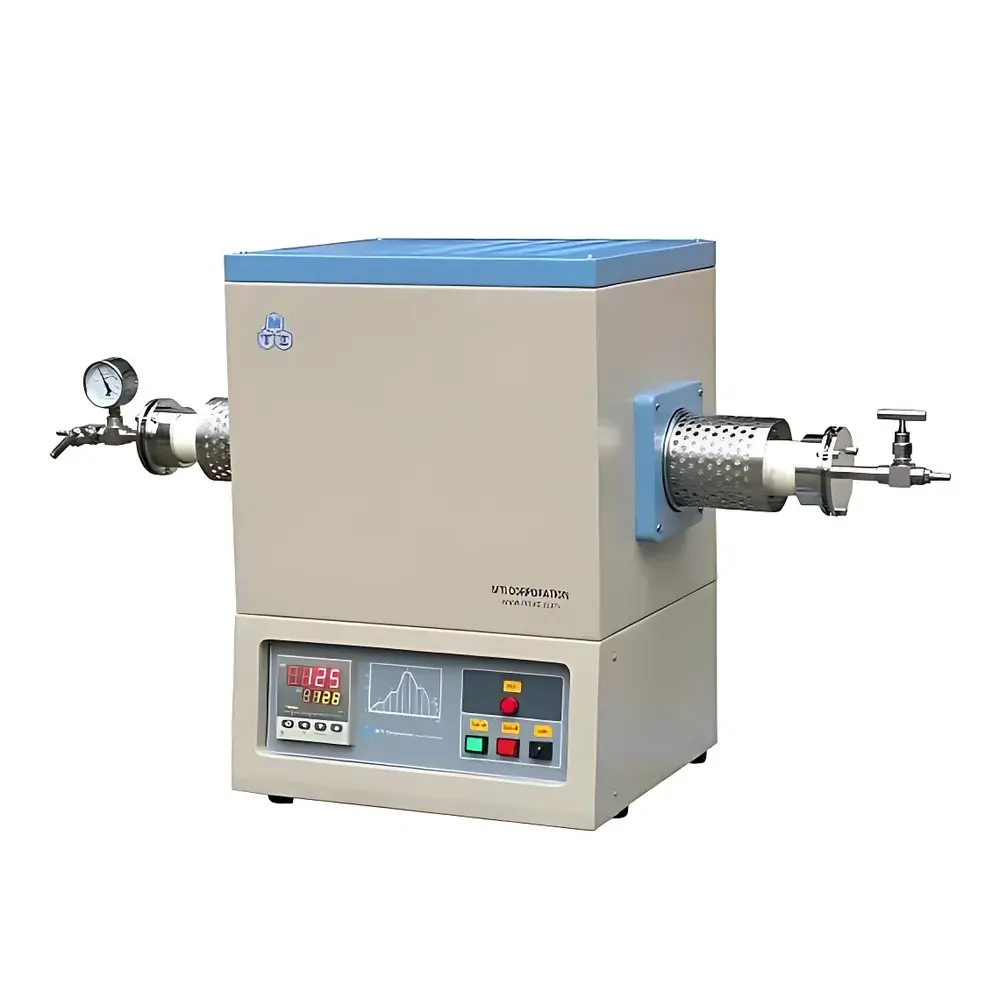
KJ GROUP GSL-1700X-S60 High-Temperature Vacuum Tube Furnace
| Brand | KJ GROUP |
|---|---|
| Origin | Liaoning, China |
| Manufacturer Type | Authorized Distributor |
| Country of Origin | China |
| Model | GSL-1700X-S60 |
| Heating Element | 1800°C-rated Molybdenum Disilicide (MoSi₂) Rods |
| Max Operating Temperature | 1700°C |
| Tube Dimensions | Ø60 mm OD × Ø54 mm ID × 790 mm L |
| Hot Zone Length | 300 mm |
| Uniformity Zone | 80 mm |
| Power Supply | AC 220 V, 50/60 Hz, 3 kW (30 A circuit breaker required) |
| Cooling | Forced-air dual-shell cooling system |
| Surface Temperature | <60°C at ambient |
| Insulation | High-purity alumina fiber |
| Temperature Control | 30-segment PID programmable controller |
| Temperature Accuracy | ±1°C |
| Vacuum Performance | 1×10⁻³ Torr (with dual-stage rotary vane pump), 1×10⁻⁵ Torr (with turbomolecular pump option) |
| Dimensions (W×D×H) | 445×380×615 mm |
| Net Weight | 150 kg |
| Compliance | Meets EN 61000-6-3 (EMC), EN 61000-6-4, EN 61010-1 (Safety) |
Overview
The KJ GROUP GSL-1700X-S60 is a precision-engineered high-temperature vacuum tube furnace designed for controlled thermal processing under inert or reduced-pressure atmospheres. It operates on the principle of resistive heating via high-stability molybdenum disilicide (MoSi₂) heating elements rated to 1800°C, enabling stable and repeatable operation up to 1700°C in the hot zone. The furnace features a double-walled stainless steel shell with integrated forced-air cooling, ensuring operator safety and long-term structural integrity during extended high-temperature cycles. Its optimized thermal architecture—comprising high-purity alumina fiber insulation and a precisely dimensioned 300 mm heating zone—delivers exceptional axial temperature uniformity across an 80 mm isothermal region, critical for reproducible sintering, annealing, crystal growth, and chemical vapor deposition (CVD) precursor decomposition.
Key Features
- Dual-shell construction with active air-cooling system maintains external surface temperature below 60°C under full-load operation, complying with IEC 61010-1 touch-safety requirements.
- High-efficiency insulation using >99.5% pure alumina fiber minimizes radial heat loss and improves energy efficiency without compromising thermal response time.
- 30-segment programmable PID temperature controller enables complex multi-step thermal profiles—including ramp-hold-cool sequences—with independent rate and setpoint control per segment.
- CE-marked design conforms to EN 61000-6-3 (emission), EN 61000-6-4 (immunity), and EN 61010-1 (electrical safety), supporting integration into ISO/IEC 17025-accredited laboratories.
- Standard quartz or high-purity alumina tube (Ø60 mm OD / Ø54 mm ID / 790 mm L) accommodates diverse sample geometries and process gas compatibility, including halogen- and sulfur-containing precursors.
- Robust flange interface (standard SS304 with Viton O-ring seal) supports vacuum-tight operation down to 1×10⁻³ Torr; optional KF25 feedthroughs and molecular pump integration enable ultra-high vacuum (UHV) configurations.
Sample Compatibility & Compliance
The GSL-1700X-S60 supports a broad range of solid-state materials—including oxides, carbides, nitrides, metals, and thin-film substrates—for applications requiring strict atmospheric control. Its alumina tube and MoSi₂ heating assembly are chemically inert toward most reducing and inert gases (e.g., Ar, N₂, H₂/Ar mixtures), making it suitable for annealing of perovskite solar cell precursors, densification of SiC ceramics, and post-deposition thermal treatment of ALD-grown films. The system meets baseline requirements for GLP-compliant thermal processing when paired with calibrated thermocouples (Type S or B, traceable to NIST standards) and validated vacuum gauges. Optional corrosion-resistant digital vacuum meters (e.g., Pirani + cold cathode combo) facilitate real-time pressure logging compatible with 21 CFR Part 11 audit trails when used with PC control software.
Software & Data Management
An optional Windows-compatible PC control software package provides remote monitoring and automated data acquisition via RS485/USB interface. The software logs timestamped temperature, setpoint, and (when equipped) vacuum pressure at user-defined intervals (1–60 s), generating CSV-formatted datasets for post-processing in MATLAB, Python, or statistical analysis platforms. All parameter changes—including program edits and manual overrides—are recorded with operator ID and timestamp, satisfying basic electronic record requirements per FDA 21 CFR Part 11 Annex 11 guidelines. Firmware updates are delivered via secure HTTPS portal, with version history and checksum verification embedded in the update package.
Applications
- Sintering of advanced ceramics (e.g., Y₂O₃-stabilized ZrO₂, AlN, BN) under vacuum or flowing Ar.
- Controlled-atmosphere annealing of transition metal dichalcogenide (TMD) monolayers and 2D heterostructures.
- Thermal decomposition of metal-organic precursors in CVD reactors for graphene and h-BN synthesis.
- Heat treatment of aerospace-grade superalloys and Ni-based turbine blade coatings.
- Calibration reference furnaces for thermocouple validation (per ASTM E230/E230M).
- Research-scale pyrolysis of polymer-derived ceramics (PDCs) under inert purge.
FAQ
What vacuum level can be achieved with the standard configuration?
The base configuration includes a dual-stage rotary vane pump capable of reaching ≤1×10⁻³ Torr. For ultra-high vacuum applications (≤1×10⁻⁵ Torr), a turbomolecular pumping station with appropriate backing and venting controls is required as an optional upgrade.
Is the furnace compatible with hydrogen atmosphere operation?
Yes—when configured with appropriate gas-handling components (leak-tested SS316 tubing, double ferrule compression fittings, and explosion-proof flow controllers), the system supports H₂/N₂ mixtures up to 5% H₂ by volume. Hydrogen service requires additional safety interlocks and ventilation per NFPA 55 and local fire codes.
Can the temperature controller be integrated into a centralized lab automation system?
The built-in Modbus RTU protocol over RS485 allows seamless integration with PLC-based SCADA systems or LabVIEW environments for synchronized multi-instrument workflows.
What maintenance is recommended for long-term reliability?
Biannual inspection of MoSi₂ element resistance, O-ring elasticity, and thermocouple calibration drift is advised. Alumina fiber insulation should be visually inspected for cracking or dust accumulation before each high-temperature campaign above 1500°C.
Does the furnace support rapid quenching?
No—this model is not equipped with internal gas-quench manifolds or water-cooled end caps. For controlled quenching protocols, users must integrate external rapid-cool modules or transfer samples to separate quench stations.



