
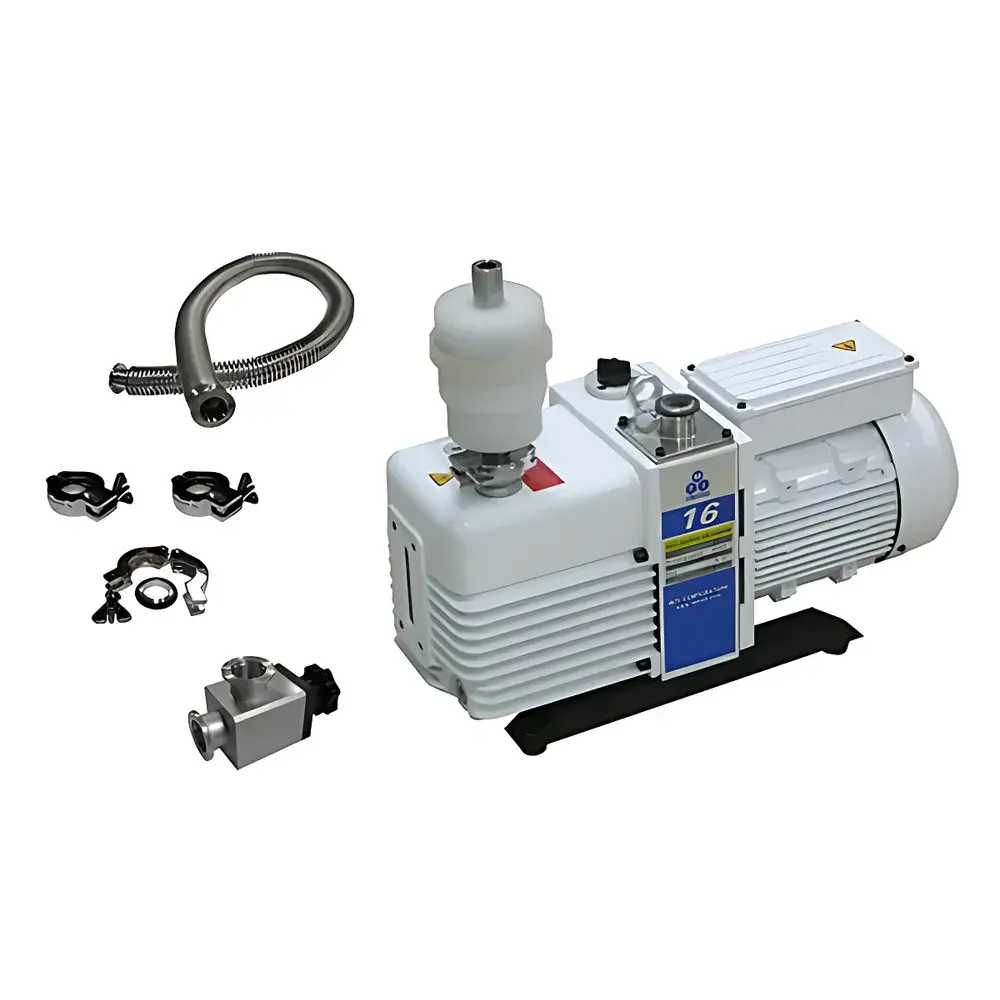
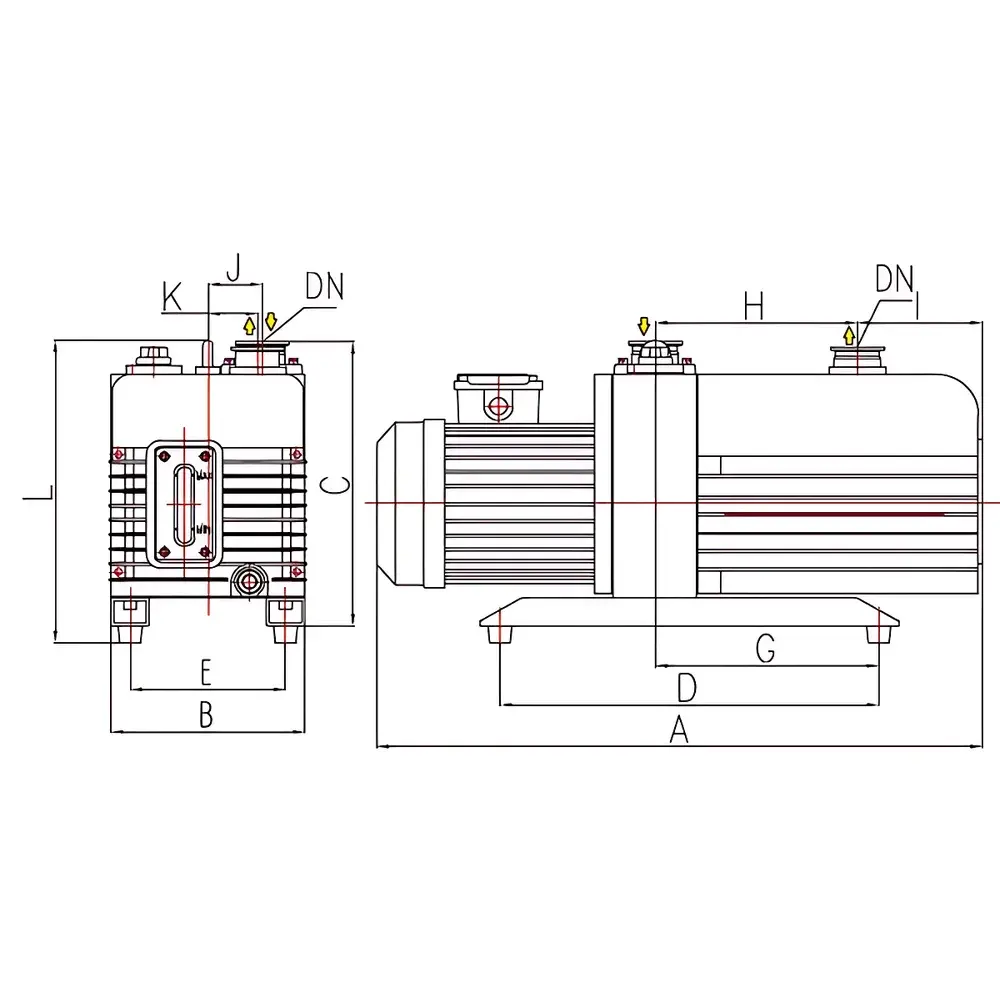
KJ GROUP VRD Series Dual-Stage Rotary Vane Vacuum Pump
| Brand | KJ GROUP |
|---|---|
| Origin | Liaoning, China |
| Manufacturer Type | Authorized Distributor |
| Country of Origin | China |
| Model | VRD-8 / VRD-16 |
| Pumping Speed (50 Hz) | 2.2 L/s (VRD-8), 4.4 L/s (VRD-16) |
| Pumping Speed (60 Hz) | 2.6 L/s (VRD-8), 5.2 L/s (VRD-16) |
| Ultimate Partial Pressure (Without Gas Ballast) | 5×10⁻² Pa (VRD-8), 4×10⁻² Pa (VRD-16) |
| Ultimate Total Pressure (Without Gas Ballast) | 5×10⁻¹ Pa (VRD-8), 4×10⁻¹ Pa (VRD-16) |
| Ultimate Total Pressure (With Gas Ballast) | 3.8×10⁰ Pa (VRD-8 & VRD-16) |
| Motor Power | 0.37 kW / 0.4 kW (VRD-8), 0.55 kW / 0.75 kW (VRD-16) |
| Inlet/Outlet Flange | KF16/KF25 (VRD-8), KF25 (VRD-16) |
| Oil Capacity | 0.6–1.0 L (VRD-8), 0.9–1.5 L (VRD-16) |
| Motor Speed | 1440 rpm (50 Hz), 1720 rpm (60 Hz) |
| Ambient Operating Temperature | 5–40 °C |
| Sound Pressure Level | ≤56 dB(A) (VRD-8), ≤58 dB(A) (VRD-16) |
| Net Weight | 21 kg (VRD-8), 30 kg (VRD-16) |
Overview
The KJ GROUP VRD Series dual-stage rotary vane vacuum pump is an engineered solution for achieving medium vacuum levels in laboratory, pilot-scale, and light industrial applications. Based on the proven principle of positive displacement via rotating vanes within an eccentrically mounted rotor chamber, the VRD series delivers stable, oil-sealed vacuum performance across a wide operational range. Its two-stage compression architecture enables significantly lower ultimate pressures compared to single-stage equivalents—particularly critical for processes requiring efficient removal of water vapor and other condensable gases. Designed for continuous duty under controlled ambient conditions (5–40 °C), the VRD-8 and VRD-16 models serve as primary or backing pumps for diffusion, turbomolecular, and cryogenic systems, as well as standalone vacuum sources for drying ovens, vacuum impregnation, degassing, and thin-film deposition support.
Key Features
- Dual-stage oil-sealed rotary vane design ensures high volumetric efficiency and consistent ultimate vacuum performance down to 4×10⁻² Pa (VRD-16) without gas ballast activation.
- Gas ballast valve integrated as standard—enabling controlled admission of atmospheric air during compression to prevent condensate accumulation and extend oil service life when pumping humid or solvent-laden gases.
- Robust cast aluminum housing with precision-machined stator and rotor components provides thermal stability and mechanical rigidity over extended operation cycles.
- Low-noise motor assembly (≤58 dB(A)) combined with vibration-damping mounting feet supports integration into shared laboratory environments where acoustic constraints apply.
- KF quick-release flanges (KF16/KF25 for VRD-8; KF25 for VRD-16) facilitate rapid, leak-tight connection to vacuum lines and process chambers per ISO-KF standards.
- Oil sight glass and drain plug allow for routine oil level verification and scheduled maintenance without disassembly—supporting adherence to GLP-aligned equipment log practices.
Sample Compatibility & Compliance
The VRD series is compatible with non-corrosive, non-reactive, and non-particulate gas loads typical of general vacuum applications—including air, nitrogen, argon, and low-concentration organic vapors. It is not rated for use with halogenated solvents, strong acids, alkalis, or abrasive particulates. While not certified to specific international safety directives (e.g., CE, UL) out-of-the-box, the pump’s electrical configuration (single/three-phase options) and mechanical construction comply with baseline IEC 60034 motor standards and ISO 21809-2 structural tolerances. When deployed in regulated environments (e.g., pharmaceutical R&D labs), its predictable performance, serviceable oil reservoir, and traceable maintenance intervals support alignment with FDA 21 CFR Part 11 expectations for ancillary vacuum infrastructure used in GMP-associated processes.
Software & Data Management
The VRD series operates as a standalone mechanical system without embedded digital controls or native data output interfaces. However, it is fully compatible with external vacuum monitoring systems via analog pressure transducer inputs (0–10 V or 4–20 mA) when paired with third-party gauges such as Pirani or capacitance manometers. Users may integrate pump status—on/off state, runtime hours, and oil change intervals—into centralized lab asset management platforms using simple relay outputs or PLC-compatible dry-contact signals (available upon request with optional control panel add-ons). This modular approach preserves compliance with audit-ready documentation requirements while avoiding proprietary firmware dependencies.
Applications
- Primary vacuum source for vacuum drying ovens and desiccators in materials science and polymer laboratories.
- Backing pump for high-vacuum systems including turbo-molecular pumps in surface analysis (XPS, AES) and electron microscopy sample preparation workflows.
- Vacuum degassing of resins, adhesives, and casting compounds prior to curing—reducing void formation and improving mechanical integrity.
- Support vacuum for freeze-drying (lyophilization) shelf pre-cooling and chamber evacuation in small-batch bioprocessing setups.
- Evacuation of gloveboxes and inert-atmosphere enclosures where moderate base pressure (<10⁻¹ Pa) and reliability are prioritized over ultra-high vacuum capability.
FAQ
What is the recommended vacuum pump oil type for the VRD series?
KJ GROUP specifies ISO VG 68 mineral-based or synthetic hydrocarbon vacuum pump oil meeting DIN 51506 VDL specifications. Use only oils tested for low vapor pressure (<1×10⁻³ Pa at 20 °C) and oxidation resistance.
Can the VRD pump operate continuously at its ultimate pressure?
Yes—designed for continuous-duty operation at rated speed and ambient temperature (5–40 °C), provided adequate ventilation and oil level are maintained per manufacturer guidelines.
Is the VRD series suitable for pumping solvent vapors?
Only with gas ballast enabled and when solvent concentration remains below 10% by volume; prolonged exposure to chlorinated or ketonic vapors requires oil change after each use and may reduce bearing life.
How often should the oil be changed under normal laboratory use?
Every 500 operating hours or quarterly—whichever occurs first—with more frequent changes advised if pumping humid or contaminated gases.
Does the VRD-16 require three-phase power?
No—the VRD-16 offers dual voltage/motor configuration: 0.55 kW for single-phase 220–240 V operation and 0.75 kW for three-phase 380–415 V supply, allowing flexibility across regional electrical infrastructures.



