
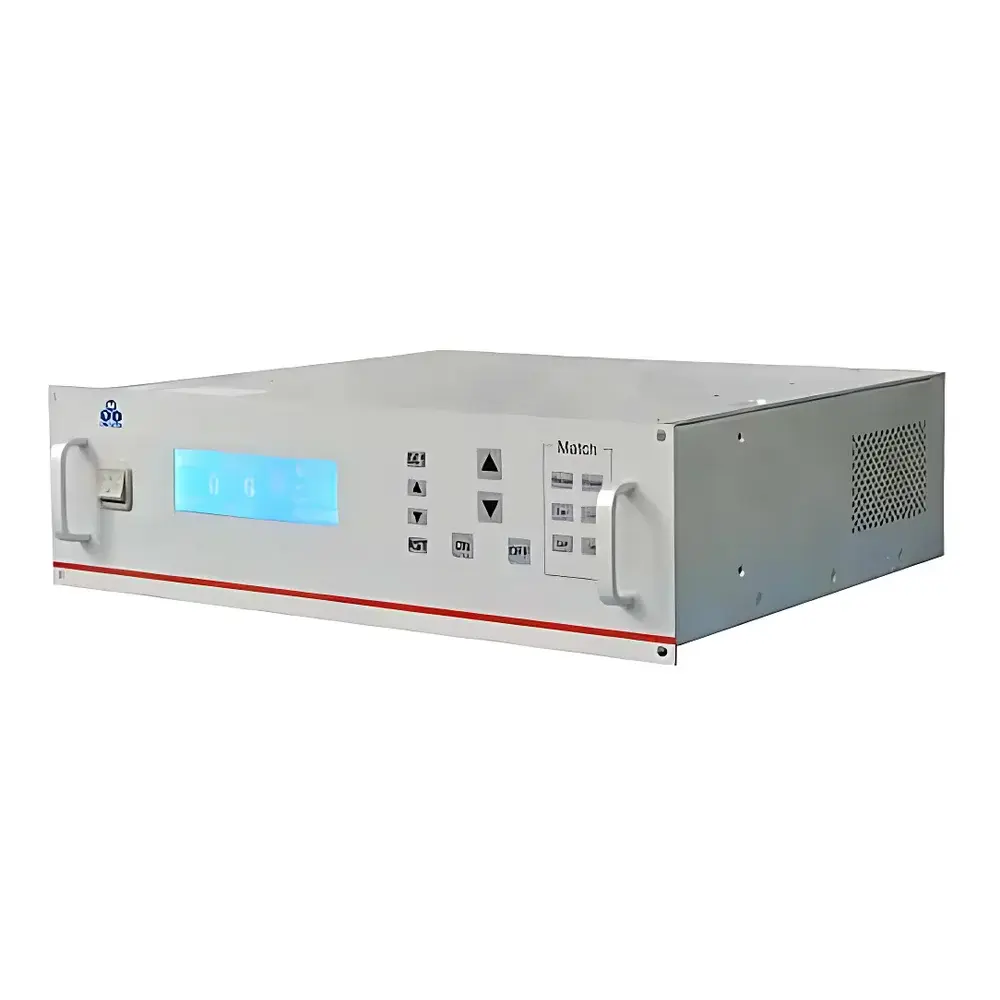
KJ GROUP RF-300I-LD 300W Integrated Automatic Matching RF Power Supply
| Brand | KJ GROUP |
|---|---|
| Origin | Liaoning, China |
| Model | RF-300I-LD |
| Input Voltage | AC 110–240 V, 50/60 Hz |
| Output Power Range | 5–300 W (adjustable, ±1% stability) |
| RF Frequency | 13.56 MHz (±0.005% stability) |
| Matching Method | Automatic impedance matching via air-variable capacitor |
| Cooling | Forced-air cooling |
| Noise Level | <50 dB(A) |
| Dimensions | 480 × 400 × 140 mm |
Overview
The KJ GROUP RF-300I-LD is a compact, integrated 300W radio frequency (RF) power supply engineered for plasma generation and thin-film deposition applications in research and pilot-scale vacuum systems. Operating at the industrial, scientific, and medical (ISM) band frequency of 13.56 MHz, the unit combines a solid-state RF generator and an automatic impedance matching network into a single chassis—eliminating external matching box complexity and minimizing signal loss through coaxial transmission lines. Its core function is to deliver stable, low-noise RF energy to reactive plasma loads (e.g., sputtering targets), dynamically compensating for complex load impedance variations caused by process drift, gas composition changes, or target erosion. This real-time matching capability ensures maximum forward power transfer (>90% typical), minimizes reflected power (<5% under matched conditions), and protects the RF amplifier from standing-wave damage—critical for long-term reliability in unattended operation.
Key Features
- Integrated architecture: Co-located RF amplifier and automatic matching network reduce system footprint and interconnect losses—ideal for benchtop vacuum deposition setups.
- Precision power control: Continuously adjustable output from 5 W to 300 W with ≤±1% line and load stability over ambient temperature range (15–35 °C).
- High-frequency stability: 13.56 MHz oscillator maintains ±0.005% frequency deviation under varying input voltage and thermal load—ensuring compliance with regulatory spectral mask requirements.
- Automatic impedance matching: Uses a motor-driven air-variable capacitor bank to tune complex load impedance (Z = R + jX) across typical plasma ranges (2–100 Ω, −j50 to +j80 Ω), completing match within ≤3 seconds.
- Air-cooled thermal management: Dual-speed axial fans with intelligent thermal feedback maintain junction temperatures below 75 °C at full 300 W output, enabling continuous-duty operation without external chillers.
- Low acoustic signature: Acoustic noise level <50 dB(A) at 1 m distance—suitable for shared laboratory environments where vibration-sensitive instrumentation (e.g., SEMs, AFMs) is present.
Sample Compatibility & Compliance
The RF-300I-LD is designed for use with standard 2-inch magnetron sputtering cathodes (including KJ GROUP’s optional high-vacuum magnetron head), capacitively coupled plasma (CCP) reactors, and RF-biased substrate stages. It supports both pulsed and continuous-wave (CW) operation modes and is compatible with common sputtering gases (Ar, N₂, O₂, Ar/O₂ mixtures) at pressures ranging from 0.1 to 15 Pa. The unit conforms to IEC 61000-6-3 (EMI emission limits for industrial environments) and IEC 61000-6-2 (immunity to electrostatic discharge, fast transients, and radiated RF fields). While not certified for medical or aerospace-grade qualification, its design follows GLP-aligned engineering practices—including traceable calibration records for power and frequency outputs, and internal watchdog circuitry for over-temperature and over-reflected-power shutdown.
Software & Data Management
The RF-300I-LD includes analog and digital I/O interfaces (0–10 V control/monitoring, RS-232 serial port) for integration into automated vacuum process sequences. Optional LabVIEW-compatible drivers enable remote power ramping, match status polling, and real-time logging of forward/reflected power (via built-in directional coupler outputs). All operational parameters—including setpoint, actual output, match state (matched/mismatched), and fault codes—are accessible via ASCII command protocol. Audit trails are supported when interfaced with host SCADA or MES platforms compliant with FDA 21 CFR Part 11 (with appropriate electronic signature implementation on the host side). No embedded operating system or cloud connectivity is included—maintaining deterministic real-time response and cybersecurity isolation per laboratory IT policy requirements.
Applications
- R&D-scale RF magnetron sputtering of metallic (Al, Ti, Cu), oxide (ITO, SiO₂, TiO₂), and nitride (TiN, Si₃N₄) thin films on silicon wafers, glass substrates, and flexible polymers.
- Plasma-enhanced atomic layer deposition (PE-ALD) precursor activation using RF-biased electrodes.
- Surface functionalization and plasma cleaning of MEMS devices prior to bonding.
- Ion-assisted deposition (IAD) processes requiring synchronized RF bias on substrate holders.
- Teaching laboratories: Demonstrating plasma ignition thresholds, impedance behavior vs. pressure/gas flow, and the role of matching networks in RF power delivery efficiency.
FAQ
What vacuum compatibility features does the RF-300I-LD support?
The unit itself is not vacuum-rated; it operates externally to the chamber. However, its RF output connector (Type N female) is designed for direct coupling to KJ GROUP’s 2″ high-vacuum magnetron head via a standard 0.75″ ID quick-connect flange (included free with head purchase), which mounts onto a 1″ OD feedthrough port with ≤1″ wall thickness.
Can the RF-300I-LD be used with DC sputtering systems?
No—it is strictly an RF (13.56 MHz) source. For hybrid RF/DC co-sputtering, it must be paired with a separate DC power supply and appropriate high-pass/low-pass filtering to prevent cross-talk.
Is water cooling required?
No. The unit uses forced-air cooling only. A separate recirculating chiller (e.g., KJ GROUP’s 16 L/min unit) is optional and intended solely for cooling the magnetron head—not the RF-300I-LD chassis.
Does the matching network require periodic calibration?
No. The air-variable capacitor mechanism is mechanically self-calibrating; no user intervention or recalibration is needed throughout the product lifetime under normal operating conditions.
What safety interlocks are implemented?
Hardware-enforced interlocks include over-temperature shutdown (thermal cutoff at 90 °C), reflected-power foldback (>20 W reflected for >500 ms), and open-circuit detection. An external E-stop input (dry contact) is provided for integration into vacuum chamber safety chains.



