
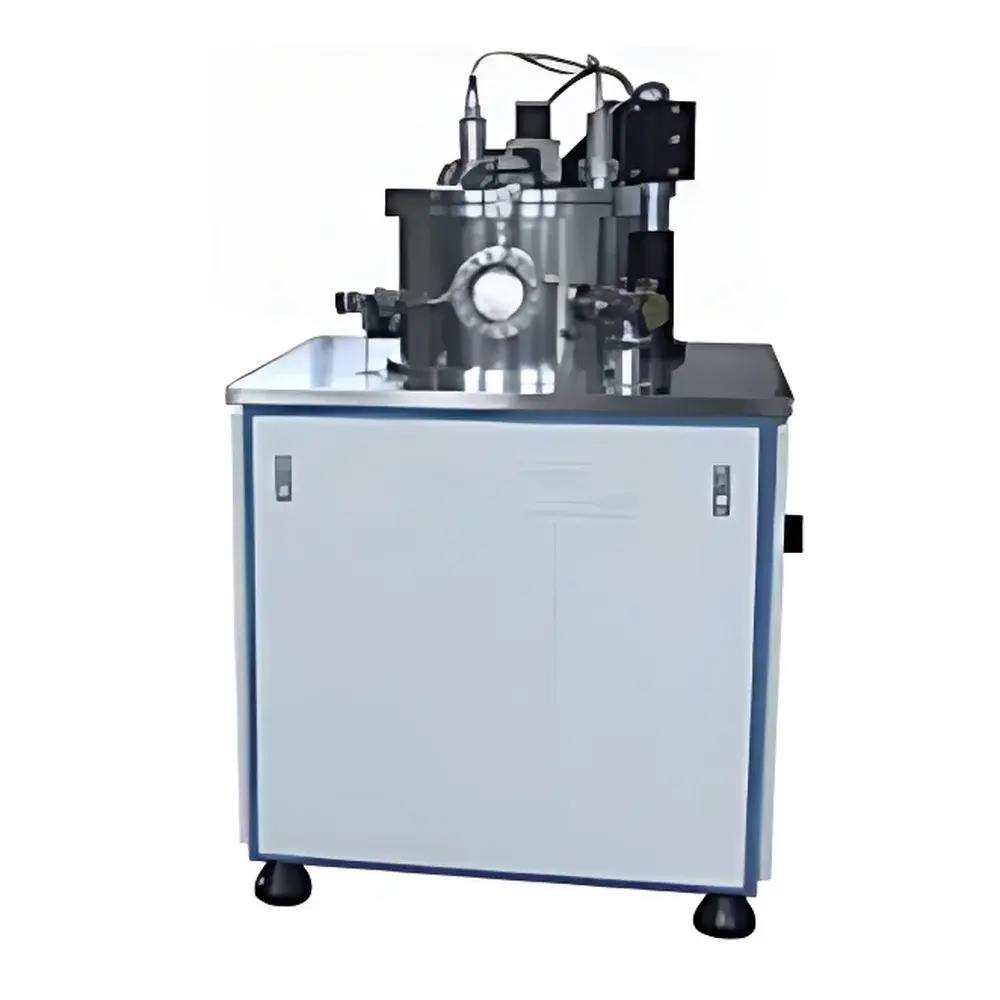
KJ GROUP GSL-CKJS-450-B1 Magnetron Sputtering System
| Brand | KJ GROUP |
|---|---|
| Origin | Liaoning, China |
| Manufacturer Type | Authorized Distributor |
| Country of Origin | China |
| Model | GSL-CKJS-450-B1 |
| Pricing | Available Upon Request |
| Main Chamber Dimensions | Ø450 × 355 mm cylindrical vacuum chamber |
| Base Vacuum | ≤5 × 10⁻⁵ Pa |
| Magnetron Targets | 3 × permanent-magnet RF/DC-compatible sputtering targets (Ø2″) |
| Target-to-Substrate Distance | 90–110 mm (adjustable) |
| Co-sputtering Geometry | Tri-target angular convergence toward sample center (40–80 mm focal distance) |
| Substrate Heating | Up to 600 °C ±1 °C (interchangeable with water-cooled stage) |
| Substrate Size | Ø25.4 mm (1″) |
| Substrate Rotation | Continuous, 5–15 rpm |
| Substrate Bias | Adjustable DC negative bias up to –200 V |
| Sample Holder Configuration | 6-position planetary rotation stage |
| Cooling | Integrated closed-loop chiller (deionized water or purified water) |
| Gas Supply | High-purity Ar/N₂ (≥99.99%) |
| Power Input | AC 380 V, 50 Hz, grounded |
| Ambient Requirements | Altitude <1000 m |
Overview
The KJ GROUP GSL-CKJS-450-B1 Magnetron Sputtering System is a high-vacuum, multi-target thin-film deposition platform engineered for reproducible physical vapor deposition (PVD) of metallic, semiconductor, and insulating thin films. Based on magnetically confined plasma generation—where crossed electric and magnetic fields trap electrons near the target surface to enhance ionization efficiency—the system enables high-rate, low-temperature sputtering with improved film density, uniformity, and adhesion. Its compact cylindrical main chamber (Ø450 × 355 mm) achieves base pressures ≤5 × 10⁻⁵ Pa via integrated turbomolecular pumping, ensuring minimal residual gas contamination during reactive or inert-gas sputtering. Designed explicitly for academic and applied R&D environments—including university materials science labs, national key laboratories, and industrial prototyping centers—the GSL-CKJS-450-B1 supports both single-target and tri-target co-sputtering configurations, enabling combinatorial synthesis, graded composition films, and multilayer heterostructures.
Key Features
- Triple independent magnetron source configuration: Three Ø2″ permanent-magnet targets—each compatible with both DC and RF power supplies—with one specifically engineered for ferromagnetic target materials (e.g., Fe, Ni, Co alloys), eliminating the need for electromagnets or external field compensation.
- Precision mechanical alignment: Adjustable target-to-substrate spacing (90–110 mm) and convergent co-sputtering geometry (40–80 mm focal distance) allow controlled flux overlap and stoichiometric tuning in multi-element systems.
- Thermally versatile substrate stage: Interchangeable heating and water-cooled sample holders; resistive heating up to 600 °C ±1 °C with PID-controlled stability; optional integration with thermocouple feedback loops for process repeatability.
- Dynamic substrate manipulation: 6-position planetary rotation stage with continuous 5–15 rpm motion and programmable dwell time per position; one heated station (600 °C ±1 °C) and five passively cooled stations support parallel processing or thermal gradient studies.
- Integrated substrate biasing: Adjustable DC negative bias (0 to –200 V) for ion-assisted deposition, enhancing film densification, reducing columnar growth, and improving interfacial adhesion—particularly critical for Al₂O₃, SiO₂, or TiN barrier layers.
- Self-contained cooling and gas delivery: Built-in closed-loop chiller (compatible with deionized water) and standardized 10 mm double-ferrule gas inlet ensure operational safety and compatibility with standard high-purity Ar/N₂ cylinders (≥99.99%).
Sample Compatibility & Compliance
The GSL-CKJS-450-B1 accommodates standard Ø25.4 mm (1″) wafers or substrates including silicon, quartz, glass, alumina, and flexible polymer foils (with appropriate thermal management). Its modular stage design permits rapid reconfiguration between high-temperature annealing, cryogenic deposition, and multi-step sequential sputtering protocols. The system conforms to IEC 61000-6-2 (electromagnetic immunity) and IEC 61000-6-4 (emission) standards. Vacuum integrity meets ISO 2740 (vacuum technology — terminology) definitions for high vacuum (<10⁻³ Pa), and all electrical interfaces comply with GB/T 16836-2018 (equivalent to IEC 60204-1) for machinery safety. While not pre-certified for GLP or GMP environments, its digital control architecture supports audit-ready operation when paired with external data logging systems compliant with FDA 21 CFR Part 11 requirements.
Software & Data Management
The system employs an integrated industrial-grade touch HMI interface running real-time embedded firmware—not Windows-based software—ensuring deterministic response times and immunity to OS-level interruptions. All process parameters—including pressure, power, bias voltage, temperature, rotation speed, and gas flow—are continuously logged at 1 Hz resolution into non-volatile memory with timestamped CSV export capability via USB. The controller supports RS485 Modbus RTU communication for integration into centralized lab automation networks (e.g., LabVIEW, Python-based SCADA). Optional Ethernet expansion enables remote monitoring and alarm notification via SNMP traps. No cloud connectivity or proprietary binary formats are used; raw log files are fully human-readable and compatible with MATLAB, Origin, or Python pandas for post-deposition analysis.
Applications
- Preparation of transparent conductive oxides (TCOs) such as ITO, AZO, and FTO for photovoltaic and display device prototyping.
- Deposition of hard coating stacks (e.g., CrN/TiN, AlCrN) for tribological evaluation and MEMS packaging.
- Synthesis of magnetic thin films (CoFeB, NiFe, TbFeCo) for spintronics and magneto-optical characterization.
- Growth of dielectric buffer layers (SiO₂, Al₂O₃, HfO₂) in gate-stack development for 2D material FETs.
- Combinatorial library fabrication using spatially resolved substrate rotation and multi-target power modulation.
- In-situ annealing and post-deposition thermal treatment under controlled vacuum or forming gas ambients.
FAQ
What vacuum level can the system achieve, and how is it measured?
The main chamber reaches a base pressure of ≤5 × 10⁻⁵ Pa, verified by a calibrated Bayard-Alpert hot-cathode ionization gauge included in the standard vacuum measurement package.
Can the system perform reactive sputtering with oxygen or nitrogen?
Yes—when equipped with mass flow controllers (optional accessory), the system supports reactive sputtering of oxides (e.g., ZnO, Ta₂O₅) and nitrides (e.g., TiN, Si₃N₄) using high-purity O₂ or N₂ gas lines.
Is the RF/DC power supply included with the system?
No—the GSL-CKJS-450-B1 is supplied with target mounting hardware and RF/DC feedthroughs; matched RF generators (13.56 MHz, 300–500 W) and DC power supplies (0–600 V, 10 A) are available as configurable options.
What maintenance intervals are recommended for the turbomolecular pump?
Per manufacturer guidelines, the turbomolecular pump requires bearing inspection every 12 months and full service (including rotor cleaning and grease replacement) every 24 months under typical usage (≤4 hrs/day, 5 days/week).
Does the system support automated recipe execution?
The HMI allows storage of up to 32 user-defined process recipes with sequential step logic (e.g., pump-down → vent → heat → sputter → cool), though advanced scripting (e.g., conditional branching) requires external PLC integration.



