
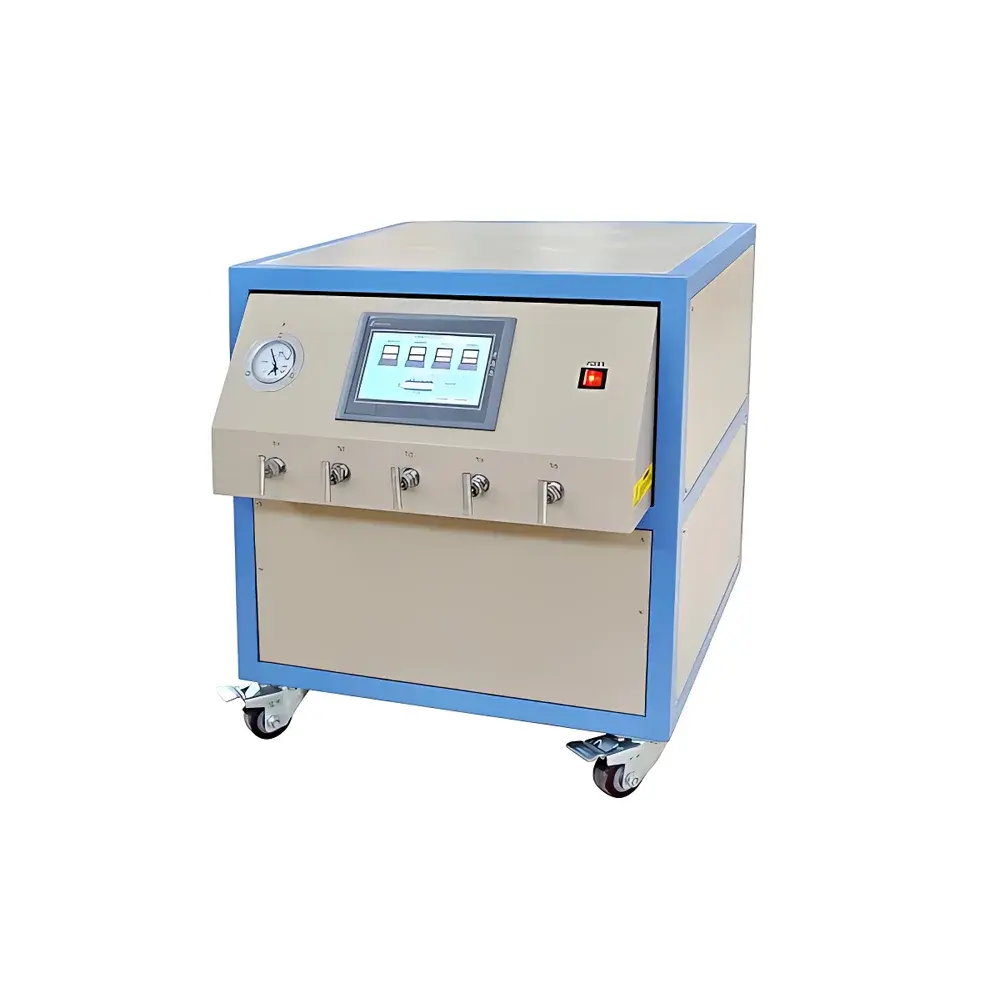
KJ GROUP GSL-LCD Multi-Channel Mass Flow Controller System
| Brand | KJ GROUP |
|---|---|
| Origin | Liaoning, China |
| Manufacturer Type | Authorized Distributor |
| Country of Origin | China |
| Model | GSL-LCD |
| Display | 6" Industrial Touchscreen HMI |
| Power Supply | AC 220 V / 50 Hz, 23 W |
| Dimensions (L×W×H) | 600 × 745 × 700 mm |
| Cabinet Load Capacity | 1000 lbs (454 kg) |
| Operating Temperature | 5–45 °C |
| Max Working Pressure | 3 × 10⁶ Pa (30 bar) |
| Accuracy | ±1.5 % FS |
| Linearity | ±(0.5–1.5) % FS |
| Repeatability | ±0.2 % FS |
| Flow Ranges (configurable per channel) | Channel 1: 0–100 SCCM |
| Channel 2 | 1–199 SCCM |
| Channel 3 | 1–199 SCCM |
| Channel 4 | 1–499 SCCM |
| Channel 5+ | customizable upon request |
| Gas Mixing Vessel | Φ80 × 120 mm 316 stainless steel |
| Tubing | Internal – 1/4" SS |
| Pressure Gauge | Mechanical, -0.1 to 0.15 MPa (0.01 MPa/div) |
| Valves | 316 SS needle valves & shut-off valves |
| Communication | RS485 interface with PC-compatible control software |
| Compliance | Designed for laboratory-scale CVD and thermal processing environments |
Overview
The KJ GROUP GSL-LCD Multi-Channel Mass Flow Controller System is an integrated, cabinet-mounted gas delivery platform engineered for precise, synchronized control of multiple process gases in high-temperature materials synthesis applications. Built upon thermal mass flow measurement principles—where gas-specific heat capacity, temperature differential, and sensor response time enable direct volumetric-to-mass conversion—the system delivers stable, repeatable flow regulation without dependence on downstream pressure or temperature compensation. Its modular architecture supports 2–9 independently controllable channels, each equipped with a calibrated thermal mass flow sensor and proportional control valve. The system is purpose-built for compatibility with tube furnaces and CVD reactors, enabling co-location of gas mixing, regulation, and furnace mounting on a single mobile base—reducing footprint, minimizing gas line dead volume, and improving thermal stability during ramp-hold-cool cycles.
Key Features
- Integrated 6-inch industrial-grade resistive touchscreen HMI providing centralized real-time control and visualization of all channel parameters—including setpoint, actual flow, valve position, and alarm status.
- Embedded RS485 serial interface compliant with Modbus RTU protocol, enabling seamless integration into lab-wide automation frameworks and SCADA systems via optional PC-based control software.
- Stainless steel (316) gas manifold, mixing chamber (Φ80 × 120 mm), and internal 1/4″ tubing ensure chemical inertness and long-term integrity with corrosive or reactive precursors (e.g., NH₃, SiH₄, Cl₂).
- Front-panel mechanical pressure gauge (-0.1 to 0.15 MPa) provides immediate verification of mixing vessel pressure—critical for leak-checking and safe startup/shutdown procedures.
- Robust mobile cabinet rated for 454 kg (1000 lbs), designed to support standard horizontal tube furnaces directly—eliminating floor-space conflicts and reducing vibration coupling between gas delivery and thermal zones.
- Configurable flow ranges per channel (e.g., 0–100 SCCM, 1–199 SCCM, 1–499 SCCM), with factory calibration traceable to NIST-traceable standards; custom ranges available upon request with documented calibration certificates.
Sample Compatibility & Compliance
The GSL-LCD system is routinely deployed in academic and industrial laboratories conducting controlled-atmosphere thermal processing, including chemical vapor deposition (CVD), atomic layer deposition (ALD), annealing, carburizing, and nitriding. It supports common process gases such as Ar, N₂, H₂, O₂, NH₃, CH₄, and SiH₄—subject to material compatibility verification per ISO 10297 and CGA G-4.1 guidelines. While not certified to IEC 61000-6-2/6-4 or ATEX/IECEx for hazardous area use, the system meets general-purpose laboratory safety requirements under ANSI Z535.4 and UL 61010-1. All firmware and HMI logic are structured to support audit-ready operation in GLP-compliant environments, with timestamped event logging and user-access-level controls configurable via password protection.
Software & Data Management
The included Windows-compatible PC software enables remote monitoring, batch parameter loading, and time-synchronized data logging at up to 1 Hz resolution per channel. Logged data exports natively to CSV and can be imported into MATLAB, Python (pandas), or LabVIEW for statistical process analysis. The software supports programmable ramp-and-soak profiles, interlock conditions (e.g., “halt flow if furnace temp exceeds 1100 °C”), and export of calibration metadata—including date, technician ID, and reference standard ID. Audit trail functionality records all configuration changes, user logins, and emergency stops—supporting alignment with FDA 21 CFR Part 11 requirements when deployed in regulated R&D settings.
Applications
- Multi-gas CVD of 2D materials (graphene, MoS₂, h-BN) requiring stoichiometric precursor blending and dynamic ratio modulation.
- Controlled oxidation/nitridation of metal oxides (e.g., NiO, Co₃O₄) and nitrides (TiN, Si₃N₄) under precisely defined pO₂/pN₂ partial pressures.
- Inert-atmosphere annealing of perovskite thin films, where residual O₂/H₂O must be suppressed below 10 ppm via high-purity Ar/N₂ purging with real-time flow verification.
- Sequential gas switching in ALD precursor dosing, leveraging repeatable ±0.2 % FS repeatability to maintain consistent monolayer growth rates across wafer batches.
- Thermal stability testing of catalysts under simulated reforming or Fischer–Tropsch atmospheres using multi-component gas mixtures (e.g., CO/H₂/CO₂/CH₄).
FAQ
Is the GSL-LCD system compatible with third-party tube furnaces from other manufacturers?
Yes—the cabinet’s structural design and standardized mounting interfaces accommodate most commercial horizontal tube furnaces with external dimensions ≤600 mm (L) × 700 mm (W) × 600 mm (H). Mechanical load distribution and vibration isolation have been validated per ISO 22867 for static and dynamic loads.
Can flow calibration be performed in-house, or is it strictly factory-based?
While end-users may perform zero-point verification and span checks using certified reference flows, full recalibration requires traceable primary standards and is recommended annually by KJ GROUP-certified service centers. Calibration certificates include uncertainty budgets per ISO/IEC 17025.
Does the system support analog (0–10 V / 4–20 mA) input for external process synchronization?
No—the GSL-LCD relies exclusively on digital RS485 (Modbus RTU) for command and telemetry. Analog interfacing requires an external signal converter module, which can be supplied as an optional accessory.
What is the maximum allowable gas dew point for reliable operation?
To prevent condensation-induced sensor drift or valve stiction, inlet gas dew point must remain ≥20 °C below ambient operating temperature. For continuous operation at 45 °C ambient, supply gas should be dried to ≤25 °C dew point (e.g., via inline desiccant or refrigerated dryer).
Are firmware updates provided free of charge after purchase?
Yes—KJ GROUP releases firmware updates quarterly via secure download portal, including bug fixes, enhanced logging features, and expanded Modbus register mapping. Updates require no hardware modification and retain all user-configured profiles.



