
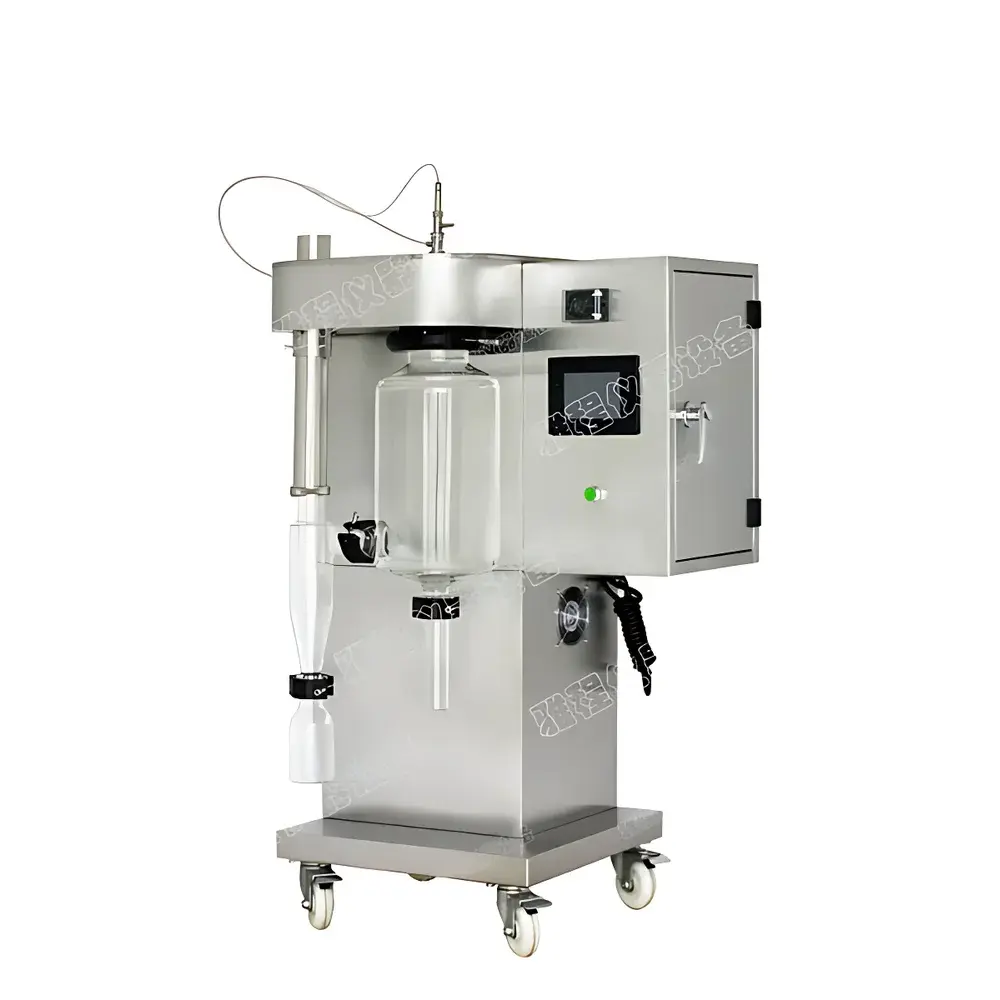
Truelab YC-015 Benchtop Spray Dryer
| Brand | Truelab |
|---|---|
| Origin | Shanghai, China |
| Model | YC-015 / YC-1800 |
| Max Feed Rate | 2000 mL/h |
| Inlet Temperature Range | 30–300 °C |
| Outlet Temperature Range | 30–140 °C |
| Particle Size Distribution | Normal (Dv50 ≈ 1–10 µm) |
| Drying Time | 1.0–1.5 s |
| Temperature Control Accuracy | ±1 °C (PID) |
| Noise Level | <60 dB(A) |
| Power Supply | 3 kW / 220 V (YC-015) |
| Dimensions | 1200 × 650 × 500 mm (H×L×W) |
Overview
The Truelab YC-015 Benchtop Spray Dryer is an engineered solution for laboratory-scale spray drying of thermally sensitive materials—including biologics, herbal extracts, fruit juices, enzymes, and polymer dispersions—using conventional hot-air atomization. It operates on the principle of rapid solvent evaporation via concurrent or counter-current contact between a fine liquid aerosol (generated by a dual-fluid nozzle) and heated process air. The system delivers consistent particle formation in under 1.5 seconds, minimizing thermal exposure while preserving structural integrity and biological activity. Designed for standalone operation in ISO Class 7–8 laboratory environments, the YC-015 integrates inlet/outlet temperature control, real-time feed rate modulation, and automated shutdown logic—all accessible through a 7-inch color LCD touchscreen interface. Its compact footprint (1200 × 650 × 500 mm), all-stainless-steel construction, and borosilicate glass process chamber enable GMP-aligned validation and routine use in academic, pharmaceutical, and food R&D settings.
Key Features
- Two operational modes: fully automated sequence control (one-touch start/stop) and manual parameter override for dynamic process optimization
- PID-based inlet temperature regulation across 30–300 °C with ±1 °C stability; outlet temperature independently controlled from 30–140 °C
- Dual-fluid pneumatic nozzle system with interchangeable orifices (0.5–2.0 mm) for precise droplet size tuning and adaptable to varying viscosities
- Integrated oil-free air compressor delivering consistent atomizing gas pressure without contamination risk
- Transparent high-borosilicate glass drying chamber, cyclone separator, and collection vessel—enabling real-time visual monitoring and rapid cleaning
- Automatic needle-cleaning mechanism (‘clearing pin’) with adjustable frequency to prevent nozzle clogging during high-sugar or viscous feed applications
- Tower wall sweeping system to reduce wall deposition and increase powder recovery efficiency (>90% typical yield)
- Standard 50 mL minimum sample volume capability; feed rate adjustable from 0–2000 mL/h via precision peristaltic pump
- Comprehensive safety logic: automatic heater deactivation upon stop command, except for cooling fan operation to prevent thermal shock and element damage
- Optional upgrades include nitrogen recirculation for organic solvent drying, fluidized bed collector, and 1-µm particulate filtration
Sample Compatibility & Compliance
The YC-015 accommodates aqueous and organic solutions, suspensions, and emulsions with total solids content up to 50% w/w. It is validated for drying heat-labile compounds including monoclonal antibody formulations, probiotic cultures, polysaccharide-rich botanical extracts, and pH-sensitive peptides. Its design conforms to general requirements of ISO 22000 (food safety), USP (sterile processing considerations), and ASTM E2500-13 (user requirement specification for lab equipment). While not intrinsically 21 CFR Part 11 compliant, audit-ready electronic logs—including timestamped temperature profiles, pump speed, airflow, and clearing pin actuation—are exportable in CSV format for GLP/GMP documentation. All wetted surfaces meet FDA 21 CFR 177.2440 (food-contact plastics) and ASME BPE-2021 surface finish standards (Ra ≤ 0.8 µm).
Software & Data Management
The embedded control system features a real-time animated process display showing airflow dynamics, temperature gradients, and feed progression. Parameter sets—including inlet/outlet temperatures, pump RPM, air volume, and clearing pin interval—are stored as named protocols with version history. Each experimental run generates a structured log file containing time-stamped sensor data at 1-second intervals, synchronized with operator-initiated events (e.g., “start”, “pause”, “clean nozzle”). Data export supports direct USB transfer or network upload to local LIMS or ELN platforms. Optional software modules provide statistical trend analysis (e.g., Cp/Cpk for particle size consistency), deviation alerts, and PDF report generation compliant with ALCOA+ principles.
Applications
- Rapid formulation screening of inhalable dry powders (e.g., insulin, corticosteroids) under controlled aerodynamic diameter constraints
- Stabilization of labile nutraceuticals (e.g., curcumin, resveratrol, anthocyanins) via matrix encapsulation using maltodextrin or gum arabic carriers
- Production of uniform microcapsules for controlled-release studies in agrochemical and cosmetic research
- Preparation of catalyst precursors (e.g., metal oxide nanoparticles) from colloidal sols without calcination-induced sintering
- Low-temperature drying of fruit juice concentrates (e.g., pomegranate, acerola) to retain >92% vitamin C and anthocyanin integrity
- Process development for continuous manufacturing pathways aligned with ICH Q5C and Q5E guidelines
FAQ
What is the minimum sample volume required for a valid drying run?
The system supports reproducible operation down to 50 mL of feed solution, provided the total solids concentration is ≥5% w/w.
Can the YC-015 handle ethanol-based solutions?
Yes—when equipped with the optional nitrogen recirculation module (YC-015-N2), it enables safe drying of flammable solvents while maintaining inert atmosphere and explosion-proof compliance.
How does the YC-1800 differ from the YC-015 in thermal management?
The YC-1800 incorporates enhanced thermal insulation and optimized air distribution to achieve stable drying at inlet temperatures as low as 105 °C—critical for sugar-rich matrices that undergo Maillard degradation above 120 °C.
Is remote monitoring supported?
Ethernet connectivity is standard; third-party SCADA integration (e.g., Ignition, LabVIEW) is achievable via Modbus TCP or OPC UA protocol adapters.
What maintenance intervals are recommended for long-term reliability?
Daily: visual inspection of nozzle and glassware; weekly: calibration verification of RTDs and pressure transducers; annually: full compressor service and PID loop re-tuning per ISO/IEC 17025 traceable procedures.



