
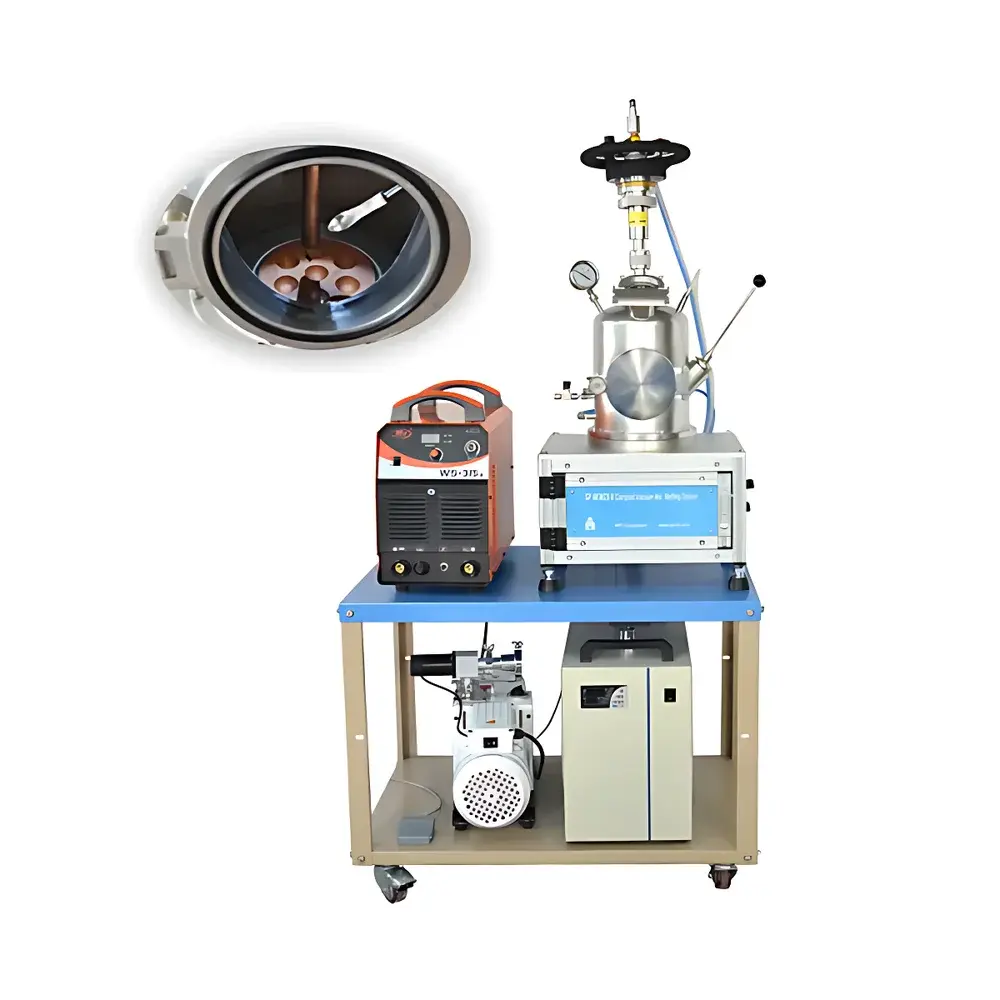
KJ GROUP MSM20-7 Non-Consumable Miniature Metal Arc Melting Furnace
| Brand | KJ GROUP |
|---|---|
| Origin | Liaoning, China |
| Manufacturer Type | Authorized Distributor |
| Country of Origin | China |
| Model | MSM20-7 |
| Power Supply | AC 380 V, 50 Hz |
| Total Power Consumption | <12 kW |
| Vacuum Chamber Dimensions | Ø200 mm × 300 mm |
| Vacuum Level | 10⁻³ mbar (with standard rotary vane pump) |
| Number of Melting Positions | 7 |
| Crucible Diameter | Ø25 mm, depth 8 mm (customizable) |
| Electrode Material | Tungsten (W) |
| Maximum Arc Temperature | up to 3500 °C |
| Operating Current Range | 20–315 A |
| Cooling | Integrated recirculating chiller (KJ-5000, deionized water) |
| Chamber Viewing Ports | Dual front/rear quartz windows |
| Tilting Mechanism | Motorized mechanical arm for in-situ ingot flipping under inert atmosphere |
| Chamber Door Opening | Ø120 mm |
| Footprint | 900 mm × 600 mm × 1800 mm (incl. frame) |
| Net Weight | 50 kg |
| Ambient Requirements | ≤1000 m altitude |
| Protective Atmosphere | High-purity argon (≥99.99 %), supplied via 6 mm double-ferrule fitting |
Overview
The KJ GROUP MSM20-7 Non-Consumable Miniature Metal Arc Melting Furnace is a compact, high-vacuum, inert-atmosphere arc melting system engineered for precise synthesis and purification of refractory metals and advanced alloys. It operates on the principle of direct-current (DC) arc discharge between a non-consumable tungsten electrode and a conductive sample—generating localized plasma temperatures exceeding 3500 °C without electrode erosion. Unlike consumable-electrode systems, the tungsten cathode remains structurally intact across repeated cycles, ensuring long-term stability, compositional fidelity, and minimal contamination risk. Designed for laboratory-scale metallurgical research, the MSM20-7 enables rapid iteration of alloy compositions—including high-entropy alloys (HEAs), nickel-based superalloys, titanium aluminides, and rare-earth intermetallics—under tightly controlled vacuum or purified argon environments. Its modular architecture supports seamless integration into multi-step materials processing workflows, such as pre-alloying prior to directional solidification or powder production.
Key Features
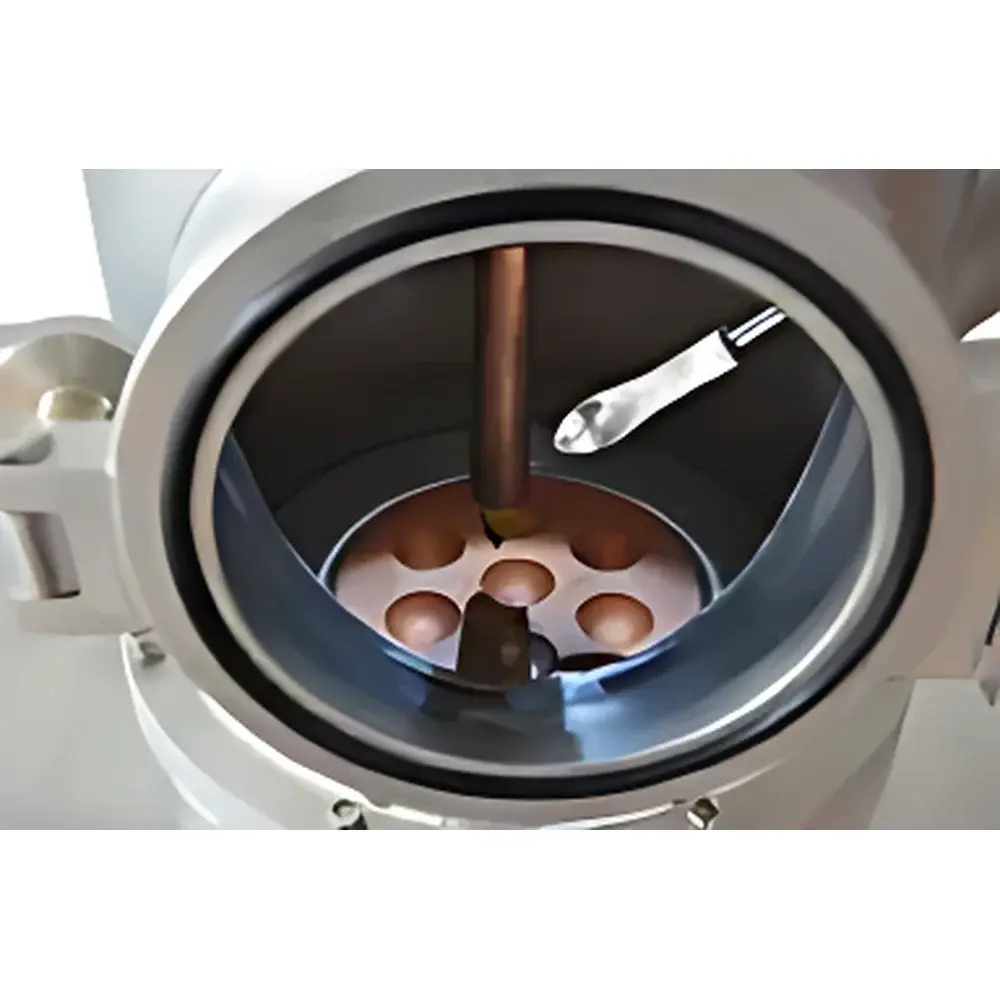
- Seven independent Ø25 mm × 8 mm water-cooled copper crucibles mounted on a rotating carousel—enabling parallel synthesis of up to seven distinct alloy compositions per cycle without cross-contamination.
- Dual quartz observation windows (front and rear) with integrated LED illumination allow real-time visual monitoring of arc ignition, melt pool dynamics, and solidification behavior.
- Motor-driven mechanical tilting arm permits in-situ flipping of solidified ingots within the sealed chamber—facilitating homogenization via multiple remelting passes without breaking inert gas integrity or requiring manual intervention.
- Non-consumable tungsten electrode assembly with precision current regulation (20–315 A DC) and adjustable electrode height control ensures reproducible arc initiation, stable plasma column geometry, and consistent thermal input across all crucibles.
- Integrated KJ-5000 recirculating chiller supplies deionized water at regulated flow and temperature to the electrode, crucible base, and vacuum chamber jacket—maintaining thermal equilibrium and preventing localized overheating during extended operation.
- Front-access Ø120 mm hinged chamber door with metal-sealed O-ring gasket simplifies sample loading/unloading while preserving vacuum integrity and minimizing downtime between runs.
Sample Compatibility & Compliance
The MSM20-7 accommodates metallic elements and intermetallic compounds with melting points below tungsten’s (3422 °C), including but not limited to Fe, Ni, Co, Ti, Al, Cu, Mo, Nb, Ta, Zr, and their binary/ternary combinations. It is routinely employed in ASTM E8/E8M-compliant tensile specimen preparation, ISO 17834-compliant high-temperature alloy qualification, and USP reference material synthesis. All wetted components—including copper crucibles, stainless-steel vacuum chamber, and tungsten electrodes—are compatible with GLP/GMP-aligned documentation practices. Optional high-vacuum configuration (10⁻⁵ mbar) meets requirements for oxygen-sensitive systems such as reactive metal hydrides or metastable phase stabilization. The furnace complies with IEC 61000-6-2 (immunity) and IEC 61000-6-4 (emission) electromagnetic compatibility standards.
Software & Data Management
While the MSM20-7 operates via analog/manual controls for maximum operational transparency and fail-safe reliability, it supports full traceability through external data logging. Analog outputs for arc current, chamber pressure (via optional EQ-PCG-554 digital gauge), and coolant temperature are provided for integration with third-party SCADA or LabVIEW-based acquisition systems. All process parameters—including dwell time per melting cycle, total number of remelts, argon purge duration, and final vacuum hold time—can be recorded in accordance with FDA 21 CFR Part 11 requirements when paired with compliant electronic lab notebooks (ELNs). Optional vacuum gauges include RS485 Modbus RTU output for automated log generation and audit trail preservation.
Applications
- Synthesis and compositional screening of multi-principal-element alloys (MPEAs) and high-entropy alloys (HEAs) for strength-to-density optimization.
- Purification of master alloys prior to casting or additive manufacturing feedstock production.
- Controlled remelting and homogenization of directionally solidified ingots to reduce microsegregation.
- Preparation of calibration standards for XRF, SEM-EDS, and ICP-MS analysis.
- Thermodynamic validation studies involving phase diagram construction via quench-and-analyze methodology.
- Rapid prototyping of novel intermetallic systems for aerospace and nuclear applications where stoichiometric control is critical.
FAQ
What vacuum level is required for optimal arc stability during titanium alloy melting?
For Ti and Ti-aluminide systems, a base pressure ≤5×10⁻³ mbar is recommended prior to backfilling with ≥99.99% argon; optional molecular pumping achieves 10⁻⁵ mbar for ultra-low-oxygen processing.
Can the crucible array be reconfigured for larger single samples?
Yes—custom crucible plates with Ø35 mm or Ø50 mm single-position configurations are available upon request; thermal mass and cooling capacity must be recalibrated accordingly.
Is the tungsten electrode replaceable, and what is its typical service life?
Electrodes are field-replaceable; under nominal operating conditions (200–250 A, 30 s pulse duration), a single tungsten tip sustains >500 melts before requiring resharpening or replacement.
Does the system support automated sequence programming?
No native programmable logic controller (PLC) is included; however, external timers and relay modules can be interfaced via dry-contact I/O terminals for semi-automated multi-step protocols.
What safety certifications does the MSM20-7 carry?
The unit conforms to CE marking requirements (2014/35/EU Low Voltage Directive and 2014/30/EU EMC Directive); full test reports are available upon request for institutional procurement compliance review.



