
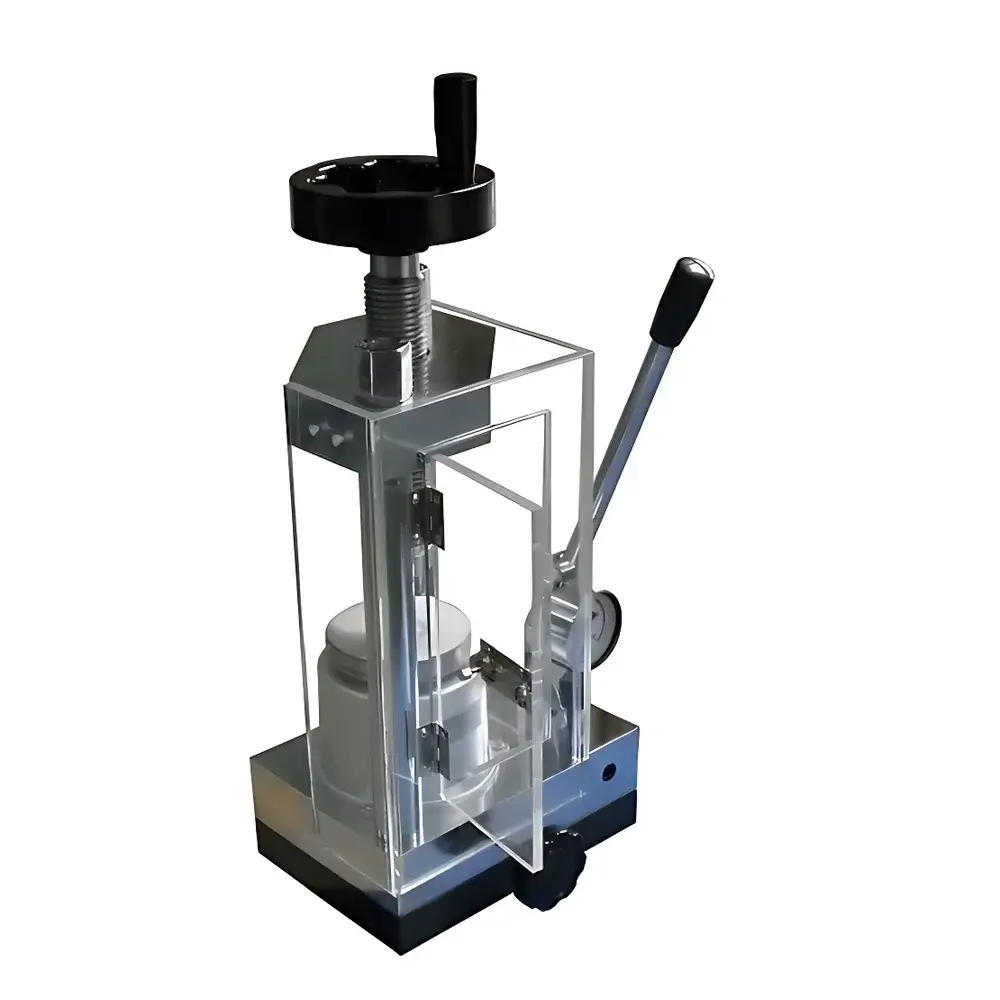
KJ GROUP YLJ-12T Manual Hydraulic Pellet Press
| Brand | KJ GROUP |
|---|---|
| Origin | Liaoning, China |
| Manufacturer Type | Authorized Distributor |
| Country of Origin | China |
| Model | YLJ-12T Manual Hydraulic Pellet Press |
| Instrument Type | Manual Hydraulic Pellet Press |
| Maximum Force | 0–12 Ton (0–117.6 kN) |
| Gauge Pressure Range | 0–38.5 MPa |
| Piston Stroke | ≤20 mm |
| Pressure Stability | ≤1 MPa/5 min |
| Working Chamber Dimensions | 105 mm × 105 mm × 80 mm |
| Unit Dimensions | 280 mm × 160 mm × 300 mm |
| Net Weight | 25 kg |
| Standard Accessories | Lever Handle, Cotter Pin, O-Rings, Fixed Wrench, Hex Key Set |
| Optional Accessories | Cold-Press Dies, Heated Dies |
Overview
The KJ GROUP YLJ-12T Manual Hydraulic Pellet Press is a precision-engineered laboratory-scale hydraulic press designed for reproducible, controlled sample compaction in analytical and materials science workflows. It operates on the principle of static hydraulic force transmission—applying uniform, uniaxial compressive load via a manually actuated lever-driven hydraulic system to consolidate powdered or granular specimens into dense, geometrically defined pellets or cylindrical compacts. Unlike motorized or pneumatic presses, this manual system eliminates electrical dependencies and provides tactile control over loading rate and dwell time—critical for pressure-sensitive samples such as battery cathode precursors, fragile ceramic powders, or hygroscopic catalysts. Its 12-ton (117.6 kN) maximum capacity enables routine preparation of 13–32 mm diameter pellets at pressures up to 38.5 MPa, meeting standard requirements for X-ray fluorescence (XRF), Fourier-transform infrared (FTIR), and wavelength-dispersive spectroscopy (WDS) sample presentation.
Key Features
- Manual lever-actuated hydraulic system delivering rapid, repeatable force application with minimal operator fatigue.
- Pressure-holding architecture engineered for ≤1 MPa drift over 5 minutes—ensuring stable dwell conditions during consolidation without active pressure regulation.
- Robust cast-iron frame with hardened steel platen surfaces and precise parallelism tolerance (<0.02 mm/m), minimizing edge shear and ensuring uniform density distribution across pellet cross-sections.
- Compact footprint (280 × 160 × 300 mm) and low net weight (25 kg) facilitate benchtop integration in shared instrumentation labs, gloveboxes, or fume hoods.
- Integrated safety mechanisms including mechanical stop limits, non-slip base feet, and leak-resistant O-ring seals compliant with ISO 4413 hydraulic fluid system standards.
- Tool-free die exchange capability supported by standardized T-slot platen mounting and modular die retention design.
Sample Compatibility & Compliance
The YLJ-12T accommodates a broad spectrum of inorganic and organic particulates—including metal oxides, lithium-ion battery active materials (e.g., NMC, LFP), geological powders, pharmaceutical excipients, and polymer blends—provided particle size distribution falls within D90 < 150 µm and moisture content remains below 2 wt%. It supports ASTM E1775–22 (Standard Practice for Preparation of Solid Samples for Spectrochemical Analysis) and aligns with ISO 12885:2021 guidelines for pressed-pellet preparation in XRF quantification. When used with certified reference materials (CRMs) and traceable calibration standards, data generated from pellets produced on this press meet GLP documentation requirements for method validation. The unit itself carries CE marking per Machinery Directive 2006/42/EC and conforms to EN 61000-6-2 electromagnetic immunity specifications.
Software & Data Management
As a manually operated hydraulic press, the YLJ-12T does not incorporate embedded electronics, firmware, or digital interfaces. All operational parameters—including applied load (via calibrated pressure gauge), dwell duration, and stroke position—are recorded manually by the user in lab notebooks or electronic lab notebooks (ELNs) compliant with 21 CFR Part 11 audit-trail requirements. This analog architecture ensures zero risk of firmware obsolescence, cybersecurity exposure, or software validation burden—making it particularly suitable for regulated environments where instrument qualification (IQ/OQ/PQ) must remain simple, transparent, and fully traceable. Calibration certificates for the integrated Bourdon-tube pressure gauge are available upon request and recommended annually per ISO/IEC 17025:2017 Clause 6.5.
Applications
- Preparation of homogeneous, binder-free pellets for quantitative XRF analysis of geochemical, metallurgical, and cementitious samples.
- Compaction of electrode slurries and dry powders for electrochemical testing in solid-state battery R&D.
- Forming IR-transparent KBr or polyethylene pellets for mid-FTIR spectral acquisition.
- Producing cylindrical compacts for cold isostatic pressing (CIP) pre-forming or sintering trials in ceramic engineering.
- Generating standardized test specimens for hardness, density, and green strength evaluation under ASTM C773 and ISO 2739.
- Custom die configurations enable fabrication of annular, stepped, or multi-layered compacts for interface studies in composite material development.
FAQ
What is the maximum recommended operating pressure for routine use?
For optimal long-term seal integrity and gauge accuracy, sustained operation above 35 MPa is discouraged; 30–35 MPa represents the recommended upper limit for daily analytical workflows.
Can the YLJ-12T be used inside an argon-filled glovebox?
Yes—the absence of electrical components, oil mist generation, or heat dissipation makes it fully compatible with inert-atmosphere gloveboxes; optional stainless-steel die sets are available for corrosion resistance.
Is pressure calibration traceable to national standards?
The factory-calibrated pressure gauge is traceable to CNAS-accredited laboratories (certificate provided); users may perform field verification using dead-weight testers per ISO 376.
What maintenance intervals are recommended?
Hydraulic oil replacement every 12 months or after 500 operating cycles, O-ring inspection prior to each use, and platen surface cleaning with isopropyl alcohol after every sample batch.
Does KJ GROUP supply custom die designs?
Yes—standardized M6 threaded die cavities support third-party and OEM-designed dies; dimensional drawings and tolerance specifications are available under NDA for collaborative development.
Related Products



