
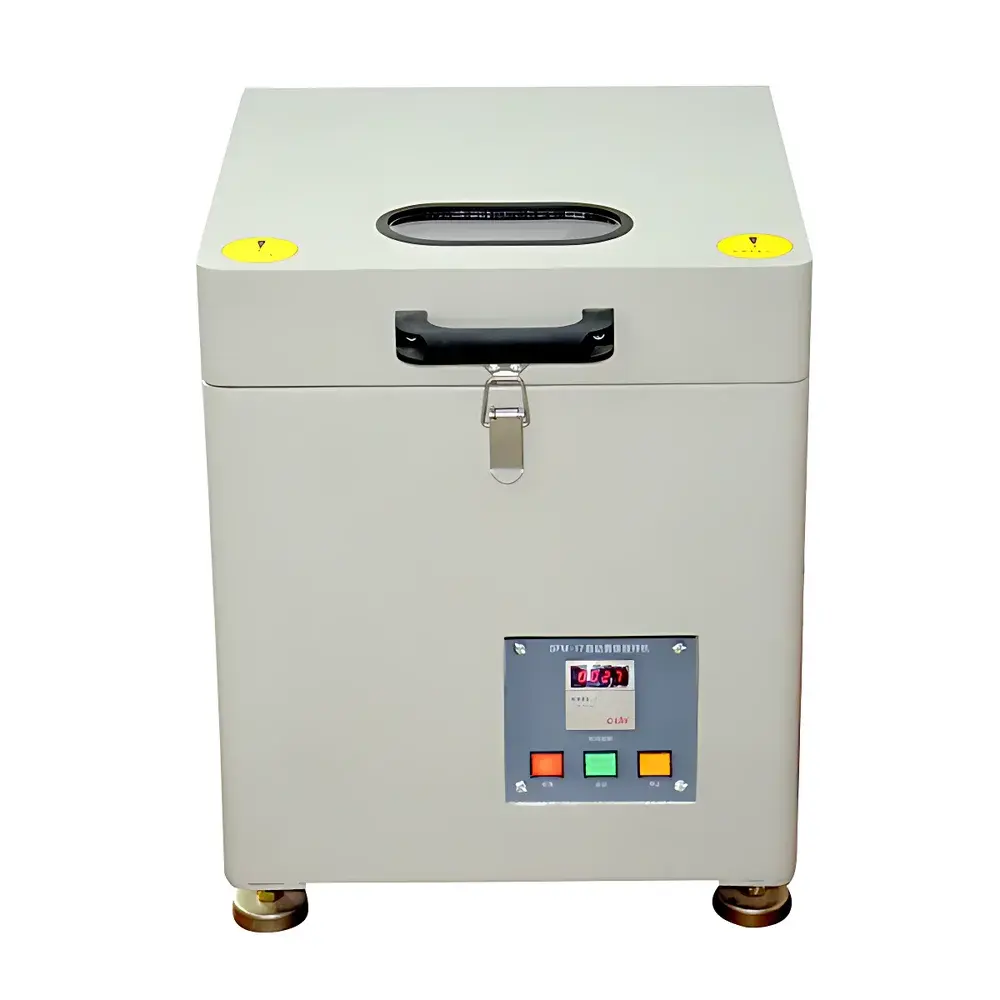
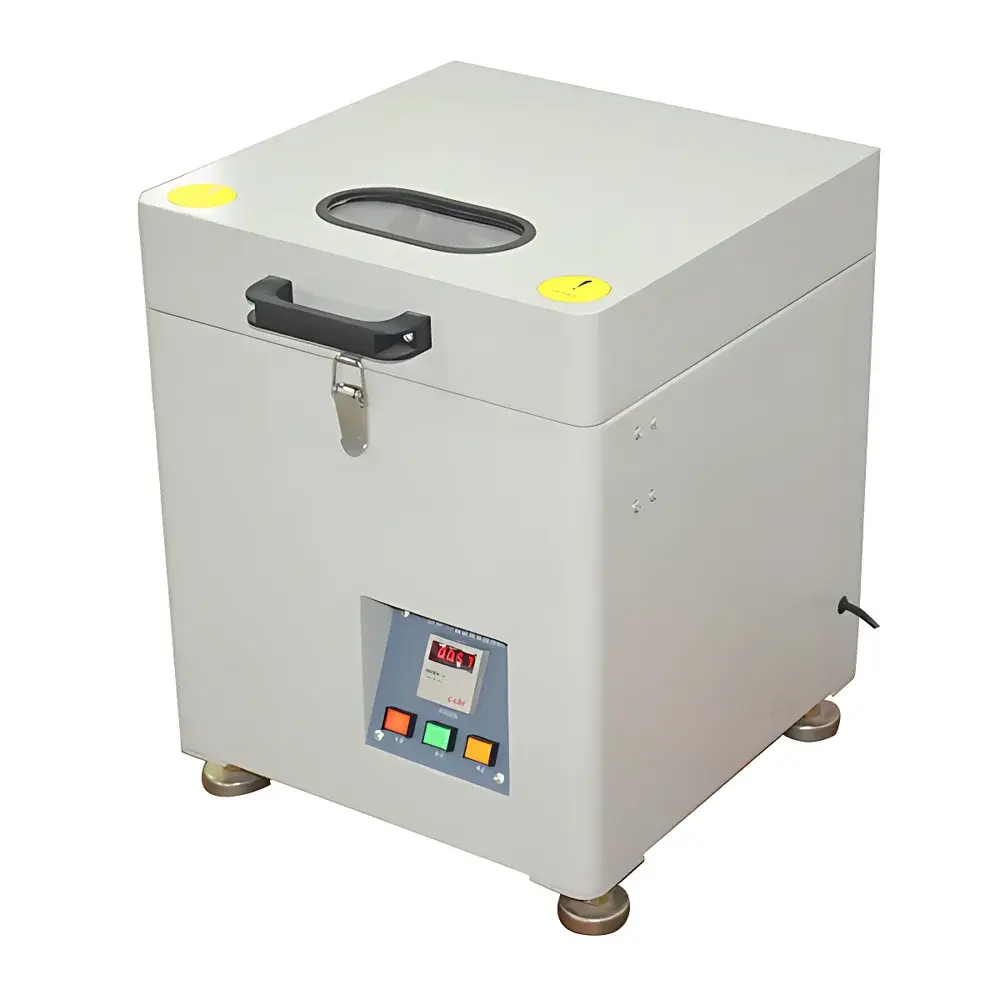
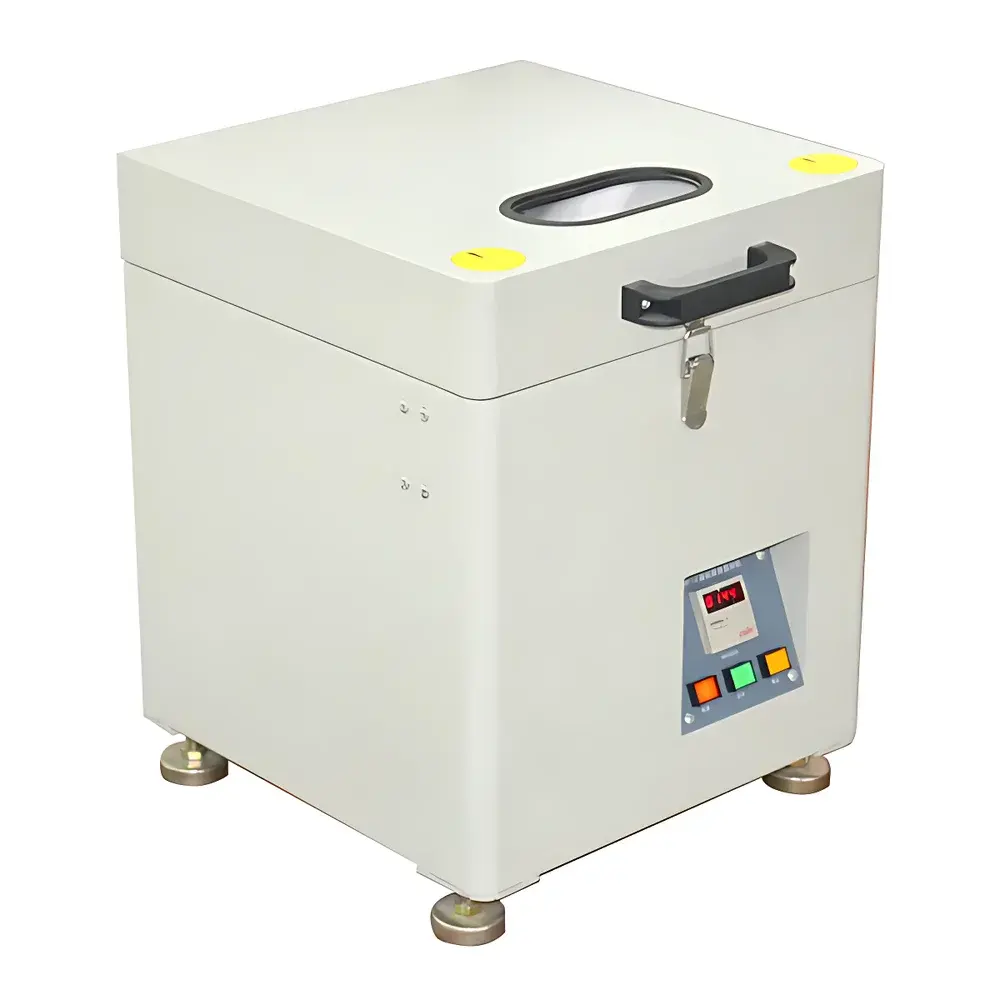
KJ GROUP SFM-17 Automatic Paste Mixer
| Brand | KJ GROUP |
|---|---|
| Origin | Liaoning, China |
| Manufacturer Type | Authorized Distributor |
| Country of Origin | China |
| Model | SFM-17 |
| Quotation | Available Upon Request |
| Mixing Principle | Planetary-Style Dual-Axis Rotation (45° Tilted Vessel) |
| Drive Configuration | Dual-Speed Motor — Main Drive 1350 RPM, Orbital Rotation 500 RPM, Axial Spin 280 RPM |
| Capacity | 2 × 0–1000 g per batch |
| Compatible Canister Sizes | Standard S (Φ53–Φ60 mm), M (Φ60–Φ67 mm), Optional L (Φ67–Φ84 mm) |
| Timing Range | 0.01 s to 99 min 99 s (LED Digital Display) |
| Motor Power | 60 W, Fixed-Speed AC Induction |
| Input Power | AC 220 V ±10%, 50 Hz |
| Dimensions (W×D×H) | 400 × 400 × 520 mm |
| Net Weight | 42 kg |
| Safety Features | Dual Interlock Lid Switch, Reinforced Acrylic View Window, Vibration-Dampening Rubber Feet & Sealing Gaskets |
| Accessories Included | Two 500 g Balance Weights, Adjustable Canister Retention Belt, Two Spare Drive Belts |
Overview
The KJ GROUP SFM-17 Automatic Paste Mixer is an engineered solution for high-reproducibility, low-shear blending of viscous pastes, solder pastes, electrode slurries, ceramic suspensions, and conductive inks in R&D laboratories and pilot-scale production environments. It operates on a mechanically synchronized dual-axis planetary mixing principle: the mixing canister is mounted at a fixed 45° inclination relative to the horizontal plane and undergoes simultaneous orbital rotation (500 RPM) around a central axis while rotating axially (280 RPM) about its own tilted centerline. This configuration generates a controlled, three-dimensional convective flow pattern—resembling a vortex funnel—where material from the upper zone continuously descends along the inner wall, while bottom-layer paste rises centrally, ensuring uniform homogenization without stratification or air entrapment. Unlike conventional vertical-axis mixers, this geometry eliminates paste adhesion to the lid surface and minimizes dead zones, thereby improving batch consistency and reducing cleaning frequency.
Key Features
- Dual-speed precision drive system: Independent control of orbital (500 RPM) and axial (280 RPM) rotational speeds ensures optimal shear profile adaptation for varying rheological profiles—from low-viscosity dispersions to highly thixotropic pastes.
- 45° fixed-tilt canister mounting: Eliminates lid contamination and enables complete gravitational discharge during unloading; supports simultaneous processing of two canisters for parallel batch operation.
- Programmable digital timer with 0.01-second resolution: LED display supports precise time-based process repeatability, critical for DOE-driven formulation development and QC release testing.
- Integrated safety architecture: Dual mechanical/electrical interlocks prevent operation when the lid is unlatched; reinforced acrylic viewport allows real-time monitoring of canister seating integrity and material motion without interrupting the cycle.
- Vibration suppression design: Rubber-isolated base feet and multi-point elastomeric gasketing at the lid interface reduce transmitted vibration by >75% (measured per ISO 5349-1), preserving structural stability during extended mixing cycles.
- Field-serviceable mechanical components: Includes two spare timing belts, adjustable canister retention bands, and calibrated 500 g counterweights to maintain dynamic balance across variable load conditions.
Sample Compatibility & Compliance
The SFM-17 accommodates standard industry canister geometries—S-type (Φ53–Φ60 mm), M-type (Φ60–Φ67 mm), and optional L-type (Φ67–Φ84 mm)—enabling compatibility with common solder paste cartridges (e.g., MP2000 series), battery slurry containers (e.g., NMC/LFP electrode slurries in 50–100 mL cylindrical vessels), and dental/medical paste dispensing vials. Its sealed mixing chamber meets IP54 ingress protection requirements for dust and splashing water resistance. While not certified to IEC 61000-6-2/6-4 for EMC immunity, the device complies with basic electrical safety standards per GB 4793.1–2007 (equivalent to IEC 61010-1:2010) for laboratory equipment. For regulated environments, its repeatable timing logic and mechanical traceability support alignment with GLP documentation workflows and internal SOP validation protocols.
Software & Data Management
The SFM-17 operates via embedded microcontroller-based firmware with no external PC dependency. All operational parameters—including elapsed time, preset duration, motor status, and lid interlock state—are logged locally in non-volatile memory with timestamped event capture (power-on, start, pause, stop, fault). Though it lacks network connectivity or FDA 21 CFR Part 11-compliant electronic signatures, the unit supports audit-ready manual recordkeeping: the LED display retains last-run settings for 72 hours after power-down, and the pause-resume function preserves accumulated mixing time without reset, enabling interruption-tolerant process execution. Users may export timing logs via optional RS-232 serial interface (available as add-on module) for integration into LIMS or MES platforms requiring chronological batch metadata.
Applications
- Electrode slurry preparation for lithium-ion battery R&D: Ensures homogeneous dispersion of active material, conductive carbon, and PVDF binder without particle fracture or solvent evaporation.
- Solder paste mixing and reconditioning: Restores rheological stability in aged or temperature-cycled pastes prior to stencil printing qualification.
- Ceramic green tape casting slurries: Maintains consistent particle suspension and eliminates agglomerates that cause defects in laminated multilayer devices.
- Conductive ink formulation: Achieves uniform distribution of silver/nickel flakes in polymer matrices for printed electronics prototyping.
- Dental composite and orthodontic adhesive pastes: Supports ISO 4049-compliant mixing procedures where viscosity recovery kinetics must remain unaffected by mechanical stress history.
FAQ
What types of paste materials are compatible with the SFM-17?
The mixer is validated for non-corrosive, non-explosive pastes with apparent viscosities ranging from ~10⁴ to 10⁶ mPa·s at shear rates of 1–10 s⁻¹, including solder pastes, battery electrode slurries, ceramic suspensions, and polymer-based conductive inks.
Can the SFM-17 be integrated into automated production lines?
It is designed as a standalone benchtop unit; however, its dry-contact relay outputs (optional) allow synchronization with PLC-controlled conveyance or vacuum loading systems for semi-automated batch handling.
Is calibration required before use?
No periodic calibration is mandated—the timing circuit is factory-trimmed to ±0.02% accuracy over 0–50°C ambient range; users should verify mechanical balance using included 500 g weights before first operation.
How often should the drive belts be replaced?
Under continuous daily use (≤4 hours/day), the polyurethane timing belts exhibit service life exceeding 12 months; visual inspection for cracking or stretching is recommended every 200 operating hours.
Does the unit meet explosion-proof requirements for solvent-based pastes?
No—it is not rated for Class I, Division 1 hazardous locations; use only in well-ventilated areas with flash point >60°C solvents, per NFPA 30 guidelines.



