
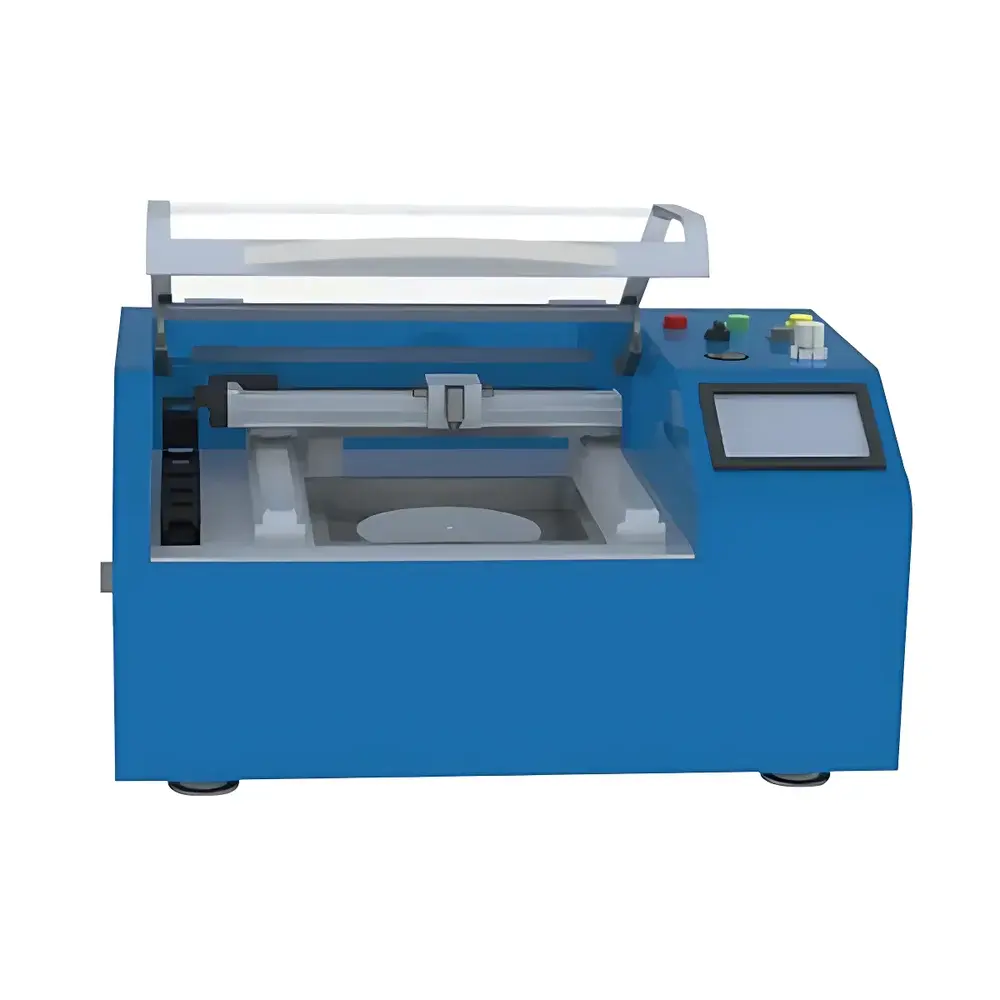
KJ GROUP VTC-100-SE Desktop Dispensing System
| Brand | KJ GROUP |
|---|---|
| Origin | Liaoning, China |
| Manufacturer Type | Authorized Distributor |
| Country of Origin | China |
| Model | VTC-100-SE |
| Pricing | Available Upon Request |
| Hotplate Temperature Range | Room Temp – 150 °C |
| Temp. Resolution | 0.1 °C |
| Temp. Uniformity | ±1% (within operating range) |
| Dispense Flow Rate | 1–20 mL/min |
| XY Linear Stage Speed | 1–200 mm/s |
| Positioning Accuracy | ±0.02 mm |
| Stroke Range | 300 × 300 mm |
| Ultrasonic Atomization Droplet Size | <50 µm |
| Max Substrate Size | 8-inch wafer |
| Footprint | 928 × 800 × 510 mm (W × D × H) |
Overview
The KJ GROUP VTC-100-SE Desktop Dispensing System is an engineered solution for precise, repeatable, and controllable liquid deposition in R&D and pilot-scale microfabrication environments. Designed around a modular platform architecture, it integrates thermal substrate conditioning, high-resolution XY motion control, and dual-mode atomization—supporting both ultrasonic and two-fluid nozzle configurations—to accommodate diverse viscosity profiles and process requirements. Its core operation relies on controlled volumetric dispensing coupled with synchronized stage movement and substrate heating, enabling uniform thin-film formation, patterned adhesive application, or localized functional coating on planar substrates up to 200 mm (8-inch) diameter. The system operates under open-loop process control with calibrated flow and thermal feedback loops, making it suitable for non-GMP laboratory settings where reproducibility, setup flexibility, and rapid prototyping are prioritized over fully automated compliance-grade execution.
Key Features
- Compact desktop footprint (928 × 800 × 510 mm) optimized for Class 1000 cleanroom benchtop integration or general lab use.
- Dual-atomization capability: interchangeable ultrasonic nozzles (droplet size <50 µm) and two-fluid (pneumatic-assisted) nozzles for tunable雾化 efficiency across low-to-medium viscosity fluids (e.g., photoresists, epoxies, conductive inks, hydrogels).
- Heated rotating chuck with PID-controlled temperature regulation from ambient to 150 °C, achieving ≤±1% spatial uniformity across the full 200-mm surface—critical for solvent evaporation kinetics and film crosslinking consistency.
- High-precision XY linear stage driven by servo-controlled electric cylinders, offering 300 × 300 mm travel range, ±0.02 mm repeatability, and programmable velocity (1–200 mm/s) to support raster, spiral, or custom path dispensing routines.
- Adjustable volumetric flow delivery (1–20 mL/min) via calibrated peristaltic or syringe pump interface (not included), compatible with standard Luer-lock fluid paths and chemically resistant tubing (e.g., PTFE, FEP).
- Modular electrical architecture with isolated I/O terminals for external trigger synchronization (TTL), vacuum chuck integration, and optional vision alignment subsystems.
Sample Compatibility & Compliance
The VTC-100-SE accommodates rigid and semi-rigid planar substrates including silicon wafers (up to 200 mm), glass slides, ceramic plates, PCBs, and polymer films. Substrate flatness tolerance is ≤10 µm PV over the active area; warpage beyond this may affect thermal contact uniformity and dispense accuracy. While not certified to ISO 13485 or FDA 21 CFR Part 11, the system supports GLP-aligned documentation practices when paired with external logging software. It complies with CE marking requirements for electromagnetic compatibility (EN 61326-1) and low-voltage safety (EN 61000-6-3). All wetted materials—including nozzle bodies, seals, and fluid path components—are selected for broad chemical resistance (e.g., 316 stainless steel, PEEK, Viton®), facilitating compatibility with common solvents (acetone, IPA, PGMEA), aqueous solutions, and mild acids/bases.
Software & Data Management
The VTC-100-SE operates via a local industrial HMI panel with embedded motion and thermal controllers—no PC dependency required for basic operation. Parameter sets (temperature setpoint, stage speed, dwell time, flow rate) are stored as named recipes (max. 50 slots) with timestamped execution logs exportable via USB. For advanced automation, optional RS-485 or Ethernet/IP communication enables integration into LabVIEW, Python-based control frameworks, or MES systems. Raw positional and thermal data streams are accessible at 10 Hz sampling rate, supporting post-process correlation of dispense geometry with thermal history. Audit trail functionality is not natively embedded but can be implemented externally using third-party SCADA platforms compliant with 21 CFR Part 11 Annex 11 guidelines.
Applications
- Photoresist and lift-off layer deposition for MEMS and semiconductor prototyping.
- Patterned dielectric or encapsulant dispensing in flexible electronics assembly.
- Controlled hydrogel or bioink deposition for 2D cell culture scaffolds and microfluidic device fabrication.
- Adhesive dotting and edge-sealing in optical component bonding (lenses, filters, sensors).
- Functional coating of battery electrode substrates (e.g., slurry overcoat, binder distribution studies).
- Rapid screening of ink formulation rheology and drying behavior under variable thermal conditions.
FAQ
Is the VTC-100-SE compatible with corrosive or high-viscosity fluids?
Yes—when equipped with chemically inert fluid path options (e.g., PTFE tubing, ceramic ultrasonic transducers) and appropriate nozzle orifice sizing. Viscosity limit is ~5000 mPa·s for two-fluid mode; ultrasonic mode is recommended for ≤500 mPa·s.
Can the system be integrated into a Class 100 cleanroom environment?
Yes—the unit meets ISO 14644-1 Class 5 particulate emission limits when operated with HEPA-filtered compressed air (for two-fluid mode) and sealed fluid reservoirs. Optional stainless-steel enclosure upgrades are available.
Does KJ GROUP provide calibration certificates for temperature and positioning?
Factory calibration reports (traceable to NIST-equivalent national standards) are provided with shipment. On-site recalibration services are available upon request through authorized service partners in APAC and EMEA regions.
What file formats are supported for motion path import?
The HMI accepts CSV-formatted coordinate lists (X,Y,Z,flow) and G-code subsets (G0/G1 commands with M-codes for auxiliary functions). DXF import requires optional CAD-to-motion conversion software.
Is vacuum chucking available as a factory option?
Yes—vacuum-compatible chucks with multi-zone suction control (up to 4 zones) and pressure monitoring are offered as configurable add-ons for warped or thin substrates.



