
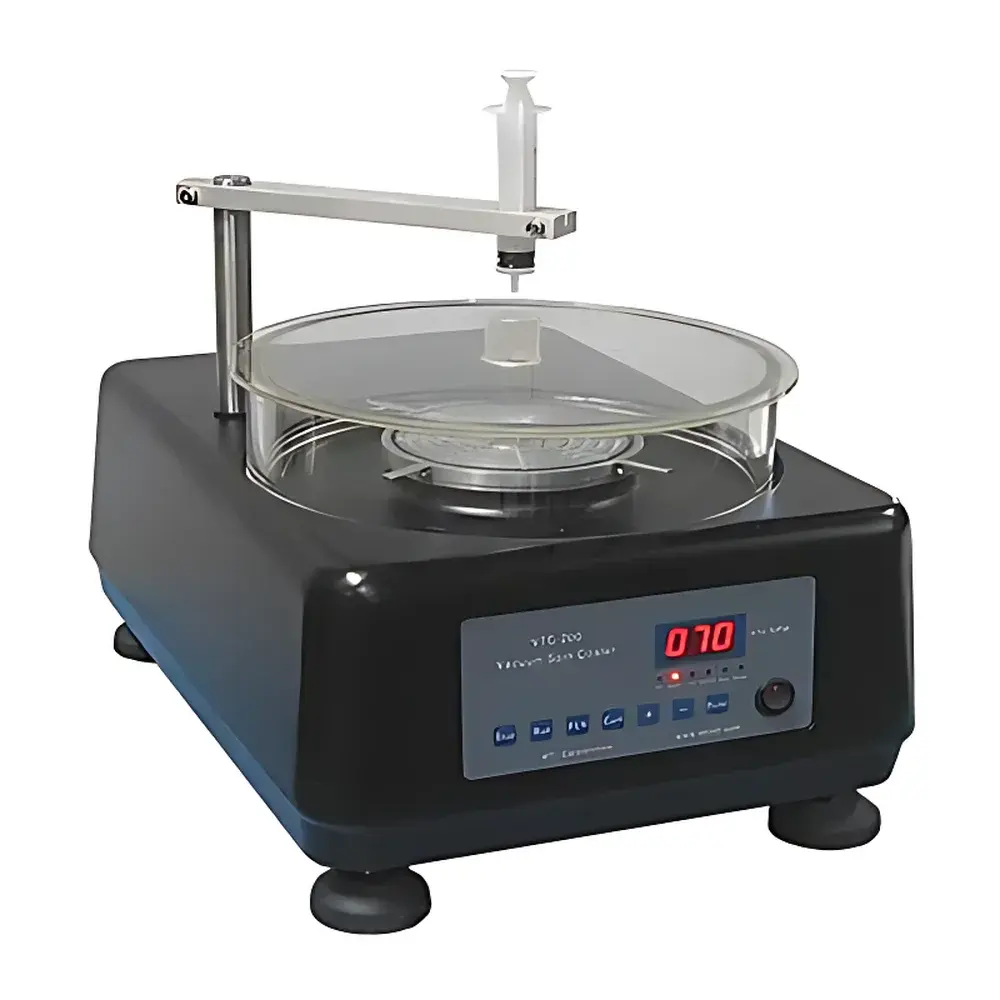
KJ GROUP VTC-200 Vacuum Spin Coater
| Brand | KJ GROUP |
|---|---|
| Origin | Liaoning, China |
| Manufacturer Type | Authorized Distributor |
| Country of Origin | China |
| Model | VTC-200 |
| Price | Upon Request |
| Power Supply | AC 220 V, 50 Hz |
| Max. Speed | 6000 rpm |
| Speed Stability | ±1% |
| Spin Time Range | 1–600 s (per stage) |
| Sample Holder Diameter | φ153 mm (6-inch), optional φ203.5 mm (8-inch) |
| Vacuum Requirement | ≥70 L/min |
| Dimensions (W×D×H) | 500 × 350 × 400 mm |
| Weight | 30 kg |
| Control | Microcontroller-based PCB with keypad & 7-segment LED display |
| Construction | Cast aluminum chassis |
| Rotation Direction | Counter-clockwise |
| Operating Environment | 0–45 °C, 10–85% RH (non-condensing) |
Overview
The KJ GROUP VTC-200 Vacuum Spin Coater is a precision-engineered benchtop instrument designed for reproducible thin-film deposition via centrifugal force-driven solution spreading under controlled vacuum conditions. It operates on the principle of spin coating — a widely adopted technique in materials science, semiconductor research, and optoelectronics — where viscous precursor solutions (e.g., sol-gel precursors, polymer resins, perovskite inks, or photoresists) are dispensed onto a substrate and uniformly distributed across its surface through high-speed rotational shear. The VTC-200 employs a two-stage programmable speed profile: Stage 1 (dispense/spread phase) establishes initial film formation at lower angular velocity with timed dispensing; Stage 2 (spin-dry/leveling phase) accelerates to higher RPM to induce solvent evaporation and thickness control via viscous drag and centrifugal thinning. Vacuum-assisted substrate fixation ensures mechanical stability during acceleration and eliminates air-gap-induced non-uniformity, especially critical for low-adhesion or warped wafers and flexible substrates.
Key Features
- Two-stage programmable rotation control: Independent adjustment of speed (500–6000 rpm) and duration (1–600 s) for both dispense and spin-dry phases, enabling precise optimization of film thickness, uniformity, and morphology.
- Vacuum chuck system: Integrated φ153 mm polypropylene vacuum suction plate with adjustable sealing ring; compatible with standard 6-inch (152.4 mm) substrates; optional 8-inch (203.5 mm) adapter kit available.
- High-stability cast aluminum frame: Minimizes vibration transmission and thermal drift; contributes to ±1% rotational speed accuracy and low acoustic emission (<55 dB(A) at 1 m).
- Dedicated vacuum interface: Designed for connection to oil-free vacuum pumps with minimum pumping capacity of 70 L/min; includes integrated pressure relief valve and vacuum gauge port (optional).
- Benchtop footprint and modular design: Compact dimensions (500 × 350 × 400 mm) and 30 kg mass facilitate integration into fume hoods, gloveboxes, or cleanroom laminar flow stations without structural reinforcement.
- Robust microcontroller-based operation: Keypad navigation with dual 7-segment LED displays for real-time monitoring of setpoints and elapsed time; no PC dependency for routine operation.
Sample Compatibility & Compliance
The VTC-200 accommodates rigid and semi-flexible planar substrates including silicon wafers (up to 200 mm), glass slides, ITO-coated PET, quartz, sapphire, and metal foils. Its vacuum retention force (>0.06 MPa at ≤10 kPa absolute pressure) ensures secure clamping of substrates ≥0.1 mm thickness. The device complies with IEC 61010-1:2010 safety standards for laboratory electrical equipment and meets EMC requirements per EN 61326-1:2013. While not certified for GMP production environments, its repeatable process parameters support GLP-aligned R&D workflows. All wetted components (vacuum plate, drip shield, chamber liner) are chemically resistant to common solvents (IPA, acetone, chlorobenzene, DMF, toluene) and compatible with Class 1000 cleanroom handling protocols when used with appropriate PPE and pre-cleaned substrates.
Software & Data Management
The VTC-200 operates as a standalone instrument with embedded firmware; no proprietary software is required for basic operation. However, it supports optional RS-232 serial output (TTL-level, 9600 bps, N-8-1) for external logging of run timestamps, speed setpoints, and cycle completion signals — facilitating integration into lab information management systems (LIMS) or custom Python/Matlab automation scripts. For audit-trail compliance in regulated development labs, users may pair the unit with third-party data acquisition hardware that records time-stamped operational events in accordance with FDA 21 CFR Part 11 principles (electronic signatures, data integrity, and change control). Firmware updates are performed via ISP programming interface upon request from KJ GROUP technical support.
Applications
- Preparative deposition of uniform organic photovoltaic (OPV) active layers (e.g., P3HT:PCBM, PTB7-Th:IEICO-4F).
- Spin-casting of metal oxide thin films (TiO₂, ZnO, NiOₓ) for perovskite solar cell electron/hole transport layers.
- Photoresist coating on silicon wafers prior to UV lithography in microfabrication prototyping.
- Functional coating of biosensor substrates with conductive polymers (PEDOT:PSS) or enzyme-immobilized hydrogels.
- Rapid screening of ink formulation rheology by correlating spin speed, time, and resulting film thickness (measured ex situ via profilometry or ellipsometry).
- Education and training in thin-film physics, surface engineering, and nanomaterials processing laboratories.
FAQ
What vacuum pump specifications are mandatory for reliable operation?
A dry (oil-free) vacuum pump with ≥70 L/min free-air displacement and ultimate vacuum ≤10 kPa (absolute) is required. Recommended models include KNF NRP series or Welch 2044; rotary vane pumps with hydrocarbon oil are discouraged due to potential backstreaming contamination.
Can the VTC-200 accommodate irregularly shaped or non-circular substrates?
No — the vacuum chuck geometry and rotational dynamics assume planar, axisymmetric samples. Non-circular or highly contoured substrates may experience uneven clamping or centrifugal imbalance, risking slippage or motor overload.
Is the unit suitable for use inside a nitrogen-purged glovebox?
Yes, provided the glovebox has a dedicated vacuum feedthrough rated for ≥10 kPa differential pressure and the pump is located externally with appropriate gas-tight tubing (e.g., reinforced silicone or PTFE-lined hose).
Does the VTC-200 support automated liquid dispensing integration?
Not natively — dispensing is manual via included syringe-type dropper. However, the T1 timing window can be synchronized with external peristaltic or piezoelectric dispensers using the RS-232 trigger signal.
What maintenance intervals are recommended for long-term reliability?
Vacuum seal rings should be inspected every 200 cycles and replaced annually; bearing lubrication is factory-sealed and non-serviceable; electrical connections and fuse (10 A, φ5 × 20 mm) should be verified during quarterly safety checks.



