
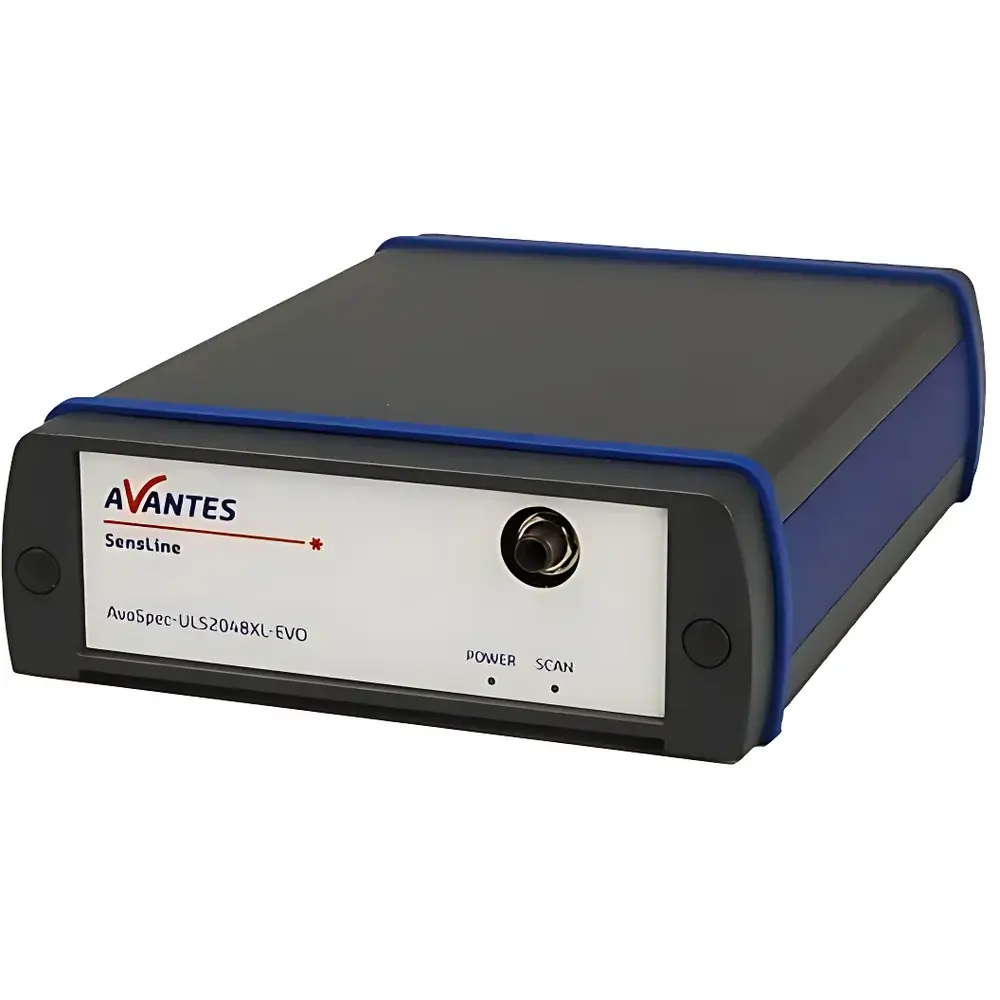
Avantes AvaSpec-ULS2048XL-EVO Fiber Optic Spectrometer
| Brand | Avantes |
|---|---|
| Origin | Netherlands |
| Model | AvaSpec-ULS2048XL-EVO |
| Spectral Range | 200–1160 nm |
| Detector | Back-Illuminated CCD (2048 pixels) |
| Optical Resolution (FWHM) | 0.09–20 nm (dependent on grating and slit width) |
| Sensitivity | 460,000 counts/µW per ms integration time |
| Signal-to-Noise Ratio | 525:1 |
| Dynamic Range | 3800 |
| Stray Light | < 0.3% |
| Integration Time | 2 µs – 20 s |
| AD Converter | 16-bit, 1 MHz |
| Data Interface | USB 3.0 (5 Gbps) and Gigabit Ethernet (1 Gbps) |
| Sampling Speed | 2.44 ms per scan |
| Optical Platform | ULS (Ultra-Low Stray Light) Czerny-Turner, 75 mm focal length |
| UV Quantum Efficiency | 60% (200–300 nm) |
| Dimensions & Weight | 175 × 127 × 44.5 mm, 1180 g |
Overview
The Avantes AvaSpec-ULS2048XL-EVO is a high-performance fiber optic spectrometer engineered for demanding spectroscopic applications requiring simultaneous high quantum efficiency, low stray light, and rapid spectral acquisition. Based on a symmetrical Czerny-Turner optical design with a 75 mm focal length and Ultra-Low Stray Light (ULS) architecture, the instrument achieves optical rejection of stray radiation to < 0.3% — critical for quantitative absorbance, fluorescence, and reflectance measurements across broad spectral domains. Its back-illuminated linear CCD detector features large 14 × 500 µm pixels, delivering exceptional responsivity in both deep UV (200–400 nm) and extended NIR (950–1160 nm) regions — a configuration distinct from conventional area-scan back-thinned CCDs. The integrated electronic shutter enables microsecond-level temporal resolution (down to 2 µs), supporting time-resolved studies such as plasma diagnostics, laser-induced breakdown spectroscopy (LIBS), and fast kinetic monitoring in chemical reaction systems.
Key Features
- Ultra-low stray light optical platform (< 0.3%) optimized for high-fidelity absorbance and transmission measurements per ISO 17025-compliant laboratory workflows.
- Back-illuminated 2048-pixel linear CCD with 60% quantum efficiency at 200–300 nm — enabling reliable UV quantification without deuterium lamp stabilization or frequent recalibration.
- Flexible resolution tuning: FWHM selectable between 0.09 nm and 20 nm via interchangeable gratings (up to 3600 l/mm) and slit widths (10–500 µm), validated against NIST-traceable emission line standards.
- Dual high-speed data interfaces: USB 3.0 (5 Gbps) and Gigabit Ethernet (1 Gbps), supporting synchronized multi-channel acquisition and remote operation in industrial process control environments.
- Onboard I/O interface (HD-26 connector) with 2 analog inputs, 2 analog outputs, 3 digital inputs, and 12 digital outputs — enabling hardware triggering, external shutter control, and integration into automated sampling stages or PLC-controlled analytical lines.
- Robust mechanical design: Aluminum housing with thermal mass optimization, rated for continuous operation under ambient temperature fluctuations (15–35 °C) and compliant with IEC 61326-1 for EMC in laboratory and light industrial settings.
Sample Compatibility & Compliance
The AvaSpec-ULS2048XL-EVO interfaces seamlessly with standard SMA 905 fiber-optic probes (core diameters up to 1000 µm), liquid cuvette holders, integrating spheres (e.g., AvaSphere-50-REFL), and reflection probes for solid, liquid, and gaseous sample analysis. Its spectral coverage (200–1160 nm) supports ASTM E308-22-compliant colorimetry, USP UV-Vis method validation, and ISO 13406-2-compliant optical density verification. The instrument’s firmware and driver stack are compatible with GLP/GMP audit requirements: full metadata logging (wavelength calibration date, grating ID, slit setting, integration time), timestamped spectra, and non-modifiable binary data export (.avd format) ensure traceability. While not FDA 21 CFR Part 11-certified out-of-the-box, its software development kit (SDK) supports implementation of electronic signatures, audit trails, and role-based access controls when deployed within validated LIMS or ELN ecosystems.
Software & Data Management
Bundled AvaSoft-Basic and AvaSoft-Full provide intuitive spectral acquisition, real-time baseline correction, peak detection, and mathematical operations (e.g., derivative spectroscopy, ratioing, multivariate regression). Raw data exports support ASCII (.txt), CSV, and HDF5 formats — ensuring compatibility with MATLAB, Python (via avaspec PyPI package), and JMP for advanced chemometric modeling. The SDK includes C++, C#, LabVIEW, and Python APIs, enabling custom integration into automated QA/QC pipelines or OEM instrumentation. All spectral acquisitions embed EXIF-like metadata (detector temperature, grating position, slit width, lamp reference ID), facilitating automated reprocessing and cross-instrument comparability in multi-site deployments.
Applications
- UV-Vis-NIR Quantitative Analysis: Concentration determination of pharmaceutical actives (e.g., paracetamol, ibuprofen) per ICH Q2(R2) guidelines using dual-beam referencing and photometric accuracy validation.
- Plasma & Laser Diagnostics: Time-gated spectral acquisition for electron temperature and species identification in low-pressure plasma reactors and pulsed laser ablation systems.
- LED & OLED Characterization: Radiometric measurement of spectral power distribution (SPD), CCT, and CRI with NIST-traceable irradiance calibration options.
- Environmental Monitoring: In-situ water quality analysis (NO₃⁻, DOC, CDOM) using submersible fiber probes coupled to flow cells.
- Material Science: Thin-film thickness mapping via interference fringe analysis and optical constant extraction using Tauc plot methodologies.
FAQ
What calibration options are available for traceable radiometric or photometric measurements?
Avantes offers factory-installed NIST-traceable irradiance (W/cm²/nm) and radiance (W/sr/cm²/nm) calibrations, performed using calibrated deuterium-halogen sources and integrating sphere standards. Optional yearly recalibration services include uncertainty reporting per ISO/IEC 17025.
Can the AvaSpec-ULS2048XL-EVO operate in a vacuum or controlled atmosphere environment?
The standard unit is rated for ambient air operation only. For inert gas purging (e.g., N₂ to suppress UV ozone absorption below 220 nm), optional quartz window upgrades and sealed fiber feedthroughs are available upon request.
Is it possible to synchronize multiple AvaSpec units for hyperspectral imaging or multi-angle reflectance?
Yes — via TTL trigger signals routed through the HD-26 I/O port or network-based PTP (Precision Time Protocol) over Gigabit Ethernet, enabling sub-millisecond inter-unit timing alignment for spatially resolved spectroscopy setups.
How does the sensitivity enhancement lens affect optical resolution and wavelength accuracy?
The lens increases photon throughput by ~60% when paired with ≥400 µm core fibers but introduces no spectral shift or resolution degradation; all calibration coefficients remain valid post-installation as the lens operates outside the collimated beam path.





