
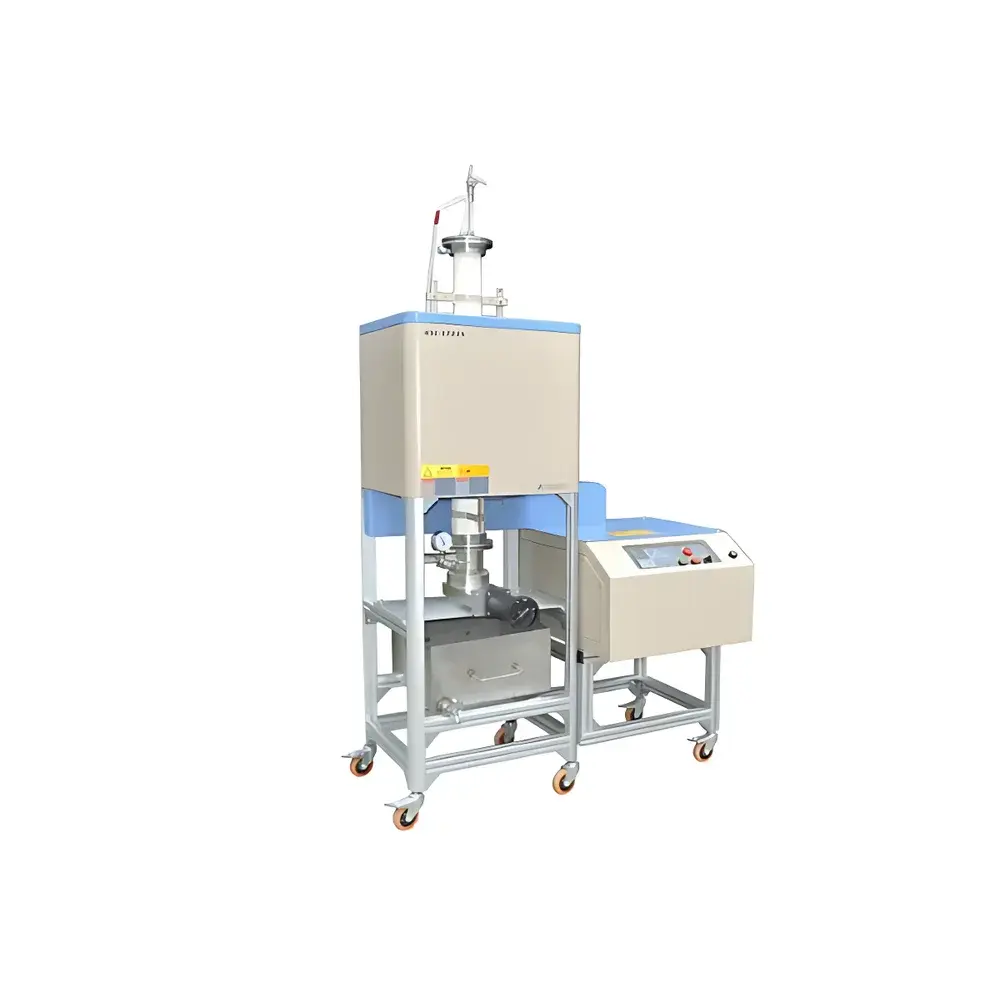
KJG GSL-1700X-VTQ Vertical Vacuum Tube Quenching Furnace
| Brand | Hefei KJG |
|---|---|
| Origin | Anhui, China |
| Model | GSL-1700X-VTQ |
| Maximum Temperature | 1700 °C |
| Temperature Accuracy | ±5 °C |
| Max. Heating Rate | 5 °C/min above 1200 °C |
| Rated Power | 4 kW |
| Input Voltage | 220 V AC, 50/60 Hz |
| Tube Dimensions (Std.) | OD 60 mm × ID 54 mm × L 850 mm (Alumina) |
| Heating Zone Length | 130 mm |
| Uniform Temperature Zone | 65 mm |
| Heating Elements | 4 × U-shaped MoSi₂ rods |
| Temperature Controller | 30-segment PID programmable controller with over-temperature alarm |
| Vacuum System | KF-25 flange, mechanical pump (50 mTorr), optional high-vacuum system (10⁻⁵ Torr) |
| Quenching Mechanism | Electromagnetic sample release into sealed liquid bath (argon-purged) |
| Safety Certifications | CE, UL/MET/CSA compliant (>24 V components), UL-listed furnace assembly |
Overview
The KJG GSL-1700X-VTQ is a vertically oriented, vacuum-capable tube quenching furnace engineered for controlled rapid thermal cycling of advanced materials under inert or reduced-pressure atmospheres. It operates on the principle of gravity-assisted vertical sample drop into a sealed, argon-purged quenching medium—enabling precise replication of non-equilibrium solidification and phase transformation kinetics. Designed for metallurgical, ceramic, and functional materials research, the furnace integrates a high-purity alumina tube (OD 60 mm, L 850 mm), dual-zone vacuum sealing (top KF-25 flange with stainless steel needle valve and analog pressure gauge; bottom manual gate valve), and an electromagnetic sample suspension/release mechanism rated for up to 500 g. Its double-walled steel housing—lined with high-density alumina fiber insulation—ensures surface temperatures remain below 65 °C during operation at 1700 °C, meeting IEC 61000-3-2 harmonic emission limits and UL 61010-1 safety requirements for laboratory equipment.
Key Features
- UL-certified vertical architecture with integrated vacuum and quenching subsystems—fully compliant with ANSI Z535.4 hazard communication standards.
- MoSi₂ heating elements (4 × U-shaped configuration) delivering stable thermal profiles across a 130 mm heating zone and 65 mm uniformity zone (±5 °C at 1650 °C).
- PID-based 30-segment programmable temperature controller with RS485 interface, configurable ramp/soak profiles, and real-time over-temperature cutoff (hardware-latched at 1750 °C).
- Dual-vacuum capability: base vacuum ≤50 mTorr with standard rotary vane pump; optional turbomolecular pumping system achieves ≤1×10⁻⁵ Torr—suitable for oxide-sensitive synthesis (e.g., Ni-based superalloys, MAX phases).
- Quenching module includes argon-purge inlet (5 psi regulated), manually actuated bottom gate valve, and electromagnetically triggered sample release into a sealed stainless-steel liquid bath—eliminating atmospheric contamination during transition.
- Comprehensive safety architecture: grounded double-shell enclosure, redundant thermal fuses, interlocked vacuum/valve sequencing logic, and CE/UL/MET/CSA certification for all >24 V electrical components.
Sample Compatibility & Compliance
The GSL-1700X-VTQ accommodates cylindrical samples up to Ø50 mm × 100 mm in length, suspended via tungsten or molybdenum wire hangers compatible with inert gas environments. It supports quenching media including deionized water, ethylene glycol–water mixtures, and mineral oil—each contained within a leak-tight, corrosion-resistant stainless-steel reservoir. The system meets ASTM E1113 (Standard Practice for Calibration of High-Temperature Furnaces) and ISO/IEC 17025 traceability requirements when paired with NIST-traceable B-type thermocouples. Vacuum integrity complies with ISO 2859-1 sampling plans for leak testing, and the furnace’s control firmware supports audit trails per FDA 21 CFR Part 11 when used with optional PC software (sold separately). All structural welds conform to ASME BPVC Section VIII Division 1 for pressure boundary integrity under inert gas overpressure conditions.
Software & Data Management
An optional RS485-to-USB interface module enables integration with KJG’s proprietary LabFurnaceControl™ software (Windows 10/11 compatible), supporting full remote monitoring, real-time temperature curve logging (≥1 Hz sampling), and export to CSV/Excel formats. The software enforces user-level access control (admin/operator modes), maintains immutable run logs with timestamps and operator IDs, and generates PDF reports compliant with GLP documentation standards. When configured with the optional digital Pirani/cold cathode vacuum gauge (range: 3.8×10⁻⁵–1125 Torr), pressure data is synchronized with thermal profiles—enabling correlation of quench rate with partial pressure effects on martensitic transformation onset. Firmware updates are delivered via signed binary packages verified using SHA-256 checksums.
Applications
- Phase transformation studies: time-temperature-transformation (TTT) and continuous-cooling-transformation (CCT) diagram construction for steels, Ti alloys, and shape-memory alloys.
- Microstructure quenching: arresting metastable phases (e.g., retained austenite, ε-carbides) for subsequent TEM/EBSD analysis.
- Ceramic sintering & densification: rapid thermal processing of SiC, AlN, and ZrO₂ under controlled oxygen partial pressure.
- Thermal shock resistance evaluation: standardized ASTM C1525 cyclic quench testing of refractory coatings and composites.
- Pre-oxidation and scale formation kinetics: in-situ oxidation followed by immediate quenching to preserve transient oxide morphologies.
FAQ
What vacuum level is achievable with the standard configuration?
The base system—equipped with a single-stage rotary vane pump—achieves ≤50 mTorr. For applications requiring ultra-high vacuum (e.g., reactive metal processing), optional turbomolecular pumping stations deliver ≤1×10⁻⁵ Torr.
Can the furnace operate continuously at 1700 °C?
The maximum rated duty cycle at 1700 °C is 1 hour per cycle. Prolonged operation above 1650 °C requires scheduled cooling intervals to maintain MoSi₂ element longevity and thermal insulation integrity.
Is the quenching liquid container accessible for cleaning or media replacement?
Yes—the stainless-steel bath is mounted externally via KF-25 flanged ports and can be disassembled without furnace cooldown. All wetted surfaces are electropolished to Ra < 0.4 µm for residue-free maintenance.
Does the system support automated quench timing synchronization with thermal profiles?
Not natively. Sample release is manually triggered via front-panel button; however, the optional PC software allows scripted event triggering based on real-time temperature thresholds.
What certifications apply to the vacuum and electrical subsystems?
All >24 V components carry UL 61010-1, MET, and CSA marks. The complete furnace assembly is UL Listed (E491100). CE marking covers EMC Directive 2014/30/EU and LVD Directive 2014/35/EU. TÜV Rheinland certification is available upon request (customer-funded).



