
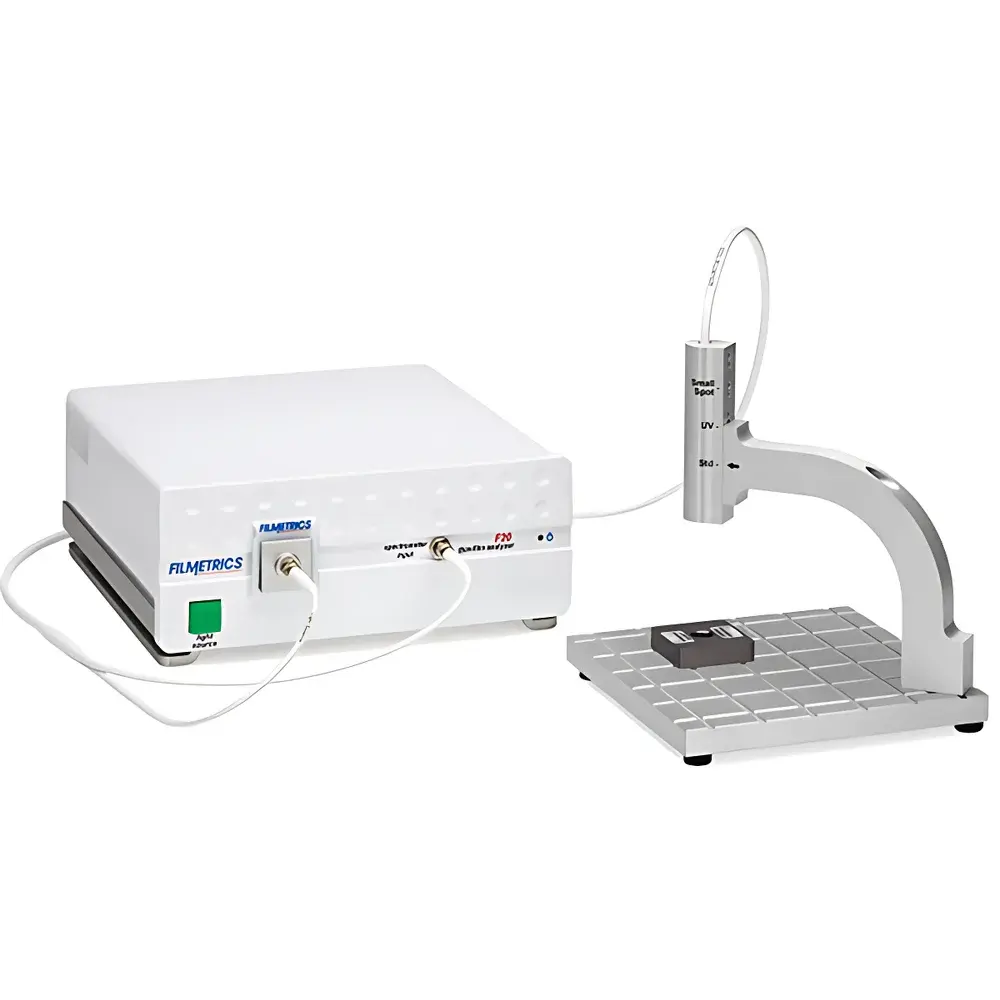
KLA Filmetrics F20 Desktop Thin-Film Thickness and Refractive Index Measurement System
| Brand | KLA |
|---|---|
| Origin | Germany |
| Distributor Type | Authorized Distributor |
| Origin Category | Imported Instrument |
| Model | F20 |
| Price | USD 27,500 (FOB Hamburg) |
Overview
The KLA Filmetrics F20 is a benchtop optical thin-film metrology system engineered for rapid, non-contact, and non-destructive measurement of film thickness and refractive index across single- and multi-layer stacks. It operates on the principle of spectral reflectance analysis—illuminating the sample with broadband visible–near-infrared light (typically 380–1050 nm), capturing the interference pattern in the reflected spectrum, and fitting the data to a physical optical model using rigorous Fresnel equations. This enables sub-nanometer thickness resolution and high reproducibility (<0.1% RSD for repeat measurements on SiO₂ on Si) without requiring vacuum, cryogenics, or complex alignment. Designed for integration into R&D labs, pilot lines, and QC environments, the F20 delivers quantitative optical constants in under one second per measurement—making it suitable for high-throughput screening, process development, and inline monitoring support.
Key Features
- Single-button operation with real-time thickness and n/k (refractive index/extinction coefficient) output
- USB-powered interface—no external power supply or dedicated controller required
- Plug-and-play compatibility with Windows 10/11 (64-bit) via native USB 2.0 connection
- Modular optical head design supporting interchangeable illumination/detection optics for varying spot sizes (down to 10 µm) and working distances
- Integrated XYZ manual stage with fine-thread micrometers (±1 µm repeatability) and optional motorized upgrade path
- Factory-calibrated using NIST-traceable Si/SiO₂ reference wafers; no user recalibration needed for standard films
Sample Compatibility & Compliance
The F20 supports transparent, semi-transparent, and weakly absorbing films on reflective (e.g., Si, Al, Cr) or transmissive (e.g., fused silica, BK7, sapphire) substrates. Typical measurable thickness ranges span 1 nm to 50 µm, depending on material dispersion and substrate reflectivity—e.g., SiO₂ on Si (1–5000 nm), photoresist on Si (100 nm–10 µm), ITO on glass (50–2000 nm). The system complies with ISO/IEC 17025 calibration traceability requirements when used with certified reference standards. All measurement data logs include full spectral acquisition metadata (wavelength array, raw intensity, fit residuals), satisfying GLP documentation needs for regulated environments. While not FDA 21 CFR Part 11–certified out-of-the-box, audit trails, user access controls, and electronic signature support are available through Filmetrics’ optional Compliance Pack (v5.4+).
Software & Data Management
Filmetrics’ proprietary F20 Software (v5.4.x) provides an intuitive GUI for measurement setup, model definition (single-layer, bilayer, graded, or custom stack), and real-time curve fitting. It includes built-in optical constant databases (e.g., Palik, SOPRA) and supports user-defined dispersion models (Cauchy, Sellmeier, Tauc-Lorentz). Batch measurement mode enables automated mapping across wafer or substrate grids (via external stage triggers or CSV coordinate import). Export options include CSV, XML, and HDF5 formats—compatible with MATLAB, Python (NumPy/Pandas), and LIMS integration. Raw spectra and fit reports are timestamped, user-tagged, and stored in a relational SQLite database with configurable backup policies and SQL query support.
Applications
- Process development and monitoring of PECVD, sputtering, ALD, and spin-coated films in semiconductor and MEMS fabrication
- Quality control of anti-reflective, hard-coat, and conductive oxide layers on display glass and solar substrates
- R&D of organic photovoltaic (OPV) active layers and perovskite thin films
- Characterization of biofunctional coatings (e.g., SiO₂, TiO₂, polymer brushes) on biosensor surfaces
- Educational use in materials science and optical engineering laboratories for teaching thin-film interference theory
FAQ
What wavelength range does the standard F20 model cover?
The base F20 configuration uses a tungsten-halogen source and silicon detector covering 380–1050 nm. Optional extended-range modules support UV (250–380 nm) or NIR (1050–1700 nm) configurations.
Can the F20 measure films on flexible or curved substrates?
Yes—within mechanical limits of the stage travel and optical working distance. For highly non-planar samples, optional fiber-coupled probe heads or custom focusing optics can be deployed.
Is training and application support included with purchase?
All systems ship with remote installation assistance and a 2-day virtual application workshop. Onsite training and method development consulting are available as billable services.
How is measurement uncertainty determined for a given film/substrate combination?
Uncertainty is calculated post-fit using propagation-of-error analysis based on spectral noise, model parameter correlation, and reference standard uncertainty—reported automatically in the measurement summary.
Does the F20 require periodic recalibration?
No routine recalibration is required. Stability is verified annually using factory-provided reference wafers; drift checks can be performed in <30 seconds using the built-in “Quick Check” utility.



