
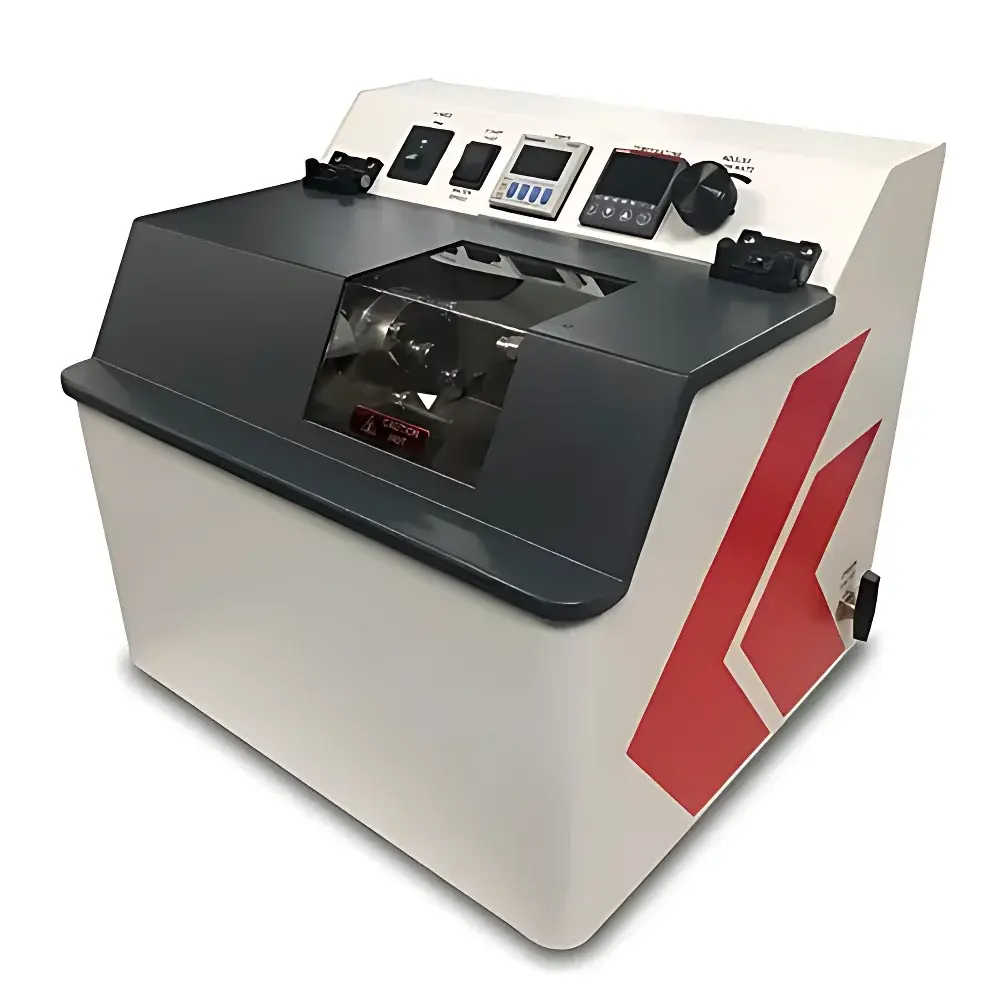
Koehler K19291 Grease Water Washout Tester
| Brand | Koehler |
|---|---|
| Origin | USA |
| Model | K19291 |
| Standards Compliance | ASTM D1264, ASTM D4950, IP 215, FTM 791-3252 |
| Test Temperatures | 38 °C and 79 °C (±0.5 °C accuracy) |
| Bearing Rotation Speed | 600 rpm |
| Motor | 1/3 HP, 1725 rpm |
| Power Supply | 220–240 V, 50 Hz, single-phase, 5.1 A |
| Dimensions (unit) | 46 × 30 × 48 cm |
| Weight (unit) | 29.5 kg |
| Water Flow Control | Capillary nozzle (1 mm), gear pump with flow meter and isolation valves |
| Independent Pump Circulation Mode | Yes |
| Temperature Control System | Cylindrical immersion heater, PID temperature controller, dual ASTM-certified thermometers (ASTM 15F: 30–180 °C |
| ASTM 15C | −2–80 °C) |
Overview
The Koehler K19291 Grease Water Washout Tester is a precision-engineered laboratory instrument designed to quantitatively evaluate the resistance of lubricating greases to water-induced displacement under standardized dynamic conditions. Based on the fundamental principle of mechanical shear combined with controlled hydraulic impingement, the system simulates real-world service environments where grease-lubricated rolling-element bearings are exposed to moisture ingress—such as in automotive wheel hubs, agricultural machinery, or marine applications. The test method relies on gravimetric analysis: a standardized ball bearing, packed with grease, rotates at 600 rpm while subjected to a calibrated stream of deionized water delivered via a 1 mm capillary nozzle. Mass loss is determined by pre- and post-test weighing of the bearing assembly after drying, expressed as percent washout. This measurement directly correlates with grease structural stability, thickener integrity, and base oil retention under hydrodynamic stress.
Key Features
- Dual-temperature capability with high-stability control at 38 °C and 79 °C (±0.5 °C), compliant with ASTM D1264 and D4950 requirements for low- and high-temperature evaluation.
- Independent circulation mode: the gear pump and heating system operate without bearing rotation—enabling system priming, thermal equilibration, and flow calibration prior to test initiation.
- Integrated PID temperature controller with dual ASTM-certified thermometers (ASTM 15C and 15F) mounted in dedicated ports for traceable, NIST-traceable temperature verification.
- Rugged steel base frame with adjustable leveling feet ensures vibration-free operation and secure benchtop mounting.
- Self-contained recirculating water system featuring a constant-speed carbon-brush gear pump, calibrated rotameter, isolation valves, and stainless-steel plumbing to maintain consistent flow rate and minimize thermal drift.
- Modular bearing assembly design accommodates standard test bearings (K192-1-4) with interchangeable inner and outer shields (K192-1-6 and 250-000-15C), enabling repeatable sample preparation per ASTM protocols.
Sample Compatibility & Compliance
The K19291 supports all NLGI-consistency-class greases—including lithium, calcium-sulfonate, polyurea, and complex-soap formulations—provided they meet minimum consistency requirements for stable packing in the specified test bearing. Sample volume is fixed at 2.0 g ± 0.1 g per bearing, ensuring interlaboratory reproducibility. The instrument fully satisfies the apparatus specifications outlined in ASTM D1264 (Standard Test Method for Water Washout Characteristics of Lubricating Grease), ASTM D4950 (Standard Classification and Specification for Automotive Lubricants), IP 215 (Institute of Petroleum), and U.S. Department of Defense specification FTM 791-3252. All critical components—including temperature sensors, flow meters, and rotational speed controllers—are subject to documented calibration intervals aligned with ISO/IEC 17025 laboratory quality management systems.
Software & Data Management
While the K19291 operates as a manually supervised benchtop instrument (no embedded microprocessor or digital interface), its design inherently supports GLP-compliant data recording. Users are expected to log test parameters—including ambient humidity, initial/final bearing mass (to 0.1 mg resolution), water temperature, flow rate, and elapsed time—in standardized laboratory notebooks or LIMS-integrated electronic records. The dual ASTM thermometer configuration enables concurrent validation of sensor accuracy, satisfying audit requirements for FDA 21 CFR Part 11–aligned environments where handwritten entries are supplemented with digital timestamped metadata. Optional Koehler-supplied test report templates align with ASTM reporting conventions, including calculation of % washout, deviation from mean, and pass/fail determination against specification limits.
Applications
- Quality control of finished grease products across OEM and additive supplier laboratories.
- Formulation development for water-resistant thickeners and anti-washout additives.
- Comparative benchmarking of competitive greases in third-party certification testing (e.g., NLGI, DIN 51825, or OEM-specific specs).
- Root-cause analysis of field failures involving grease emulsification, leakage, or premature bearing wear in wet-service applications.
- Regulatory submission support for automotive, aerospace, and industrial lubricant registrations requiring ASTM D1264 compliance evidence.
FAQ
What standards does the K19291 explicitly support?
ASTM D1264, ASTM D4950, IP 215, and U.S. DoD FTM 791-3252.
Can the instrument operate at temperatures other than 38 °C and 79 °C?
No—the heating system and control architecture are validated only for these two setpoints per ASTM requirements; deviation invalidates conformance.
Is the water flow rate adjustable?
Yes, via calibrated needle valves and a visual rotameter; however, final flow must be verified using a certified volumetric flask and stopwatch to meet ASTM-specified 150 ± 5 mL/min at 38 °C.
Does the system include data logging or PC connectivity?
No—it is an analog, operator-controlled instrument; all measurements require manual recording in accordance with laboratory SOPs.
What maintenance is required for long-term accuracy?
Monthly verification of thermometer calibration, quarterly inspection of pump seals and nozzle orifice integrity, and annual recalibration of the temperature controller’s PID output against reference standards.





