
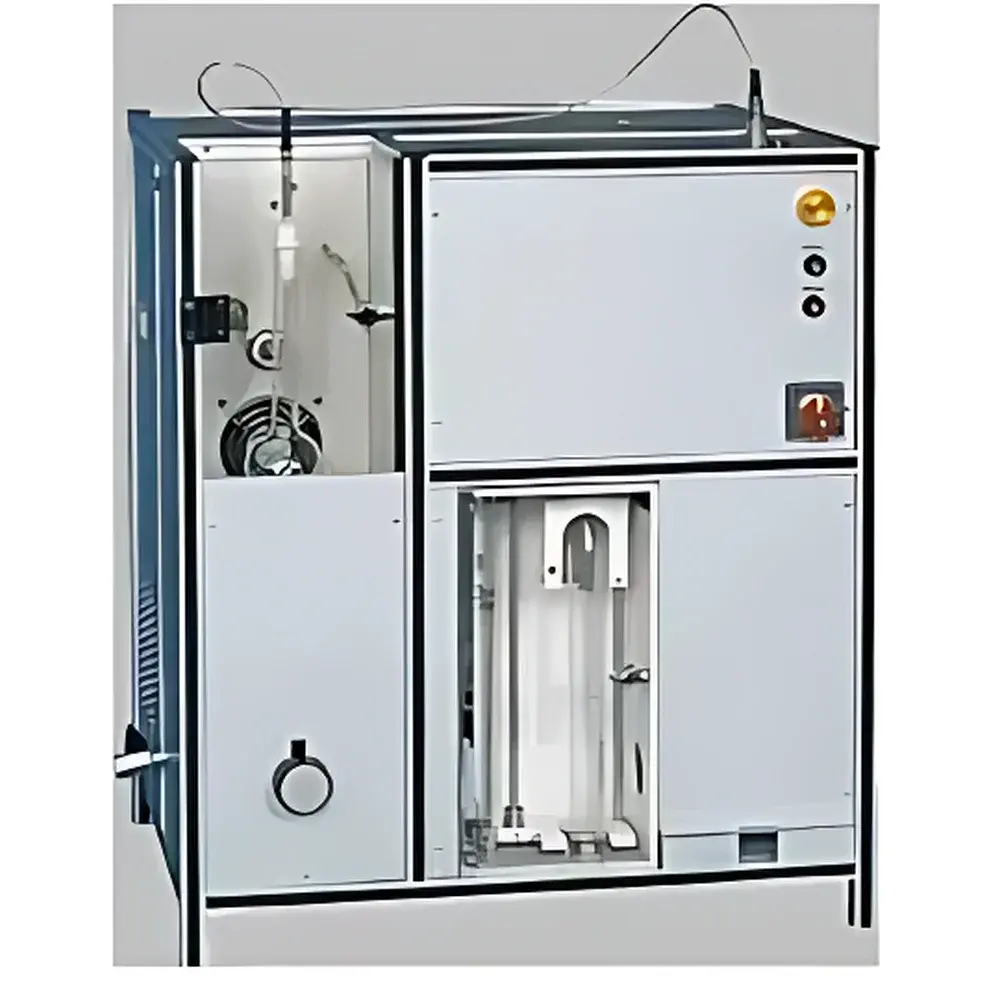
Koehler K3018 Automated Petroleum Distillation Apparatus
| Origin | Germany |
|---|---|
| Manufacturer Type | Authorized Distributor |
| Origin Category | Imported |
| Model | K3018 |
| Pricing | Upon Request |
| Temperature Range | 0–420 °C |
| Volume Resolution | 0.01 mL |
| Distillation Rate Programmable | 2–15 mL/min |
| Compliance | ASTM D86, D850, D1078, ISO 3405, DIN 51751, IP 123 |
| Receiver Heating | Up to 60 °C |
| Safety Systems | Integrated optical level detection, automatic fire suppression (manual override), continuous self-diagnosis |
| Power Supply | 230 V, 50/60 Hz, 10 A |
| Dimensions (L×W×H) | 53.3 × 54.6 × 70.5 cm |
| Net Weight | 91 kg |
Overview
The Koehler K3018 Automated Petroleum Distillation Apparatus is an engineered solution for standardized atmospheric distillation of petroleum products in accordance with globally recognized test methods including ASTM D86, D850, D1078, ISO 3405, DIN 51751, and IP 123. It implements a controlled batch distillation process wherein a sample is heated under defined conditions, vaporized, condensed, and fractionally collected—enabling precise determination of key distillation characteristics: initial boiling point (IBP), final boiling point (FBP), dry point, and recovery volume at specified temperatures. The system operates on the principle of differential vapor pressure and thermal equilibrium across a calibrated distillation train, with real-time monitoring of both temperature (via Pt-100 RTD sensors) and condensate volume (via optical meniscus detection). Designed for routine QC laboratories in refineries, fuel testing facilities, and independent certification labs, the K3018 delivers reproducible, auditable results compliant with GLP and GMP frameworks.
Key Features
- Programmable distillation rate control (2–15 mL/min) ensures method-specific heating profiles and consistent vaporization kinetics.
- High-precision Pt-100 RTD sensor array monitors steam temperature, condenser wall temperature, and receiver bath temperature—calibrated to ±0.01 °C traceable to NIST standards.
- Optical convex meniscus detection system provides sub-0.01 mL resolution for volume measurement, eliminating parallax error and mechanical wear associated with float-based systems.
- Fluorocarbon-free refrigeration and heating modules enable rapid thermal transitions between runs, reducing cycle time by up to 40% compared to conventional oil-bath systems.
- Integrated 24 VAC low-voltage heating elements deliver stable, localized thermal input with minimal thermal inertia—critical for accurate IBP determination.
- Automated atmospheric pressure compensation and residue correction algorithms apply in real time per ASTM D86 Annex A2 and ISO 3405 Clause 9.
- Continuous self-diagnostic firmware monitors heater integrity, coolant flow, sensor continuity, and fire suppression readiness—logging all events with timestamps.
- Receiver chamber heating (up to 60 °C) prevents wax precipitation during naphtha, kerosene, and diesel distillations, maintaining fluidity for unambiguous endpoint detection.
- Modular fire suppression system includes halon-free extinguishing agent, optical flame detection, and manual activation port—fully compliant with EN 61000-6-4 and IEC 61010-1 safety directives.
Sample Compatibility & Compliance
The K3018 supports distillation of volatile and semi-volatile hydrocarbon mixtures across ASTM Distillation Classes 0 through 4—including gasoline, aviation turbine fuel (Jet A/A-1), diesel fuel, naphthas, solvents, aromatic blends, and light lubricating oil fractions. Its design conforms to the mechanical and procedural requirements of ASTM D86 (Standard Test Method for Distillation of Petroleum Products at Atmospheric Pressure), ASTM D850 (for solvent distillation), ASTM D1078 (for low-boiling materials), and equivalent ISO, DIN, and IP protocols. All calibration and verification procedures align with ISO/IEC 17025:2017 clause 6.5 (Equipment) and support full audit trails required for FDA 21 CFR Part 11 compliance when used with validated software configurations.
Software & Data Management
Koehler’s proprietary K-Distill™ software provides instrument control, method development, data acquisition, and report generation in a single interface. Users may define custom distillation programs—including multi-step ramp rates, hold times, and endpoint logic—without scripting. The software automatically calculates repeatability (r) and reproducibility (R) per ASTM D86-04b Annex B, generates ASTM-compliant PDF reports with embedded metadata (operator ID, ambient pressure, calibration status), and exports structured CSV or XML files for LIMS integration. Networked deployment supports centralized management of up to 32 K3018 units via Ethernet TCP/IP, with role-based access control, electronic signatures, and full 21 CFR Part 11 audit trail functionality—including user action logging, parameter change history, and result modification tracking.
Applications
The K3018 is routinely deployed in refinery process control labs to verify cut-point specifications for crude fractionation; in fuels quality assurance to assess volatility compliance for gasoline (RVP, T50, T90) and jet fuel (distillation curve shape); in regulatory testing laboratories performing EPA Method IP 123 or EU EN 15199-1; and in R&D settings evaluating alternative fuel blends (e.g., ethanol-gasoline, biodiesel-diesel). Its ability to execute Class 0–4 distillations without hardware reconfiguration—combined with automated dry point detection (optional K3025 Dry Point Module)—makes it suitable for both routine screening and method validation studies requiring high inter-laboratory agreement.
FAQ
Does the K3018 require external cooling water or compressed air?
No. The system uses a closed-loop, fluorocarbon-free refrigeration circuit and solid-state heating—eliminating dependency on utility services.
Can the K3018 perform simultaneous distillations?
No. It is a single-sample, sequential distillation apparatus. However, networked units can be scheduled for staggered operation via K-Distill™ scheduler.
Is dry point detection fully automated?
Yes—with the optional K45654 Dry Point Detection Kit (including thermocouple probe, 200 mL receiver flask, and PTFE stopper), the system detects dry point per ASTM D850/D1078 without operator intervention.
How is temperature calibration verified?
The system supports dual-point calibration using certified reference thermometers traceable to national metrology institutes; calibration logs are stored with digital signatures.
What maintenance intervals are recommended?
Daily visual inspection, monthly optical sensor cleaning, and annual full performance verification using NIST-traceable standards—documented in the included Maintenance Logbook module.





