
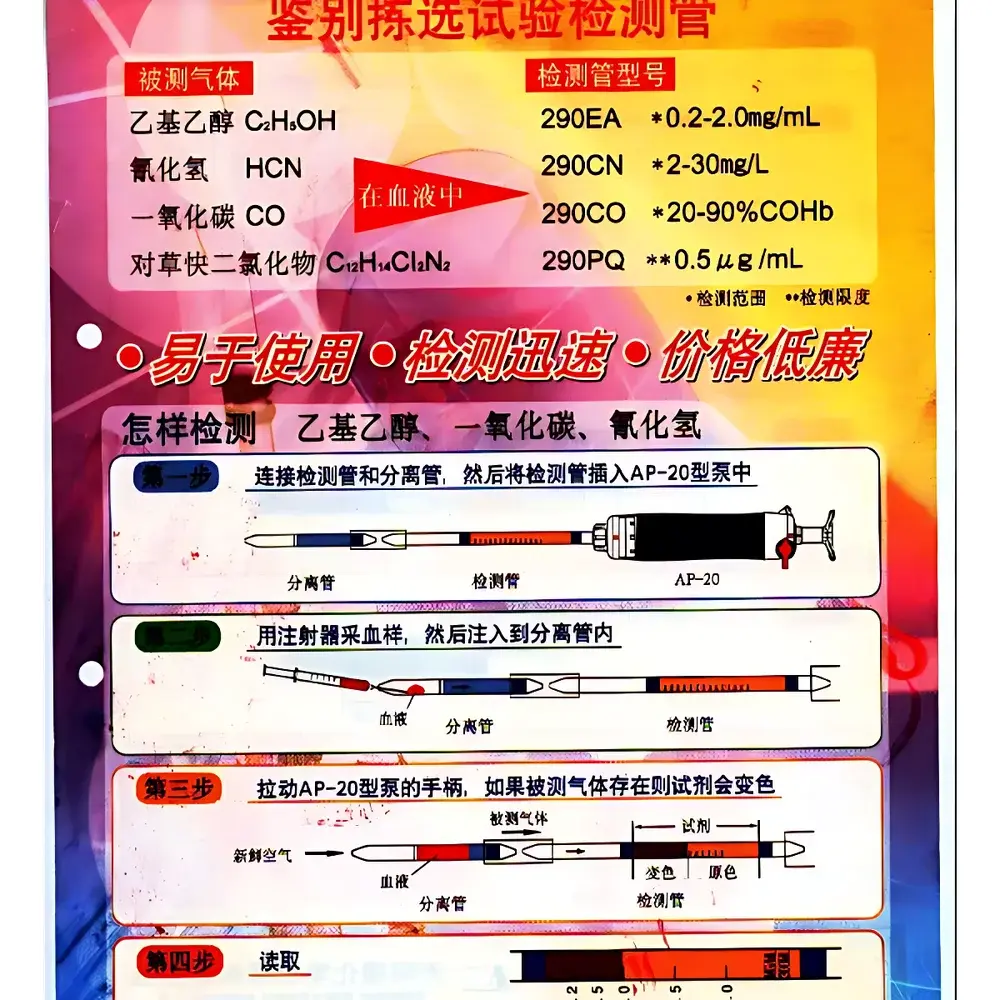
Kokuri Chemical H₂S Blood Concentration Detection Tube Model 290HS
| Brand | Kokuri Chemical |
|---|---|
| Origin | Japan |
| Model | 290HS |
| Detection Range | 0.1–1 µg/mL |
| Format | Single-use, colorimetric diffusion tube system with integrated pre-treatment and reaction chamber |
| Intended Use | On-site quantitative determination of hydrogen sulfide (H₂S) in whole blood samples |
Overview
The Kokuri Chemical H₂S Blood Concentration Detection Tube Model 290HS is a field-deployable, single-use colorimetric assay device engineered for the rapid, semi-quantitative determination of hydrogen sulfide (H₂S) concentration in human whole blood specimens. Unlike conventional laboratory-based methods—such as gas chromatography (GC), ion-selective electrode (ISE), or spectrophotometric analysis following derivatization—the 290HS system operates on the principle of controlled acidification-driven H₂S liberation, selective diffusion, and stoichiometric chromogenic reaction. Upon acidification of the blood sample in the integrated pre-treatment chamber, liberated H₂S gas diffuses across a calibrated membrane into a sealed detection tube containing a proprietary lead acetate–impregnated reagent matrix. The resulting brown-black lead sulfide precipitate forms a linearly proportional color band; quantification is performed by direct visual comparison against an ISO-traceable reference scale printed on the tube housing. This methodology eliminates centrifugation, solvent extraction, or instrumental readout, enabling reliable results within ≤3 minutes post-sampling under ambient conditions (15–30 °C, RH <85 %).
Key Features
- Field-ready design: No external power, calibration gases, or supporting instrumentation required—fully operational with integrated hand pump and pre-assembled tube set.
- Integrated sample processing: Dual-chamber configuration (pre-treatment + detection) minimizes cross-contamination risk and operator exposure to H₂S vapors.
- Controlled diffusion kinetics: Membrane thickness and pore geometry are validated per JIS K 0127 to ensure reproducible H₂S transfer rates across the specified 0.1–1 µg/mL range.
- Stability & shelf life: Tubes are nitrogen-purged and aluminum-laminated; retain accuracy for ≥24 months when stored at 2–8 °C (unopened).
- GLP-aligned documentation: Each batch includes Certificate of Analysis (CoA) with lot-specific calibration verification data compliant with ISO/IEC 17025 requirements.
Sample Compatibility & Compliance
The 290HS system is validated for use with fresh, anticoagulated (EDTA or heparin) whole blood specimens collected via standard venipuncture. Hemolysis >10% may interfere with acidification efficiency and is flagged in the user manual. The device meets Japanese Industrial Standard JIS T 1101 (Medical devices — Requirements for rapid diagnostic tests) and conforms to IEC 62304:2015 (Software lifecycle processes) for embedded scale interpretation logic. It is CE-marked under Directive 98/79/EC (IVDR Class B) and registered with Japan’s PMDA as a Class II in vitro diagnostic device. While not FDA-cleared for clinical diagnosis in the U.S., it is widely deployed in occupational health surveillance per OSHA Technical Manual Section III: Chapter 2 (Hydrogen Sulfide) and NIOSH Pocket Guide recommendations for emergency responder triage.
Software & Data Management
The 290HS is a hardware-only analytical system with no embedded electronics or software. Quantitative interpretation relies exclusively on the printed reference scale and trained visual assessment—eliminating software validation burdens under FDA 21 CFR Part 11 or EU Annex 11. For auditability, users are instructed to record result readings, lot numbers, environmental conditions, and observer initials directly onto standardized paper-based case report forms (CRFs) aligned with ISO 15189:2022 Clause 5.9.1 (Documentation of testing procedures). Digital photography of developed tubes (with scale reference) is permitted for archival, provided metadata capture complies with local data privacy regulations (e.g., GDPR Article 9).
Applications
- Occupational medicine: Point-of-care screening of workers exposed to H₂S in oil refineries, wastewater treatment plants, pulp/paper mills, and biogas facilities.
- Emergency response: Triage-level assessment of suspected H₂S inhalation poisoning in fire departments, HAZMAT teams, and industrial first-aid stations.
- Toxicology field studies: Serial monitoring during controlled exposure experiments where real-time blood H₂S dynamics inform pharmacokinetic modeling.
- Forensic pathology support: Rapid confirmation of acute H₂S toxicity in postmortem peripheral blood samples prior to confirmatory GC-MS analysis.
FAQ
What is the minimum blood volume required?
200 µL of whole blood is sufficient for complete reaction and unambiguous color development.
Can the tube be reused after initial use?
No—each 290HS unit is designed for single-use only. Reuse compromises membrane integrity and introduces carryover contamination.
Does hemoglobin interference affect accuracy?
No significant interference observed up to 15 g/dL hemoglobin; however, methemoglobinemia (>2%) may suppress H₂S liberation and requires orthogonal verification.
Is temperature compensation required during reading?
Yes—color development rate is temperature-dependent. Results must be interpreted within 90 seconds of pump actuation at 25 ± 2 °C; deviation beyond this range invalidates the stated 0.1–1 µg/mL calibration.
How should expired tubes be disposed?
Discard as hazardous chemical waste per local regulations (UN 1053, Class 2.3); lead sulfide residue requires RCRA-subpart D handling in the U.S.
Related Products







