
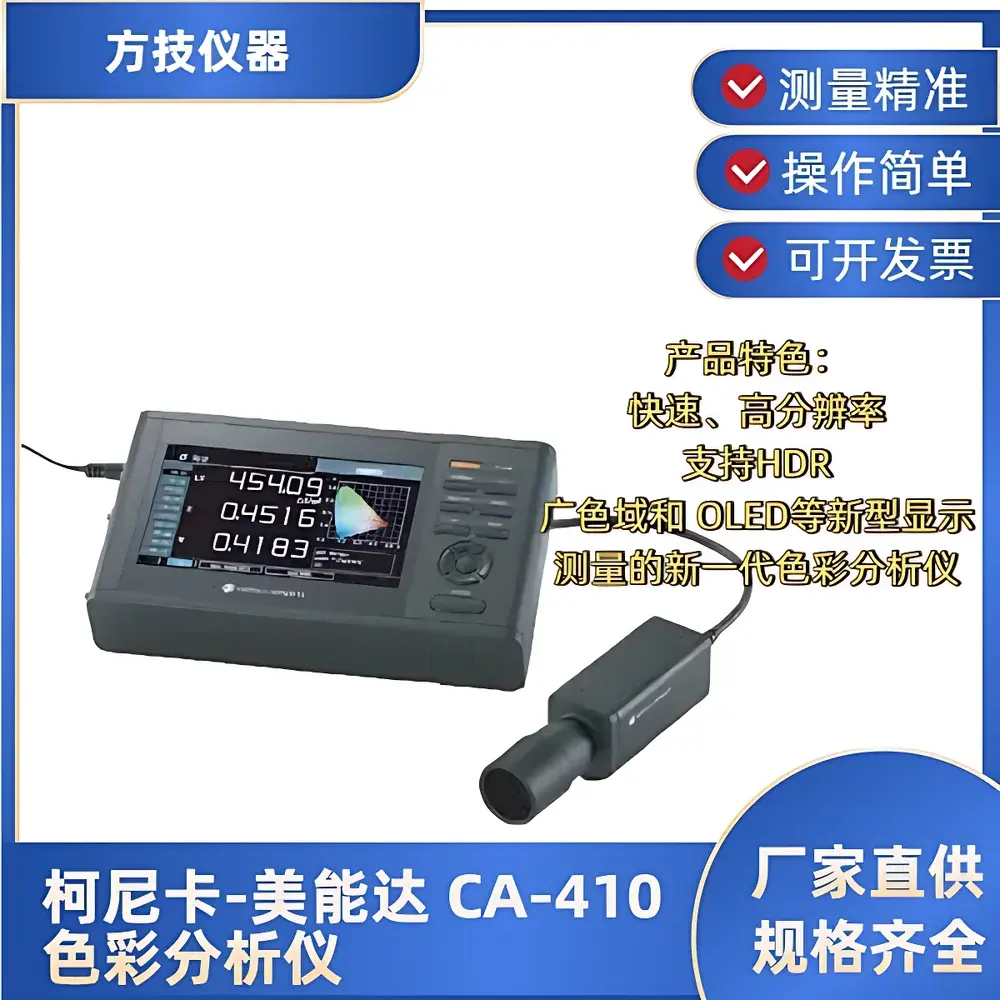
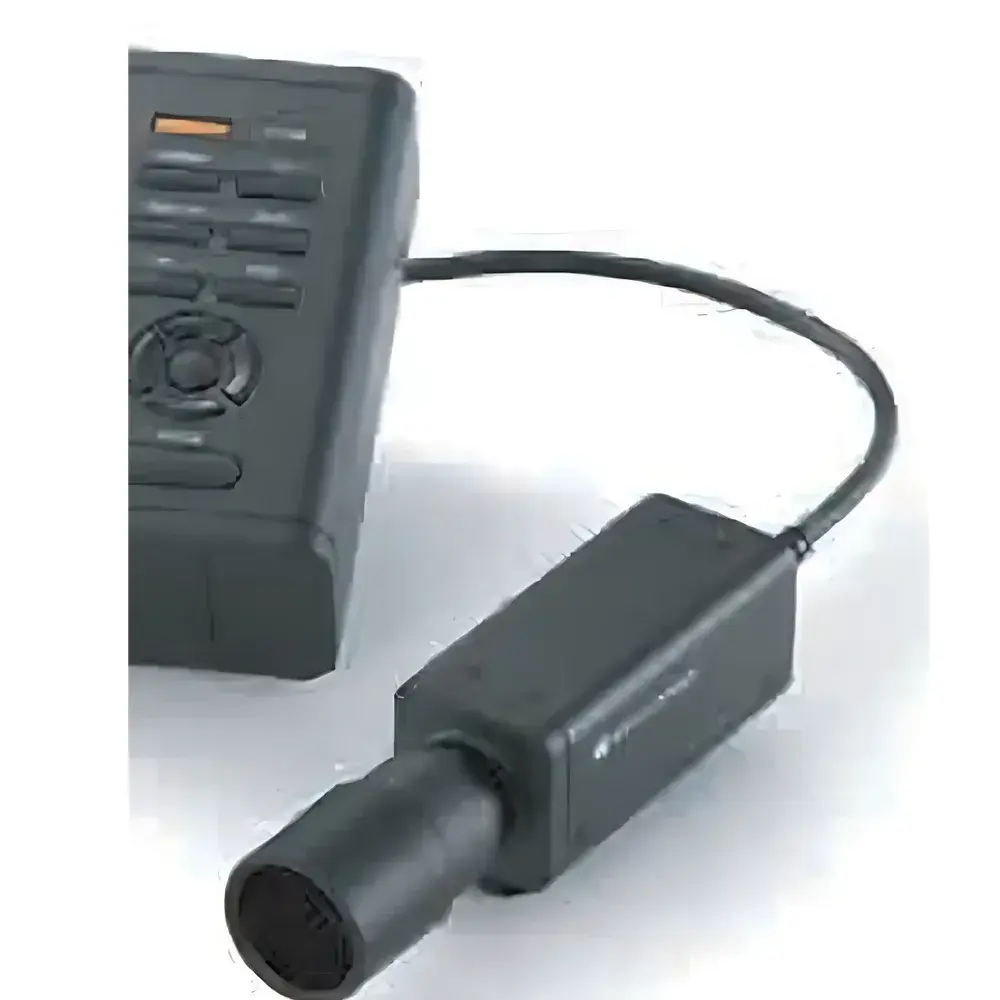
Konica Minolta CA-410 Series Color Analyzer for HDR and Wide-Gamut OLED Displays
| Brand | Konica Minolta |
|---|---|
| Origin | Japan |
| Manufacturer Type | Authorized Distributor |
| Origin Category | Imported |
| Model | CA-410 Series (including CA-VP410, CA-VP410A, CA-P410, CA-P410H, CA-MP410, CA-MP410H, CA-VP402, CA-VP404, CA-VP410T) |
| Measurement Aperture | Ø2.1 mm, Ø4 mm, Ø10 mm |
| Receiving Angle | ±4° to ±10° (model-dependent) |
| Guaranteed Measurement Distance | 10–200 mm (model-dependent) |
| Luminance Range (Guaranteed Accuracy) | 0.0003–30,000 cd/m² |
| Chromaticity Range (Guaranteed Accuracy) | 0.003–30,000 cd/m² |
| Zero Calibration Time | 3–10 s (model-dependent) |
| Interface Options | USB (IF-A28/A40/A42/A43/A30/A31/A32), RS-232C, BNC sync |
Overview
The Konica Minolta CA-410 Series is a precision color and luminance measurement system engineered for objective evaluation of modern emissive displays—including OLED, microLED, and high-dynamic-range (HDR) panels—across R&D, production QA, and calibration workflows. Unlike spectroradiometers or general-purpose photometers, the CA-410 employs a calibrated tristimulus sensor architecture optimized for CIE 1931 XYZ color matching functions, with spectral response corrected via factory-installed filter sets and reference-standard traceability to NIST-traceable luminance standards. Its core function is photometric and colorimetric quantification under controlled geometry: it measures absolute luminance (cd/m²), chromaticity coordinates (x, y and u’, v’), dominant wavelength, CCT, and ΔE (CIE 1976 or CIE 2000) with repeatability validated per ISO/CIE 11664-4 and IEC 62341-6-3 for OLED display characterization. The series supports real-time gamma curve acquisition, white point drift monitoring, and uniformity mapping when integrated into automated test stations—making it suitable for compliance verification against ITU-R BT.2100 (HDR), DCI-P3, Rec.2020, and sRGB gamut specifications.
Key Features
- Modular probe architecture with nine interchangeable optical heads: Ø2.1 mm (CA-VP402), Ø4 mm (CA-VP404), Ø10 mm standard (CA-P410/VP410), high-brightness (CA-P410H/MP410H), low-light/high-speed (CA-VP410A), mini-form-factor (CA-MP410), and long-working-distance (CA-VP410T, 200 mm)
- Guaranteed accuracy across six orders of magnitude in luminance: from 0.0003 cd/m² (sub-millilambert black-level validation) up to 30,000 cd/m² (HDR peak brightness verification)
- Angle-resolved measurement capability via ±4° narrow-angle optics (CA-VP410T) for viewing angle dependency analysis per ISO 13406-2 and VESA DisplayHDR TV Compliance Test Specification
- Integrated zero-calibration routine with model-specific timing (3 s for standard probes; 10 s for ultra-low-light variants), eliminating thermal drift and ambient light offset prior to each measurement sequence
- Robust mechanical design compliant with IP52 dust resistance and vibration tolerance per IEC 60068-2-6, supporting integration into inline manufacturing test cells
Sample Compatibility & Compliance
The CA-410 Series is validated for direct-contact and non-contact measurement of self-luminous flat-panel displays ranging from 0.5″ micro-OLED wearables to 10″ automotive infotainment modules. Its Ø2.1 mm probe enables pixel-level evaluation of RGB stripe subpixels on high-PPI AMOLEDs, while the Ø10 mm aperture satisfies ISO 11664-7 requirements for average luminance sampling over ≥10×10 mm² areas. All probes meet JIS Z 8722:2012 (photometry) and CIE S 014/E:2006 (colorimetry) calibration protocols. For regulated environments—including medical display validation (IEC 62303) and broadcast monitor certification (SMPTE RP 166)—the system supports audit-ready data logging with timestamped metadata, user-defined pass/fail thresholds, and export formats compatible with FDA 21 CFR Part 11-compliant LIMS platforms when used with optional CA-S4W software.
Software & Data Management
The CA-410 operates natively with Konica Minolta’s CA-S4W application software (Windows 10/11, 64-bit), which provides synchronized multi-probe control, batch measurement scripting, and real-time gamma/CCT/ΔE trend visualization. Raw data exports include CSV, XML, and proprietary .ca4 formats containing full spectral weighting coefficients, integration time, probe ID, and environmental temperature/humidity tags (when connected to optional sensors). For enterprise deployment, CA-S4W supports ODBC connectivity to SQL Server databases and REST API endpoints for integration with MES systems. All measurement sessions generate immutable audit trails—including operator ID, calibration history, and firmware revision—enabling GLP/GMP-aligned documentation per ISO/IEC 17025:2017 Clause 7.8.
Applications
- OLED panel R&D: black-level leakage analysis, burn-in quantification, and temporal luminance decay profiling at 0.001 cd/m²
- Automotive HMI validation: sunlight-readable display testing under simulated daylight (≥10,000 cd/m²) using CA-P410H probe
- AR/VR microdisplay calibration: sub-pixel chromaticity mapping using CA-VP402 with 28 mm ±2 mm working distance constraint
- Display manufacturing QC: automated pass/fail screening for Rec.2020 coverage, EOTF conformance, and spatial uniformity (ΔL*, Δu’v’)
- Content creation studio verification: HDR tone-mapping accuracy assessment per SMPTE ST 2084 and ITU-T H.265/HEVC metadata alignment
FAQ
What display technologies is the CA-410 Series certified for?
The CA-410 is specifically calibrated and validated for OLED, AMOLED, QD-OLED, and microLED emissive displays—not LCDs with backlight bleed or reflective e-ink panels.
Can the CA-410 measure angular color shift (viewing angle dependence)?
Yes—using the CA-VP410T long-working-distance probe (±4° acceptance angle) in conjunction with motorized goniometric stages, users can acquire u’v’ vs. θ/φ datasets compliant with ISO 13406-2 Annex D.
Is firmware and calibration certificate included with shipment?
Each unit ships with current firmware (v4.20 or later), a NIST-traceable calibration certificate valid for 12 months, and individual probe-specific spectral responsivity data files.
Does the system support external trigger synchronization for pulsed or PWM-driven displays?
Yes—via BNC input on IF-A35, IF-A42, or IF-A43 interface cables, enabling frame-locked measurements synchronized to display vertical blanking or PWM cycle edges.
How is measurement uncertainty defined for chromaticity at low luminance?
Per Konica Minolta Technical Note TN-CA410-03, chromaticity uncertainty at 0.003 cd/m² is ±0.0025 in CIE 1931 x,y space, derived from Type A (statistical) and Type B (calibration + environmental) uncertainty components per GUM (JCGM 100:2008).





