
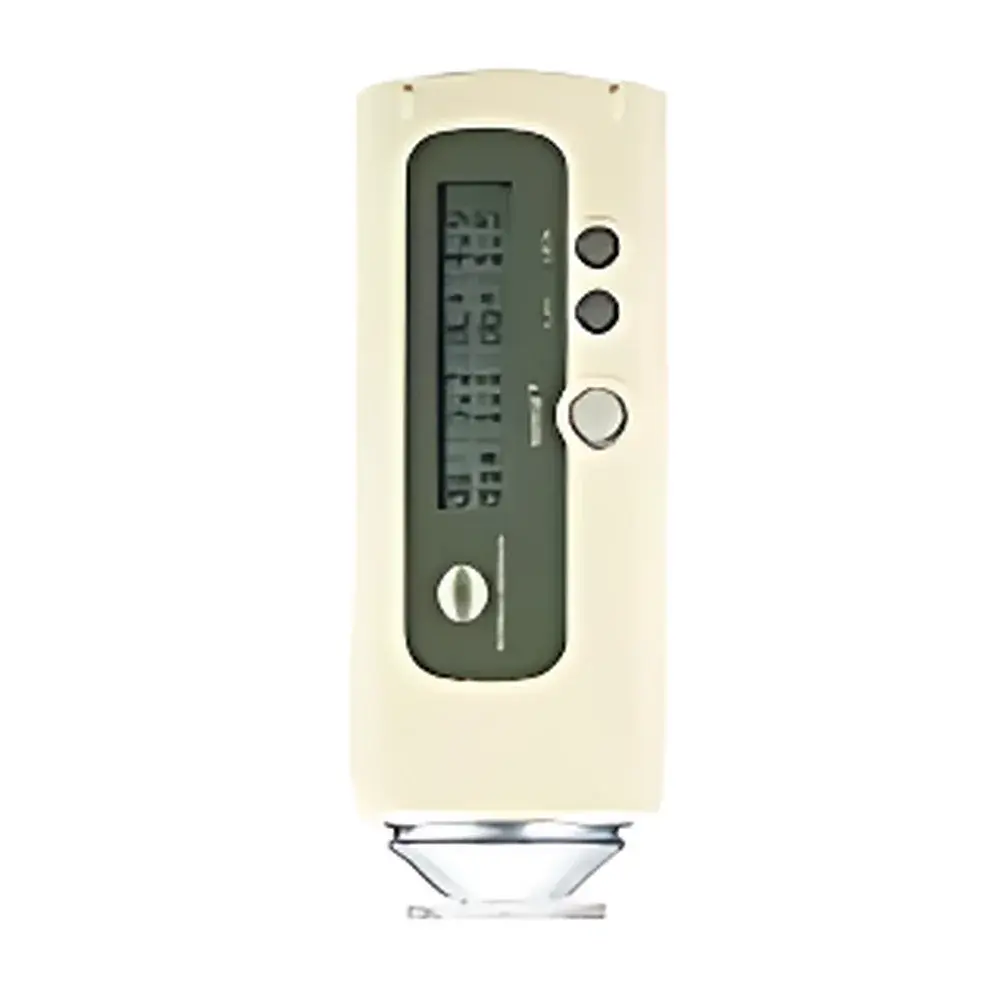
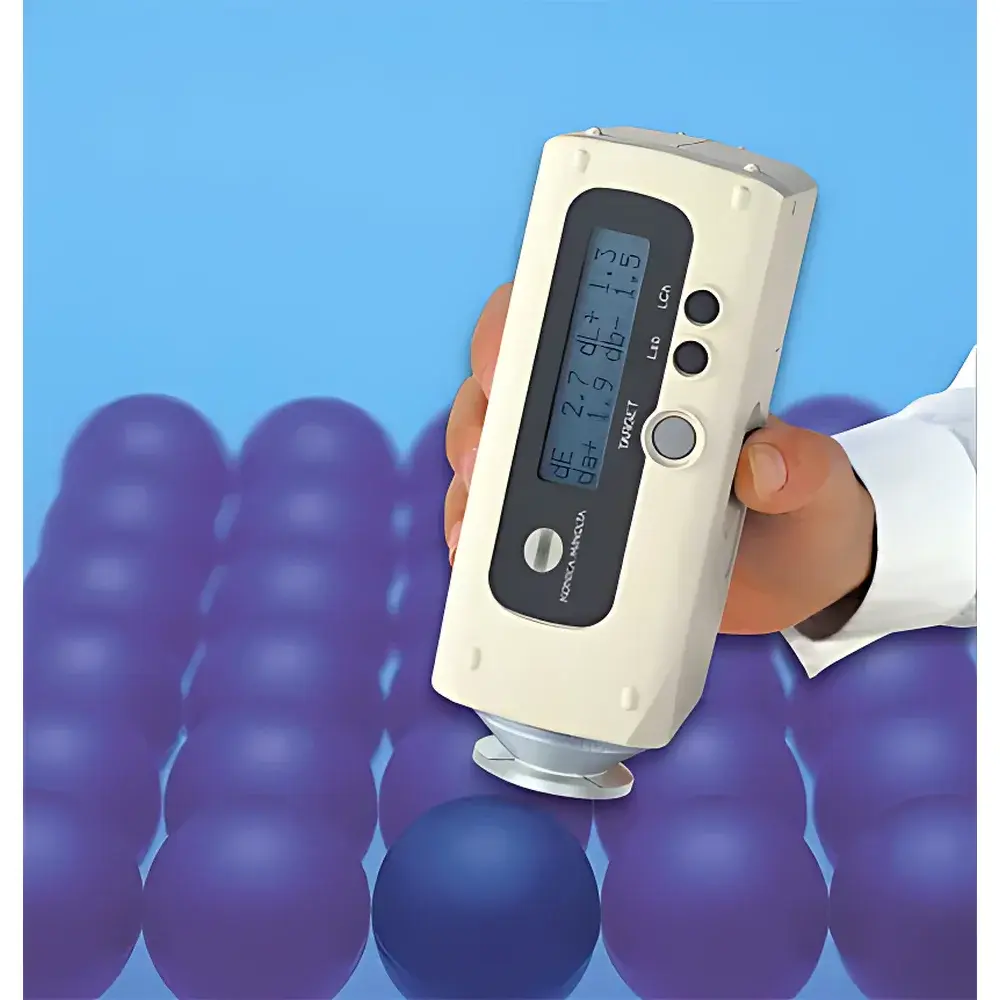
Konica Minolta CR-10 Portable Color Difference Meter
| Brand | Konica Minolta |
|---|---|
| Origin | Japan |
| Instrument Type | Portable |
| Optical Geometry | d/8° integrating sphere |
| Illuminant | CIE D65 |
| Observer Angle | 10° |
| L* Range | 10–100 |
| Repeatability | ΔE*ab ≤ 0.1 (std. dev., white tile average) |
Overview
The Konica Minolta CR-10 Portable Color Difference Meter is a compact, battery-powered handheld instrument engineered for rapid, on-site color quality control in production, inspection, and field service environments. It operates on the fundamental principles of tristimulus colorimetry—measuring reflected light across the visible spectrum (approx. 400–700 nm) using silicon photodiodes filtered to approximate the CIE 1931 standard observer functions. The d/8° optical geometry—diffuse illumination with 8° viewing—ensures uniform measurement of textured, matte, and slightly glossy surfaces by minimizing directional bias. All measurements are referenced to the CIE D65 illuminant (6504 K daylight simulation) and the 10° standard observer, conforming to ISO 7724-1, CIE No. 15, and ASTM E308. Designed for robustness and operational simplicity, the CR-10 delivers L*a*b* and L*C*H* color space values along with ΔE*ab color difference calculations in approximately one second—enabling real-time pass/fail decisions without laboratory dependency.
Key Features
- Compact ergonomic design (59 × 158 × 85 mm, 360 g without batteries) optimized for single-hand operation in constrained or mobile workspaces
- Integrated d/8° integrating sphere optics with 8 mm measurement aperture—compatible with flat, curved, and moderately textured substrates
- CIE D65 illuminant simulation via tungsten-halogen lamp with stable spectral output; calibrated against NIST-traceable standards
- High-repeatability performance: ΔE*ab standard deviation ≤ 0.1 under controlled conditions (white calibration tile, ambient temperature 23 ± 2°C, RH < 85%)
- Dual display modes: simultaneous Δ(L*a*b*) / ΔE*ab or Δ(L*C*H*) / ΔE*ab, supporting both metric-based and perceptually uniform evaluation workflows
- Onboard memory for one reference standard—set directly via measurement, eliminating external configuration files
- Flexible power options: four AA alkaline batteries (≥2000 measurements at 10-sec intervals) or optional AC adapter (AC-A12)
Sample Compatibility & Compliance
The CR-10 is validated for reflectance-based color measurement of non-fluorescent, opaque, and semi-opaque materials—including painted surfaces, plastics, textiles, coatings, ceramics, and printed media. Its 8 mm aperture accommodates typical industrial sample sizes while maintaining geometric consistency per ISO 5-4. The instrument complies with international metrological requirements for color measurement instrumentation, including traceability to CIE-defined colorimetric functions and adherence to ISO 7724-2 (instrumental colorimetry) and ISO 11664-4 (CIEDE2000 implementation framework). While not FDA 21 CFR Part 11–compliant out-of-the-box (lacking audit trail and electronic signature functionality), its measurement data supports GLP/GMP documentation when paired with validated manual recording procedures. Temperature stability is maintained between 0–40°C; however, users must account for thermal drift in red-dominant samples above 30°C, as noted in ASTM D2244 Annex A3.
Software & Data Management
The CR-10 operates as a standalone device with no embedded Bluetooth, USB, or PC connectivity—intentionally designed to minimize firmware complexity and maximize field reliability. Measurement results can be exported via optional thermal printer (CR-A13, connected through proprietary interface) for hard-copy traceability. For digital workflow integration, Konica Minolta recommends pairing the CR-10 with upstream instruments such as the CM-3600A spectrophotometer and SpectraMagic NX software for centralized database management, statistical process control (SPC), and tolerance mapping. All CR-series devices share consistent color calculation engines, ensuring cross-platform repeatability within ±0.05 ΔE*ab across units calibrated to the same master standard.
Applications
- Automotive OEM and Tier-1 suppliers: Spot verification of body panel, trim, and interior component color consistency during line-side audits
- Paint and coating manufacturers: Batch-to-batch comparison against master standards in R&D labs and QC checkpoints
- Plastics extrusion and injection molding: In-process monitoring of pigment dispersion uniformity and thermal degradation effects
- Printing and packaging: Press-side evaluation of spot color fidelity and substrate metamerism screening
- Food and pharmaceutical packaging: Visual quality assurance of label and carton color compliance under standardized lighting
- Educational laboratories: Teaching core concepts of CIE color spaces, illuminant dependency, and inter-instrument agreement
FAQ
What does “d/8°” mean in the optical specification?
The d/8° geometry denotes diffuse illumination (d) with an 8° viewing angle—achieved via an integrating sphere that uniformly scatters incident light before collection. This configuration minimizes sensitivity to surface texture and gloss, making it suitable for industrial materials where measurement repeatability across varying finish types is critical.
Is the CR-10 suitable for measuring metallic or pearlescent finishes?
No. The CR-10 is a tristimulus meter with fixed D65 illumination and 10° observer; it lacks multi-angle capability required for gonioapparent materials. For effect pigments, Konica Minolta recommends the CM-2600D or FD-9 series spectrophotometers with 25°/45°/75° geometries.
How often should the instrument be recalibrated?
Konica Minolta recommends daily zeroing using the included white calibration tile (CR-A72) and full recalibration every 12 months by an authorized service center using NIST-traceable standards.
Can multiple reference standards be stored internally?
No—the CR-10 supports only one user-defined reference standard. For multi-standard workflows, external documentation or migration to the CR-14 (with expanded memory) is advised.
Does the CR-10 comply with ISO 13655 for M0/M1/M2/M3 measurement conditions?
No. The CR-10 uses only D65 illumination and does not support UV-cut filters or alternative illuminants required for M1 (D50 + UV), M2 (UV-cut), or M3 (polarized) modes defined in ISO 13655.




