
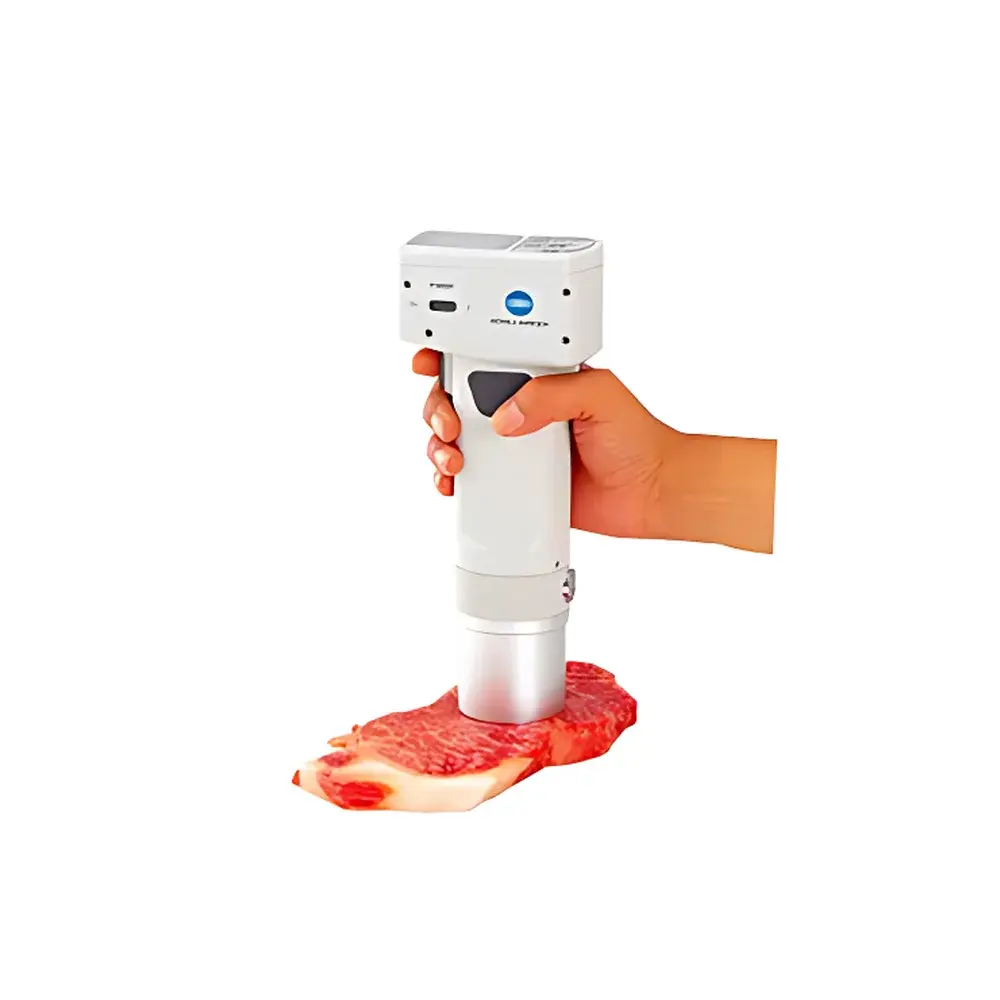
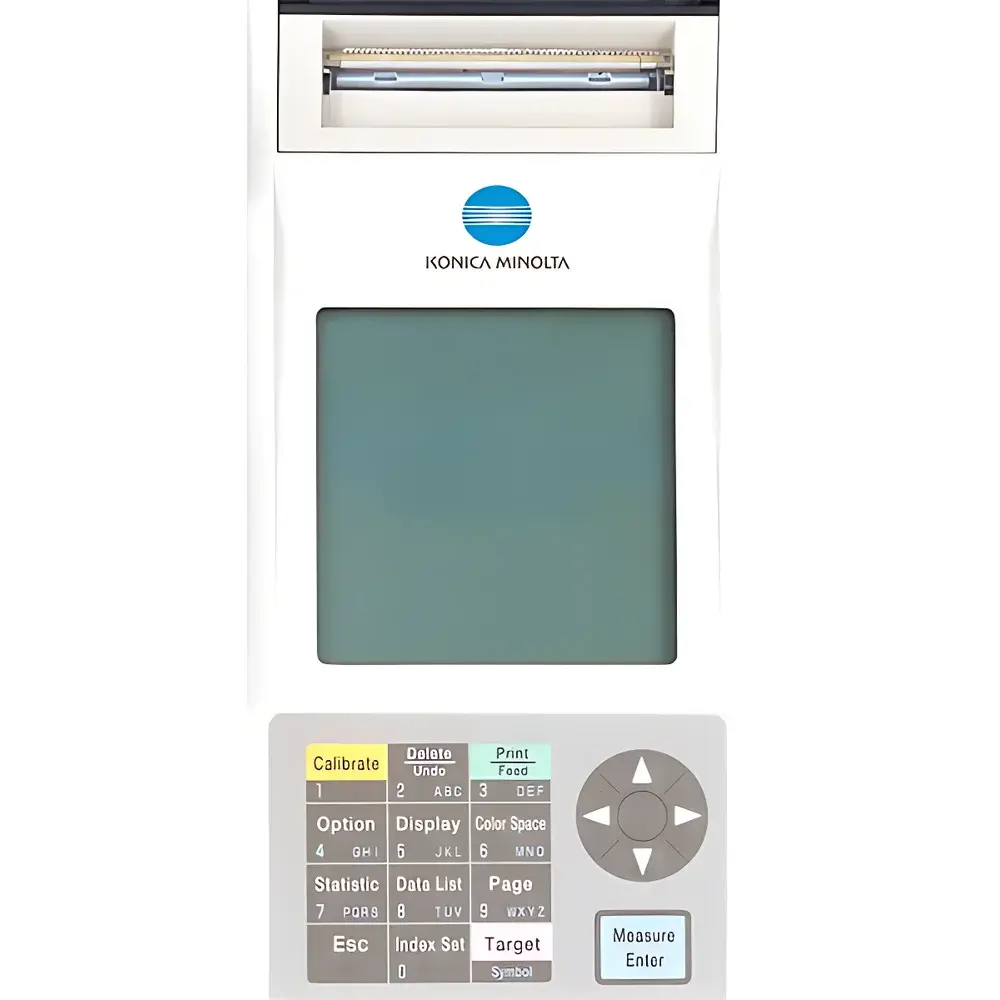
Konica Minolta CR-400/CR-410 Portable Color Difference Meter
| Brand | Konica Minolta |
|---|---|
| Origin | Japan |
| Model | CR-400 / CR-410 |
| Instrument Type | Portable |
| Optical Geometry | d/8° integrating sphere (with specular component included) |
| Light Source | Pulsed xenon lamp |
| Spectral Range | Y Reflectance 0.01–160.00% |
| Repeatability | ΔE*ab ≤ 0.07 (standard deviation, after white calibration tile measurement, 30 times at 10-second intervals) |
Overview
The Konica Minolta CR-400 and CR-410 are fourth-generation portable color difference meters engineered for high-precision, field-deployable spectral reflectance measurement in industrial quality control environments. Based on the CIE 1931 standard observer (2°) and compliant with ISO 5-4, ISO 11664 (CIE S 014), and ASTM E308 methodologies, these instruments employ a pulsed xenon lamp and an 8° d/8° integrating sphere optical system—including specular component (SCI)—to deliver stable, geometry-consistent measurements across diverse surface topographies. The CR-400 features an 8 mm measurement aperture optimized for flat, homogeneous surfaces such as painted panels, plastic injection-molded parts, or printed labels. In contrast, the CR-410 integrates a large 50 mm aperture to accommodate heterogeneous, textured, or granular samples—e.g., textiles, wood veneers, ceramic tiles, agricultural produce, or powdered pharmaceuticals—without requiring spatial averaging via multiple point measurements. Both models conform to CIE illuminants C and D65 and support full tristimulus (XYZ), chromaticity (Yxy), and perceptually uniform color spaces including CIELAB, CIELCH, CMC (l:c), CIE94, CIE2000, and WI/TWI (ASTM E313, ISO 2470-1). Their design bridges laboratory-grade metrological rigor with operational flexibility in production-line, R&D lab, and field inspection settings.
Key Features
- Modular architecture: detachable probe enables standalone operation—ideal for rapid spot checks without the data processor unit.
- Dual-aperture configuration: CR-400 (Φ8 mm / Φ11 mm) for standard reflective surfaces; CR-410 (Φ50 mm / Φ53 mm) for coarse, irregular, or low-uniformity substrates.
- High repeatability: ΔE*ab ≤ 0.07 (std. dev., white calibration tile, n = 30), ensuring statistical confidence in process monitoring and pass/fail decisions.
- Inter-instrument agreement: inter-unit variability ≤ ΔE*ab 0.6 (CR-400) and ≤ 0.8 (CR-410) when measuring BCRA Series II reference tiles—critical for multi-site color consistency programs.
- Configurable evaluation: up to six user-defined formulas (e.g., custom whiteness index, yellowness index, or industry-specific tolerancing) stored and recalled via intuitive menu navigation.
- Multi-language UI: display language selectable among English, German, French, Italian, Spanish, and Japanese; keypad labeling remains English by default.
- Onboard memory: 1,000 measurements stored directly in the probe; expands to 2,000 when paired with the integrated data processor.
- Built-in thermal printer: battery-powered, compact, and capable of real-time hardcopy output—supports GLP-compliant record retention without external peripherals.
Sample Compatibility & Compliance
The CR-400/CR-410 series accommodates solid, semi-solid, and liquid samples via optional accessories—including liquid cells, powder cups, and transmission adapters—enabling compliance with ASTM D2244 (color difference calculation), ISO 11664-6 (colorimetric computation), and USP (color assessment of pharmaceutical dosage forms). Its d/8° SCI geometry satisfies ISO 7724-1 requirements for diffuse illumination and directional viewing, making it suitable for QC applications governed by automotive OEM standards (e.g., GMW14872, Ford CETP), food safety regulations (FDA 21 CFR Part 11 audit trail readiness when used with SpectraMagic NX software), and textile color management per AATCC Evaluation Procedure 1.
Software & Data Management
When connected to a Windows PC via RS-232C (4800–19200 bps), the CR-400/CR-410 interfaces seamlessly with Konica Minolta’s SpectraMagic NX software—a validated platform supporting 21 CFR Part 11 compliance through electronic signatures, audit trails, and role-based access control. The software enables advanced reporting (SPC charts, tolerance ellipses, batch trend analysis), database synchronization across distributed sites, and export to CSV, PDF, or XML for integration into LIMS or MES systems. All calibration events, user-defined formula edits, and pass/fail judgments are timestamped and logged with operator ID—meeting GLP/GMP documentation requirements for regulated industries.
Applications
- Paint & Coatings: batch-to-batch consistency verification against master standards under D65 illumination.
- Plastics & Rubber: pigment dispersion assessment in extruded profiles and molded components.
- Food & Agriculture: objective quantification of fruit ripeness (L*a*b* hue angle), meat discoloration, or cereal whiteness (WI ASTM E313).
- Pharmaceuticals: tablet coating uniformity, capsule shell color stability, and excipient batch release testing.
- Textiles & Apparel: shade matching across dye lots using CIE2000 ΔE tolerances.
- Ceramics & Building Materials: glaze consistency, tile batch homogeneity, and façade cladding color fidelity.
- Clinical Dermatology Research: non-invasive skin tone mapping and melanin/erythema index tracking over time.
FAQ
What is the difference between CR-400 and CR-410?
The CR-400 uses an 8 mm measurement aperture optimized for flat, smooth surfaces; the CR-410 features a 50 mm aperture designed for textured, granular, or low-uniformity materials—reducing sampling error and eliminating the need for manual averaging.
Does the instrument comply with FDA 21 CFR Part 11?
Yes—when used with SpectraMagic NX software configured with audit trail, electronic signature, and user access controls, the system meets Part 11 requirements for electronic records and signatures.
Can I import legacy CR-300/CR-310 data?
Yes—the CR-400/CR-410 shares identical illumination/receiving geometry and spectral response with prior generations, enabling direct backward compatibility of measurement datasets and calibration references.
Is the built-in printer battery-operated?
Yes—the thermal printer operates on the same AA alkaline or Ni-MH batteries powering the main unit, delivering up to 800 measurements per charge cycle.
What color spaces and indices are supported out-of-the-box?
Standard support includes XYZ, Yxy, L*a*b*, Hunter Lab, L*C*h, Munsell (C-illuminant only), CMC (l:c), CIE94, CIE2000, WI (ASTM E313/D65), YI (ASTM D1925/C), and six user-programmable formulas.





