
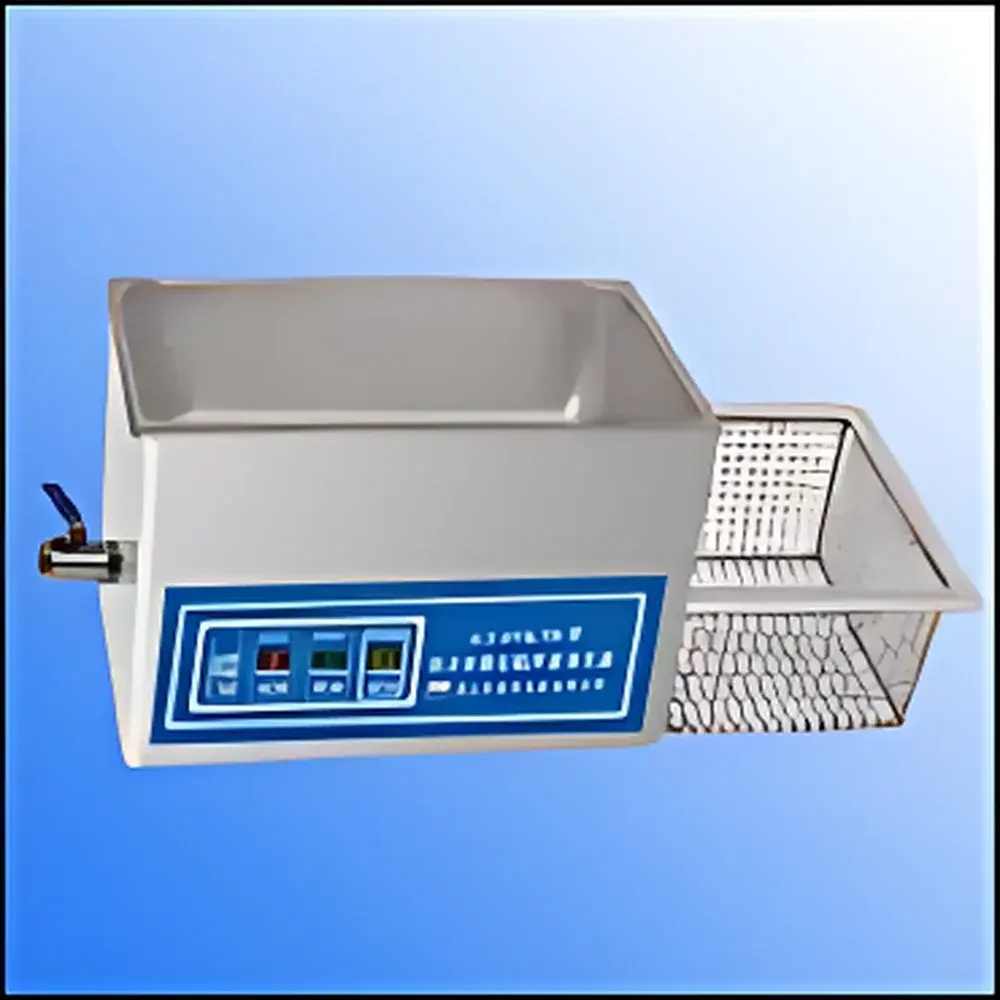
KQ-250DA Desktop Digital Ultrasonic Cleaner (10 L)
| Origin | Shanghai, China |
|---|---|
| Manufacturer Type | Authorized Distributor |
| Origin Category | Domestic (China) |
| Model | KQ-250DA |
| Price | USD 760 (FOB Shanghai) |
| Dimensions (W×D×H) | 320 × 264 × 320 mm |
| Tank Internal Dimensions | 300 × 240 × 150 mm |
| Tank Capacity | 10 L |
| Ultrasonic Frequency | 40 kHz |
| Total Ultrasonic Power Output | 250 W |
| Power per Transducer | 50 W (5 transducers) |
| Temperature Control Range | Ambient to 80 °C (±1 °C accuracy) |
| Timer Range | 1–99 min (digital, programmable) |
| Heating Function | Yes |
| Drain Valve | Integrated |
| Rack | Stainless steel mesh rack (argon-welded) |
| Tank Material | 304 stainless steel |
| Housing Material | 304 stainless steel |
| Safety Features | Low-water level detection, over-temperature, over-voltage, and over-current protection |
| Cumulative Operating Hours Counter | Up to 999,999 h |
| Microcontroller-Based Control System | Embedded single-chip processor with non-volatile memory for parameter retention |
Overview
The KQ-250DA Desktop Digital Ultrasonic Cleaner is a precision-engineered benchtop instrument designed for routine cleaning, degassing, dispersion, emulsification, homogenization, solvent extraction, and cell lysis in academic laboratories, R&D centers, quality control facilities, and small-scale industrial settings. It operates on the principle of ultrasonic cavitation—generating high-frequency mechanical vibrations (40 kHz) via piezoelectric transducers bonded to the bottom of a 304 stainless steel tank. These vibrations propagate through the cleaning medium (typically aqueous or mild organic solvents), inducing transient microcavities that collapse violently, producing localized shockwaves and microstreaming. This physical mechanism enables effective removal of particulate contaminants, oxides, oils, and biofilms from delicate components—including optical lenses, semiconductor wafers, surgical instruments, microfluidic devices, and analytical sample vials—without mechanical abrasion or thermal degradation.
Key Features
- Digitally controlled 40 kHz ultrasonic generation with total output power of 250 W, distributed across five independently mounted 50 W transducers for uniform energy distribution across the 10 L tank volume.
- Integrated PID temperature regulation system with digital display, enabling precise heating from ambient up to 80 °C with ±1 °C stability—critical for temperature-sensitive cleaning protocols and accelerated solvent-based extractions.
- Programmable digital timer (1–99 minutes) with automatic shutdown; all operational parameters—including time, temperature, and power level—are retained in non-volatile memory after power cycling.
- Comprehensive safety architecture: real-time monitoring of water level, tank temperature, input voltage, and current draw, with immediate cut-off and visual alarm indication upon fault detection (e.g., dry-run, overheating, or electrical overload).
- Robust 304 stainless steel construction for both inner tank and exterior housing, ensuring corrosion resistance, long-term dimensional stability, and compatibility with common laboratory solvents and disinfectants.
- Argon-welded stainless steel mesh rack included as standard, optimized for load distribution and acoustic transparency to minimize shadowing effects during sonication.
- Embedded microcontroller-based control system supports cumulative runtime logging (up to 999,999 hours), facilitating preventive maintenance scheduling and GLP-compliant equipment usage tracking.
Sample Compatibility & Compliance
The KQ-250DA accommodates a wide range of sample formats—including Petri dishes, cuvettes, chromatography vials, probe tips, pipette components, watch parts, dental tools, and PCB assemblies—within its 300 × 240 × 150 mm internal tank. Its design conforms to general safety requirements outlined in IEC 61010-1 (Safety Requirements for Electrical Equipment for Measurement, Control, and Laboratory Use). While not certified for medical device reprocessing under ISO 15883 or EN 285, it meets baseline performance expectations for non-critical cleaning tasks aligned with CLSI GP26-A4 and ASTM D2603-20 (Standard Test Method for Sonic Shear Stability of Lubricating Oils). The unit is suitable for use in environments operating under ISO/IEC 17025, GLP, and internal QA/QC frameworks where documented cleaning validation is required.
Software & Data Management
The KQ-250DA operates via an embedded firmware platform with no external PC dependency. All user inputs and system states are logged locally in non-volatile memory and displayed on a high-contrast LED interface. Parameter history—including start/stop timestamps, setpoints, and fault events—is accessible via the front-panel display. For auditability, the cumulative operating hour counter provides traceable evidence of instrument utilization, supporting equipment qualification (IQ/OQ) documentation and regulatory readiness. Though lacking USB or Ethernet connectivity, its deterministic behavior, repeatable timing resolution (±1 s), and stable thermal control enable full procedural reproducibility—essential for method transfer and inter-laboratory consistency.
Applications
- Routine cleaning of glassware, metal parts, and ceramic substrates prior to spectroscopic or surface analysis.
- Degassing of HPLC mobile phases and resin slurries to prevent pump cavitation and column blockage.
- Cell disruption for protein extraction in microbiology and molecular biology workflows (e.g., E. coli lysis at controlled amplitude and duration).
- Ultrasonic-assisted leaching of plant matrices or soil samples for elemental analysis (ICP-MS/OES).
- Removal of flux residues from SMT assemblies and MEMS components without damaging fine-pitch solder joints.
- Preparation of nanomaterial dispersions and colloidal suspensions requiring homogeneous deagglomeration.
FAQ
What is the recommended cleaning solution for general laboratory use?
Deionized water or 1–2% laboratory-grade detergent solutions are optimal for most applications. Avoid strong acids, halogenated solvents, or highly viscous media unless validated for compatibility with 304 stainless steel and transducer bonding integrity.
Can this unit be used for sterilization?
No. The KQ-250DA is not a sterilizer. It achieves cleaning and bioburden reduction but does not meet the microbial lethality requirements of ISO 17665 or AAMI ST58 for sterilization validation.
Is the drain valve compatible with standard lab waste tubing?
Yes—the integrated brass drain valve accepts 8 mm OD polyethylene or silicone tubing, enabling direct connection to chemical waste collection systems.
How often should the transducers be inspected for performance drift?
Under normal operation, transducer efficiency remains stable for ≥5 years. Annual verification using a calibrated hydrophone or aluminum foil erosion test (per ASTM E1000) is advised for GxP environments.
Does the unit support continuous operation beyond 99 minutes?
No. The maximum single-cycle timer is 99 minutes. For extended processes, manual restart or integration with external programmable logic controllers (PLCs) is required.



