
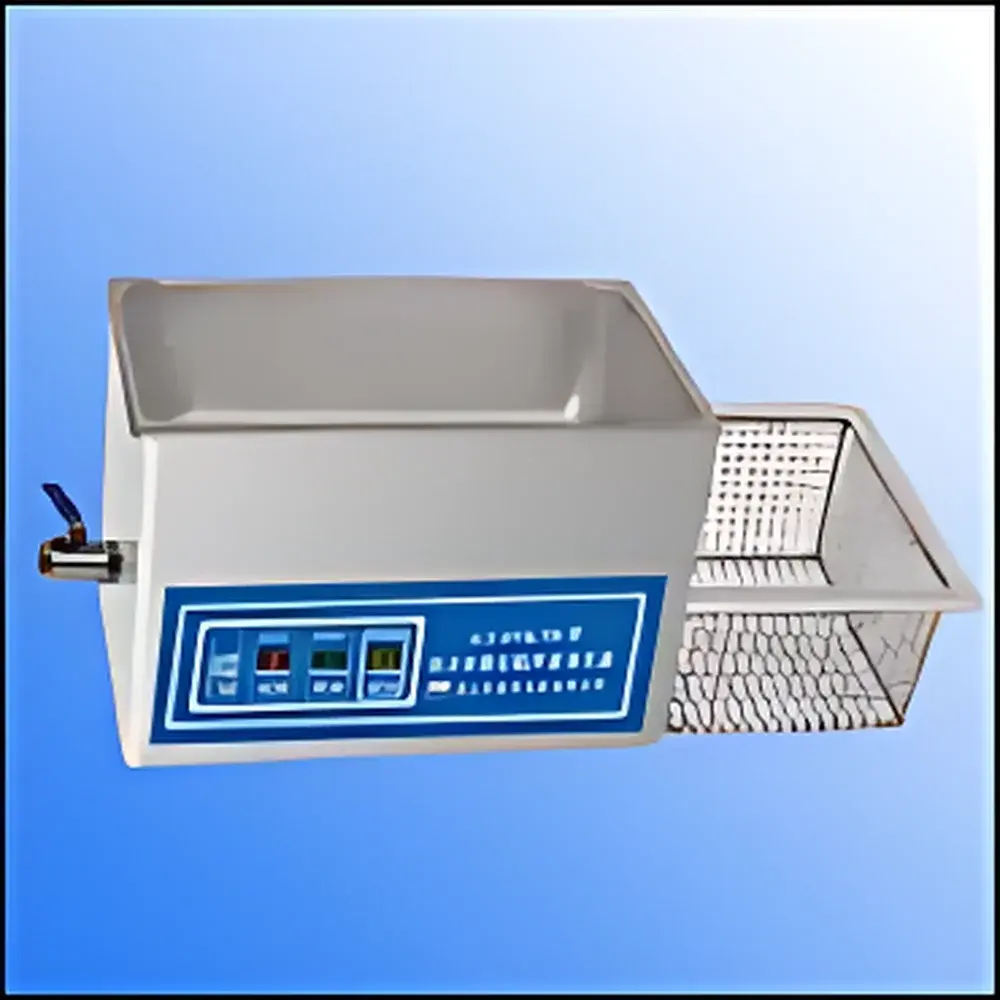
KQ-50DE/KQ-50DA/KQ-50DB Benchtop Digital Ultrasonic Cleaner
| Origin | Shanghai, China |
|---|---|
| Manufacturer Type | Authorized Distributor |
| Origin Category | Domestic (China) |
| Model Variants | KQ-50DE / KQ-50DA / KQ-50DB |
| Price | USD 310 (approx. based on ¥2180 at 1 USD = ¥7.03) |
| Dimensions (W×D×H) | 208 × 192 × 210 mm |
| Tank Internal Dimensions | 150 × 140 × 100 mm |
| Tank Capacity | 2 L |
| Ultrasonic Frequency | 40 kHz |
| Ultrasonic Power Output | 50 W (total) |
| Power per Transducer | 80 W (system-level specification |
| Temperature Control Range | Ambient to 80 °C (KQ-50DE/DB only) |
| Timer Range | KQ-50DA: 1–99 min |
| KQ-50DB/DE | 40–99 min |
| Safety Features | Low-water detection, over-temperature, over-voltage, and over-current protection |
| Accessories | Stainless steel mesh basket (KQ-50DB/DE), acoustic lid (KQ-50DE only) |
| Construction | 304 Stainless Steel Tank |
| Compliance | CE-marked per EN 61000-6-3 (EMC) and EN 61000-6-2 (Immunity) |
Overview
The KQ-50DE/KQ-50DA/KQ-50DB series represents a compact, digitally controlled benchtop ultrasonic cleaning system engineered for precision laboratory environments where space, repeatability, and operational safety are critical. These units operate on the principle of piezoelectric transduction at a fixed frequency of 40 kHz, generating high-frequency pressure waves in liquid media that induce controlled cavitation—microscopic bubble formation and collapse—resulting in mechanical shear forces effective for particle removal, degassing, dispersion, and cell lysis. Unlike analog predecessors, the KQ-50 series integrates microprocessor-based digital control for time, temperature (on DE/DB models), and power delivery, enabling protocol-driven operation essential for GLP-compliant workflows in academic research labs, QC laboratories, and small-scale R&D facilities.
Key Features
- Digital LED display showing real-time and set values for cleaning duration, bath temperature (KQ-50DE/DB), and operating power level
- Programmable timer with extended range: 1–99 minutes (KQ-50DA) or 40–99 minutes (KQ-50DB/DE), supporting both short-cycle decontamination and extended extraction protocols
- Integrated thermal regulation (KQ-50DE/DB only): Adjustable heating from ambient up to 80 °C with ±2 °C accuracy, enhancing solubilization efficiency for waxy or viscous residues
- Robust 304 stainless steel tank (150 × 140 × 100 mm internal, 2 L capacity) formed via deep-drawn stamping for structural integrity and corrosion resistance
- Acoustic damping lid included with KQ-50DE model to reduce airborne noise by ≥15 dB(A) and minimize solvent evaporation during prolonged operation
- Comprehensive electronic protection suite: automatic shutdown triggered by low liquid level, thermal runaway (>85 °C), voltage fluctuation (>±10% nominal), or current overload
- Modular transducer array delivering 50 W total ultrasonic output, configured for uniform energy distribution across the tank floor—optimized for consistent cleaning efficacy in small-volume samples (e.g., HPLC vials, microscope slides, MEMS components)
Sample Compatibility & Compliance
The KQ-50 platform accommodates standard laboratory vessels including glass beakers (up to 100 mL), plastic centrifuge tubes, metal sample holders, and ceramic crucibles. Its 2 L capacity supports simultaneous processing of multiple small parts without compromising cavitation density. All variants comply with EU directives for electromagnetic compatibility (EN 61000-6-2/6-3) and hazardous substance restrictions (RoHS 2011/65/EU). While not certified to ISO 13485 or FDA 21 CFR Part 11, the device’s deterministic digital controls, non-volatile parameter memory, and hardware-enforced safety interlocks support audit-ready documentation in ISO/IEC 17025-accredited testing labs. For sterilization validation, users must validate cycle parameters per ISO 15883-1 when used in conjunction with compatible disinfectant solutions.
Software & Data Management
This is a standalone hardware-controlled instrument with no embedded software stack, cloud connectivity, or data export capability. All operational parameters—including elapsed time, set temperature, and fault logs—are retained in non-volatile memory and displayed in real time on the front-panel LED interface. No drivers, firmware updates, or PC interfaces are required. This architecture ensures long-term reliability, eliminates cybersecurity exposure vectors, and aligns with ITAR-free procurement requirements common in government-funded research institutions. Parameter recall functionality allows immediate re-execution of previously validated cleaning protocols without manual re-entry.
Applications
- Routine cleaning of analytical glassware (volumetric flasks, pipettes, cuvettes) prior to UV-Vis or ICP-MS analysis
- Removal of organic residues from semiconductor wafers, optical lenses, and precision machined components
- Cell disruption and nucleic acid extraction in molecular biology workflows (e.g., bacterial lysis for plasmid prep)
- Ultrasonic-assisted solvent extraction of plant metabolites or polymer additives
- Degassing of HPLC mobile phases and epoxy resins to eliminate microbubbles affecting flow stability
- Homogenization of nanoparticle suspensions and emulsion stabilization in colloid science
FAQ
Is the KQ-50 series suitable for cleaning delicate optics or MEMS devices?
Yes—when operated at reduced time intervals (e.g., 2–5 min) and with low-surface-tension solvents such as isopropanol or terpene-based cleaners, the 40 kHz frequency provides sufficient energy for contaminant removal without inducing pitting or coating delamination.
Does the unit include a heater in all models?
No—only the KQ-50DE and KQ-50DB models feature integrated heating elements. The KQ-50DA is a non-heating variant intended for ambient-temperature applications.
Can the timer be paused or reset mid-cycle?
No—the timer is non-interruptible once initiated; however, power cycling resets all parameters to default settings, requiring full reconfiguration.
What maintenance is required for long-term reliability?
Routine cleaning of the tank interior with mild detergent and periodic inspection of the transducer mounting surface for adhesive integrity are recommended. Avoid abrasive cleaners or chlorine-based solutions that may accelerate stainless steel passivation layer degradation.
Is calibration traceable to NIST or other national standards?
The unit does not provide factory calibration certificates. Users performing critical cleaning validation should employ external thermometers (for temperature verification) and calibrated ultrasonic power meters (e.g., calorimetric probes per ASTM E1573) to establish measurement traceability.
Related Products



