KRI RFICP40 Radio-Frequency Inductively Coupled Plasma Kaufman Ion Source
| Brand | KRI (Kaufman & Robinson, Inc.) |
|---|---|
| Origin | USA |
| Model | RFICP40 |
| Ion Beam Current | Up to 1.2 A (typical, scalable by aperture and gas flow) |
| Operating Gases | Ar, O₂, N₂, Xe, or mixtures |
| RF Frequency | 13.56 MHz |
| Nominal Beam Energy Range | 50–1500 eV (adjustable via extraction voltage) |
| Extraction Aperture Diameter | 40 mm |
| Vacuum Compatibility | ≤5×10⁻⁴ Torr (base pressure), ≥1×10⁻³ Torr (operational) |
| Cooling | Water-cooled anode and cathode assembly |
| Compliance | CE-marked, RoHS-compliant, compatible with ISO 9001-certified vacuum integration workflows |
Overview
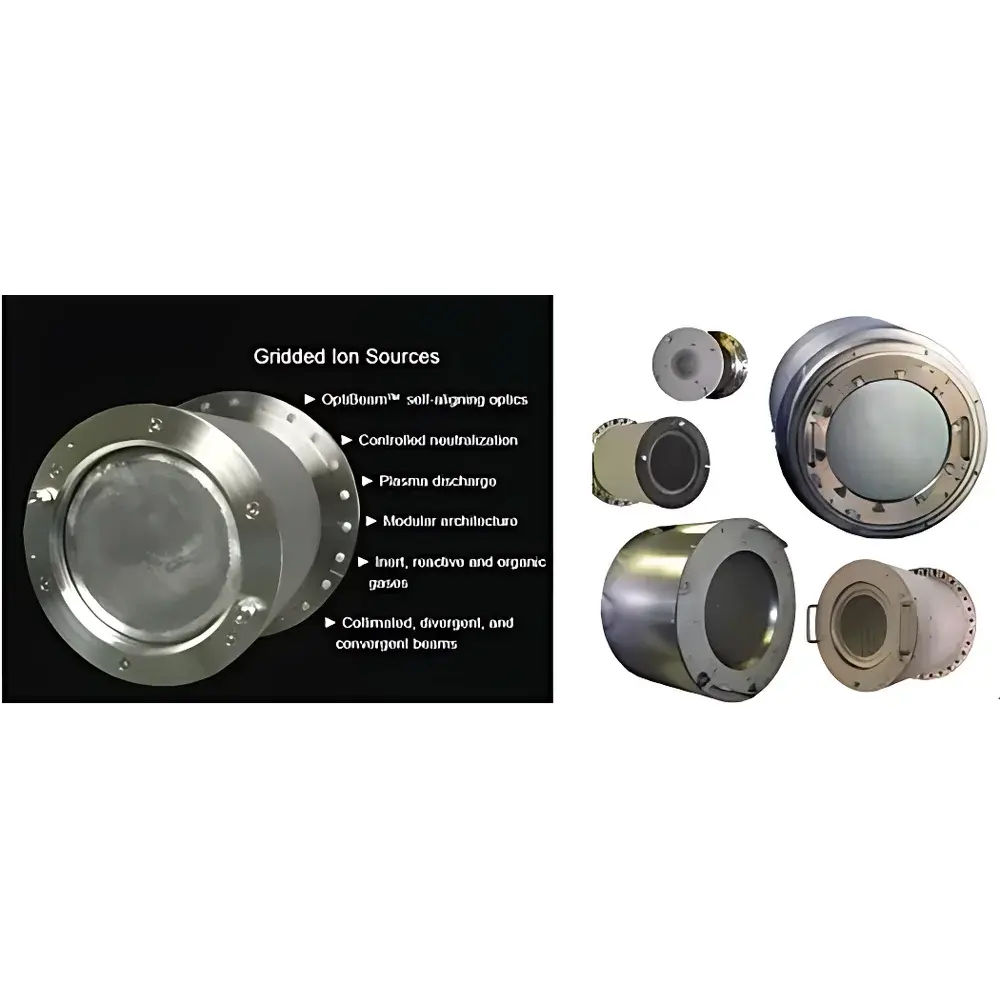
The KRI RFICP40 is a radio-frequency inductively coupled plasma (RF-ICP) Kaufman-type ion source engineered for high-precision, low-damage ion beam etching (IBE) in ultra-high vacuum (UHV) and high-vacuum environments. Unlike thermionic or DC-discharge ion sources, the RFICP40 employs a self-sustaining, electrodeless plasma generation mechanism: RF power at 13.56 MHz couples energy into neutral process gas (e.g., Ar, O₂, or N₂) within a quartz discharge chamber, producing a dense, spatially uniform plasma with electron temperatures of ~2–4 eV. Ions are extracted through a precisely aligned, water-cooled three-grid electrostatic system—comprising screen, accelerator, and decelerator grids—enabling independent control of beam current (via plasma density) and ion energy (via grid bias potentials). This decoupling ensures stable, reproducible ion fluxes across wafer-scale substrates while minimizing surface charging, lattice disorder, and thermal loading—critical for etching delicate thin-film stacks (e.g., III–V semiconductors, high-k dielectrics, or 2D materials) and nanoscale photonic structures.
Key Features
- Electrodeless RF-ICP plasma generation eliminates cathode sputtering and extends source lifetime beyond 10,000 operating hours under routine maintenance
- 40 mm diameter extraction aperture supports uniform beam profiles over Ø75–Ø150 mm substrates; optional beam shaping apertures available for collimation or divergence control
- Independent regulation of beam current (50–1200 mA) and ion energy (50–1500 eV) enables process optimization for both physical sputtering and reactive ion etching (RIE) modes
- Water-cooled stainless-steel anode and borosilicate quartz discharge tube ensure thermal stability during extended duty cycles (>8 h continuous operation)
- Integrated Faraday cup and beam profile monitor ports support real-time beam diagnostics without breaking vacuum
- Designed for seamless integration into UHV systems compliant with ISO 27497-2 (vacuum interface standards) and ASTM F2107 (ion source performance testing)
Sample Compatibility & Compliance
The RFICP40 operates effectively on conductive, semiconductive, and insulating substrates—including Si, GaAs, InP, SiO₂, Si₃N₄, Al₂O₃, and polymer films—without requiring conductive coatings or RF biasing of the sample stage. Its low-energy, high-current capability mitigates ion-induced defect formation in crystalline lattices and reduces redeposition artifacts common in high-energy broad-beam etching. The source meets material compatibility requirements for semiconductor front-end-of-line (FEOL) R&D and MEMS fabrication per SEMI E10 and ISO/IEC 17025-accredited laboratories. All wetted components conform to USP Class VI biocompatibility standards where applicable, and electromagnetic emissions comply with FCC Part 18 and EN 61326-1 for laboratory instrumentation.
Software & Data Management
The RFICP40 interfaces via RS-232 or Ethernet (Modbus TCP) with host vacuum control systems (e.g., MKS Instruments FlowBus, Pfeiffer Vacuum HiCube controllers) and third-party SCADA platforms. KRI’s IonSource Control Suite (v3.2+) provides closed-loop regulation of RF forward/reflected power, gas flow rates (via integrated MFC drivers), grid voltages, and cooling water temperature—logging all parameters with timestamped, audit-trail-enabled records. Data export complies with ASTM E2500-20 (data integrity for regulated processes) and supports 21 CFR Part 11-compliant electronic signatures when deployed in GMP/GLP environments. Raw beam current and energy calibration files are traceable to NIST-standard Faraday cup measurements.
Applications
- Atomic-layer precision etching of multilayer heterostructures in quantum device fabrication
- In-situ cleaning and surface activation prior to molecular beam epitaxy (MBE) or atomic layer deposition (ALD)
- Maskless patterning of sub-100 nm features in resist-free lithography workflows
- Ion milling of cross-sectional TEM lamellae with minimal amorphization zone (<2 nm)
- Surface modification of biomedical implants to enhance hydrophilicity or protein adhesion
- Spacecraft component testing under simulated LEO atomic oxygen exposure using O⁺ beams
FAQ
What vacuum conditions are required to operate the RFICP40?
Optimal operation requires a base pressure ≤5×10⁻⁴ Torr; operational pressure during beam extraction ranges from 1×10⁻³ to 3×10⁻³ Torr, depending on gas type and flow rate.
Can the RFICP40 be used with reactive gases such as Cl₂ or SF₆?
Yes—though aggressive halogen chemistries require quartz chamber upgrades and enhanced corrosion-resistant grid materials (e.g., Ir-coated Mo); consult KRI Application Note AN-RFICP-07 for reactive gas protocols.
Is remote monitoring and predictive maintenance supported?
Yes—the source’s embedded diagnostics report RF impedance drift, grid emission asymmetry, and coolant flow anomalies; these metrics feed into KRI’s Predictive Health Dashboard (PHD) for proactive service scheduling.
How does the RFICP40 compare to gridded DC Kaufman sources in terms of beam uniformity?
RF-ICP architecture delivers ±3% current density variation across a 100 mm diameter beam—superior to typical ±8–12% for DC sources—due to absence of cathode potential gradients and improved plasma confinement.
What certifications accompany the RFICP40 for export-controlled applications?
The system carries EAR99 classification; dual-use configurations (e.g., >2000 eV operation or >2 A current) may require BIS license review per Supplement No. 1 to Part 774, Category 3 (Electronics).