
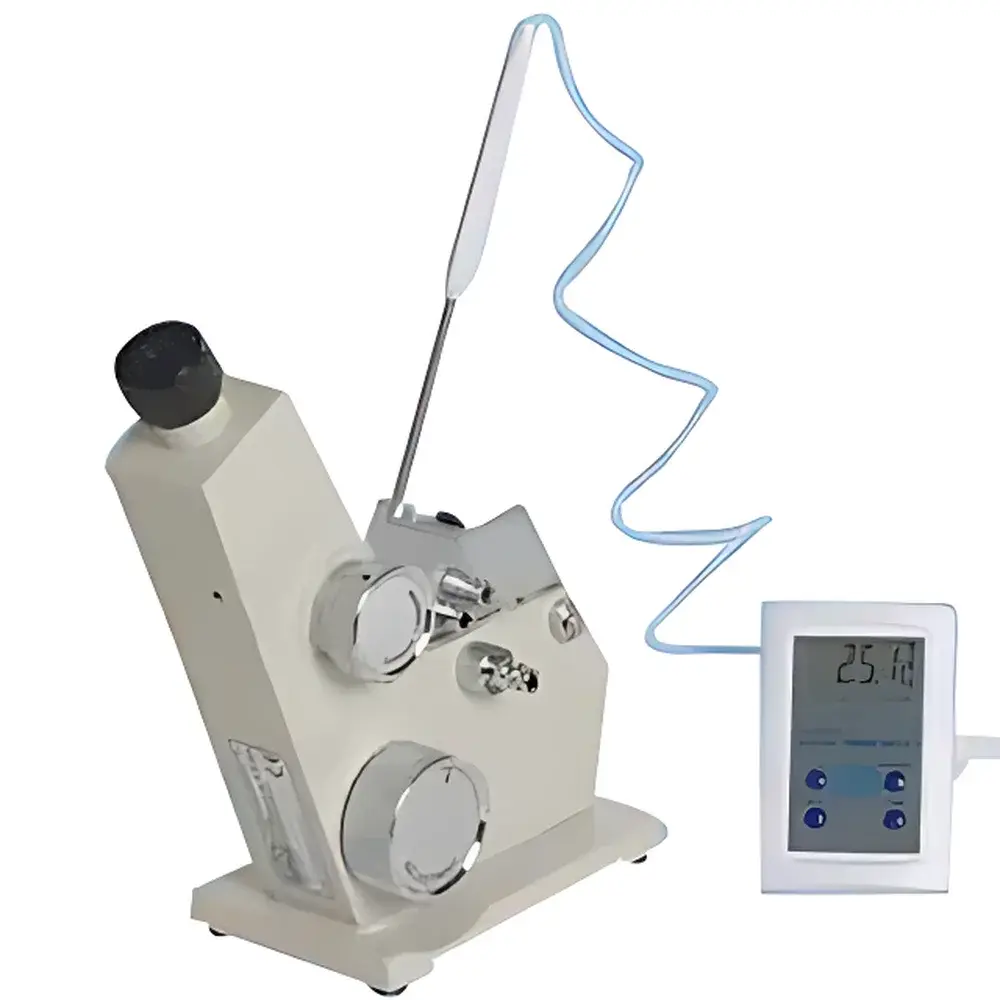
KRUESS AR4 Abbe Refractometer
| Brand | KRUESS |
|---|---|
| Origin | Germany |
| Model | AR4 |
| Type | Benchtop Abbe Refractometer |
| Temperature Control | Integrated Peltier-based thermostatic system |
| Readout Method | Analog optical scale via calibrated eyepiece |
| Measurement Range | 1.3000–1.7000 nD |
| Brix Range | 0–95 % |
| Accuracy | ±0.0002 nD / ±0.1 %Brix |
| Scale Division | 0.0005 nD / 0.25 %Brix |
| Light Source | Stable 589 nm LED (Lifespan >100,000 h) |
| Temperature Monitoring | Digital sensor, -40 to +120 °C |
| Power Supply | Dual-voltage auto-switching (110 V / 220 V, 50/60 Hz) |
| Dimensions | 140 × 100 × 235 mm |
| Weight | 4.4 kg |
| Calibration Standard | ASTM D1218-compliant calibration plate |
| Prism Material | High-stability optical glass with refractive index >1.75 |
Overview
The KRUESS AR4 Abbe Refractometer is a precision benchtop instrument engineered for accurate and repeatable measurement of refractive index (nD) and soluble solids content (°Brix) in transparent or translucent liquids, semi-solids, and homogeneous solids. Based on the classical Abbe principle—first developed by Ernst Abbe in 1869—the instrument exploits the critical angle of total internal reflection at the interface between a high-refractive-index measuring prism and the sample. The fixed wavelength illumination (589 nm sodium-D line equivalent, delivered via long-life LED) ensures spectral consistency essential for traceable metrology. Because refractive index is inherently temperature-dependent, the AR4 integrates dual thermostatic control: both the measuring and illuminating prisms are actively coupled to a Peltier-based temperature regulation system, enabling stable thermal equilibration across the full operating range (−40 to +120 °C). This architecture eliminates drift due to ambient fluctuations and supports compliance with standardized test conditions required in quality control laboratories.
Key Features
- High-precision optical design with calibrated Abbe prism assembly (refractive index >1.75) ensuring reliable upper-range performance up to nD = 1.7000
- Stable 589 nm LED light source with >100,000-hour operational lifetime—eliminates filament degradation and spectral shift associated with traditional sodium lamps
- Integrated digital temperature sensor and Peltier-controlled prism thermostating for real-time thermal stabilization and reproducible measurements
- Analog optical scale with 0.0005 nD resolution and 0.25 %Brix graduation, viewed through an adjustable, anti-glare eyepiece
- ASTM D1218-compliant calibration plate included for routine verification and traceable recalibration
- Compact, robust benchtop housing (140 × 100 × 235 mm; 4.4 kg) with dual-voltage power supply (110/220 V, auto-sensing)
- No moving parts in optical path—minimizes mechanical hysteresis and enhances long-term stability
Sample Compatibility & Compliance
The AR4 accommodates a broad spectrum of sample types—including aqueous solutions, syrups, oils, polymer melts, pharmaceutical excipients, and solid crystals—when used with appropriate contact fluid (e.g., bromonaphthalene or specialized immersion oils). Its optical design renders it insensitive to sample coloration or minor particulate contamination, making it suitable for raw material screening in food, beverage, and chemical production environments. The instrument meets fundamental requirements of ISO 21747 (Refractometers — General requirements), and its calibration protocol aligns with ASTM D1218 (Standard Test Method for Refractive Index of Hydrocarbon Liquids). While the AR4 itself does not generate electronic audit trails, its analog readout and manual calibration workflow support GLP-compliant documentation when integrated into laboratory SOPs. It is routinely deployed in facilities operating under FDA 21 CFR Part 11–aligned quality systems where operator-recorded values are validated against reference standards.
Software & Data Management
The KRUESS AR4 operates as a standalone optical instrument without embedded microprocessor control or digital data output. All readings are captured visually through the calibrated eyepiece and recorded manually by the operator. This design prioritizes mechanical reliability, minimal maintenance, and immunity to firmware-related obsolescence. For laboratories requiring digital archiving, external documentation workflows—such as structured paper logbooks, LIMS-integrated manual entry, or time-stamped photographic capture of the scale—are recommended. Optional accessories include a camera adapter for objective-scale imaging and a temperature data logger compatible with the built-in digital sensor output (0–5 V analog signal available upon request).
Applications
- Quality assurance of sucrose concentration in soft drinks, fruit juices, and confectionery syrups (0–95 %Brix)
- Concentration monitoring of caustic soda, glycol, and other industrial process fluids in chemical and petrochemical plants
- Raw material identity testing and purity verification in pharmaceutical manufacturing (e.g., ethanol/water mixtures, glycerin, propylene glycol)
- Solid content analysis in pulp and paper industry effluents and coating formulations
- Concentration control in textile dye baths and metalworking coolants
- Wastewater treatment parameter estimation (e.g., total dissolved solids proxy via nD)
- Educational use in university physics and analytical chemistry laboratories for foundational optics and solution thermodynamics experiments
FAQ
Does the AR4 support automated data export or USB connectivity?
No. The AR4 is an analog optical instrument with no digital interface, memory, or communication ports. Data recording is performed visually and manually.
Can the AR4 measure opaque or highly viscous samples?
Yes—provided the sample forms a continuous, bubble-free film between the prism and contact fluid. Semi-solids such as honey, molasses, or polymer gels can be measured using standard Abbe methodology and appropriate temperature conditioning.
Is temperature calibration traceable to national standards?
The integrated digital temperature sensor is factory-calibrated and provides direct readout in °C. Traceable calibration certificates (NIST-traceable) are available as an optional service through KRUESS-certified service centers.
What maintenance is required for long-term accuracy?
Routine cleaning of prism surfaces with lens-grade tissue and spectroscopic-grade solvent (e.g., xylene or acetone), periodic verification using the included ASTM D1218 calibration plate, and annual inspection of Peltier module thermal coupling are recommended.
Is the 589 nm LED replaceable in the field?
Yes—the LED module is user-replaceable using standard KRUESS service kit AR4-LED-KIT, requiring no optical realignment.





