
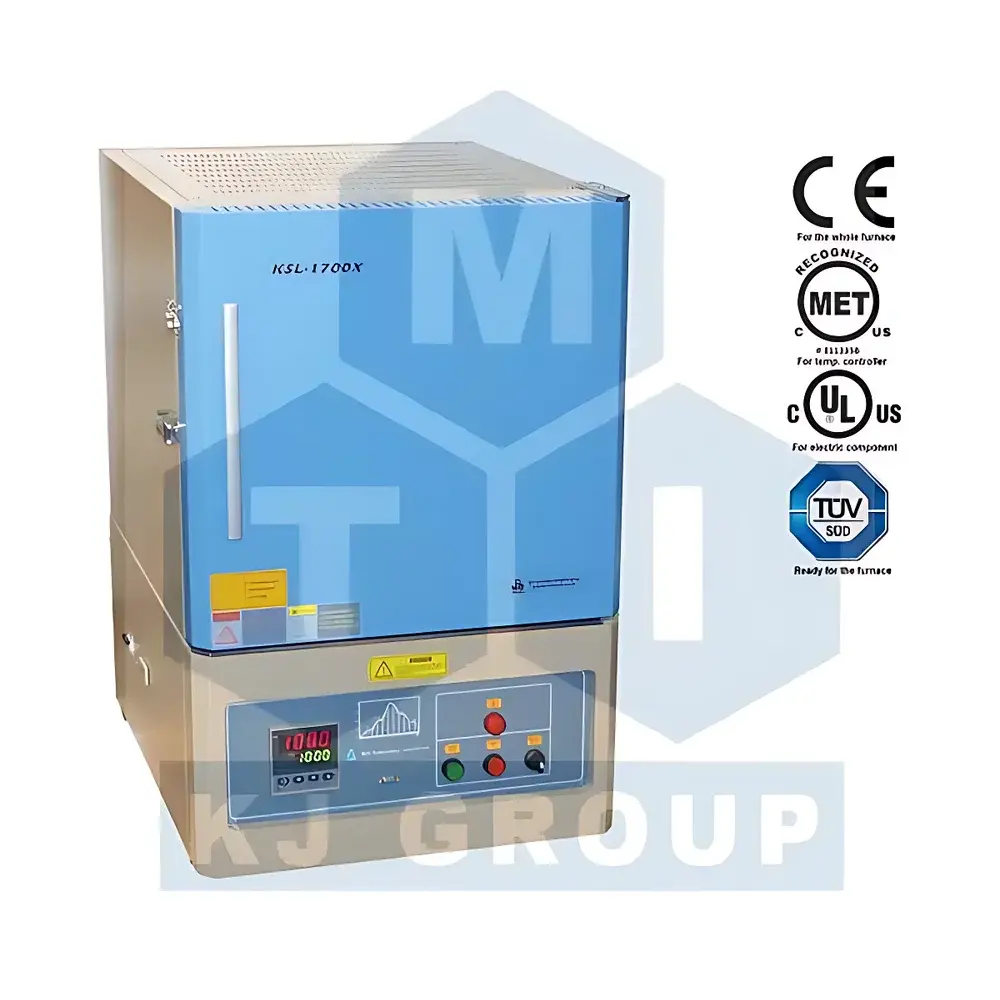
KSL-1750X-A3 High-Temperature Box Furnace (1750°C, 19 L Capacity)
| Brand | Hefei Kejing |
|---|---|
| Origin | Anhui, China |
| Model | KSL-1750X-A3 |
| Maximum Temperature | 1750°C |
| Temperature Uniformity | ±1°C |
| Rated Power | 9 kW |
| Heating Rate (to Max Temp) | 10°C/min |
| Heating Element | Silicon Molybdenum (MoSi₂) Rods |
| Internal Chamber Dimensions | 250 × 300 × 250 mm (19 L) |
| Control System | 30-Stage Programmable PID Controller with Type B Dual Platinum-Rhodium Thermocouple |
| Chamber Lining | Polycrystalline Alumina Fiber with US-Imported 1760°C Alumina Reflective Coating |
| Certifications | CE, UL/MET/CSA (components >24 V), Optional TÜV or CSA Single-Unit Certification Available |
Overview
The KSL-1750X-A3 is a high-temperature box furnace engineered for precision thermal processing in materials science laboratories, ceramic R&D facilities, and advanced powder metallurgy applications. Operating on the principle of resistive heating via silicon molybdenum (MoSi₂) rods, it delivers stable, uniform temperatures up to 1750°C within a 19-liter working chamber. Unlike conventional resistance-heated furnaces using Fe-Cr-Al alloys, the MoSi₂ heating elements provide superior oxidation resistance above 1500°C, enabling extended service life under repeated high-temperature cycling. The furnace employs a dual platinum-rhodium (Type B) thermocouple—calibrated for accuracy across the full 0–1820°C range—integrated with a 30-segment programmable PID controller (518P series) to ensure repeatable thermal profiles and minimal overshoot. Its polycrystalline alumina fiber insulation, coated with a proprietary US-sourced alumina reflective layer rated to 1760°C, minimizes radial heat loss and enhances energy efficiency while maintaining structural integrity at peak operating conditions.
Key Features
- High-temperature capability: Continuous operation up to 1700°C; short-term maximum 1750°C (≤1 hour per cycle)
- Precision temperature control: ±1°C uniformity across the hot zone (measured at center and ±25 mm from walls)
- Robust thermal architecture: Multi-layer polycrystalline alumina fiber insulation (≥200 mm thickness) with high-emissivity reflective coating
- Programmable thermal profiling: 30-step ramp-hold sequences with user-defined rate limits (0.1–10°C/min), soak times, and cooling protocols
- Side-opening door design with reinforced ceramic fiber gasket ensures rapid access while minimizing thermal leakage
- Comprehensive safety compliance: CE-marked; all low-voltage control circuits and power components (>24 V) certified to UL 61010-1 / MET / CSA standards
- Modular heater replacement: Pre-aligned MoSi₂ rod mounting system enables field servicing without recalibration
Sample Compatibility & Compliance
The KSL-1750X-A3 is designed for atmospheric or inert-gas (N₂, Ar) environments only. It lacks vacuum-tight sealing or gas-purging ports; therefore, operation under reducing, flammable, or explosive atmospheres (e.g., H₂, CO, CH₄) is strictly prohibited. Corrosive gases—including Cl₂, NH₃, HF, SO₂, and sulfur-containing vapors—will degrade the alumina fiber lining and MoSi₂ elements unless pre-approved modifications are implemented (e.g., specialized SiC-coated chamber liners or quartz diffusion barriers). For GLP/GMP-regulated environments, optional audit-ready data logging (with timestamped temperature traces and operator ID tagging) complies with FDA 21 CFR Part 11 requirements when paired with validated software. The furnace meets ASTM E1142 (Standard Specification for Laboratory Furnaces) for dimensional stability and thermal performance verification.
Software & Data Management
While the standard configuration features a front-panel 518P controller with local setpoint adjustment and real-time curve display, optional RS485 Modbus RTU or Ethernet TCP/IP interfaces enable integration into centralized lab management systems (LIMS). Third-party SCADA platforms (e.g., Ignition, LabVIEW) can acquire time-stamped temperature data at 1-second intervals, supporting automated report generation per ISO/IEC 17025 documentation requirements. Firmware supports password-protected parameter locking, event logging (door open/close, over-temperature alarms, power interruption), and export of CSV-formatted thermal histories for traceability audits.
Applications
- Sintering of advanced ceramics (Al₂O₃, ZrO₂, SiC, Si₃N₄) and refractory metals (W, Mo, Ta)
- Heat treatment of battery cathode precursors (e.g., LiCoO₂, NMC, LFP) under controlled air or O₂-rich atmospheres
- Thermal gravimetric analysis (TGA) sample pre-conditioning and ashing protocols
- Glass melting and homogenization studies requiring precise soak cycles above 1600°C
- Calibration of high-temperature reference standards (e.g., fixed-point cells, thermocouple wire annealing)
- Research-scale crystal growth via flux or solid-state reaction methods
FAQ
Can this furnace be used under vacuum or hydrogen atmosphere?
No. The KSL-1750X-A3 has no vacuum seal or gas-tight construction. Use only in ambient air or inert purge (N₂/Ar) environments.
What is the expected service life of the MoSi₂ heating elements?
Under recommended ramp/cool rates (≤10°C/min) and continuous operation ≤1700°C, typical element lifetime exceeds 1,200 hours at 1750°C or 3,500+ hours at 1600°C.
Is furnace calibration traceable to NIST standards?
Yes—optional factory calibration includes as-found/as-left reports with uncertainty budgets referenced to NIST-traceable secondary standards (±0.5°C at 1750°C).
Does the unit include data logging capability by default?
No. Local controller display shows real-time temperature only. Data logging requires optional communication module and host PC software.
How should minor cracks in the furnace lining be addressed?
Surface microcracking in the alumina fiber is normal after thermal cycling. Apply KEJING’s OEM alumina repair paste (ref. AL-RC-1760) to restore emissivity and prevent fiber dusting.



