
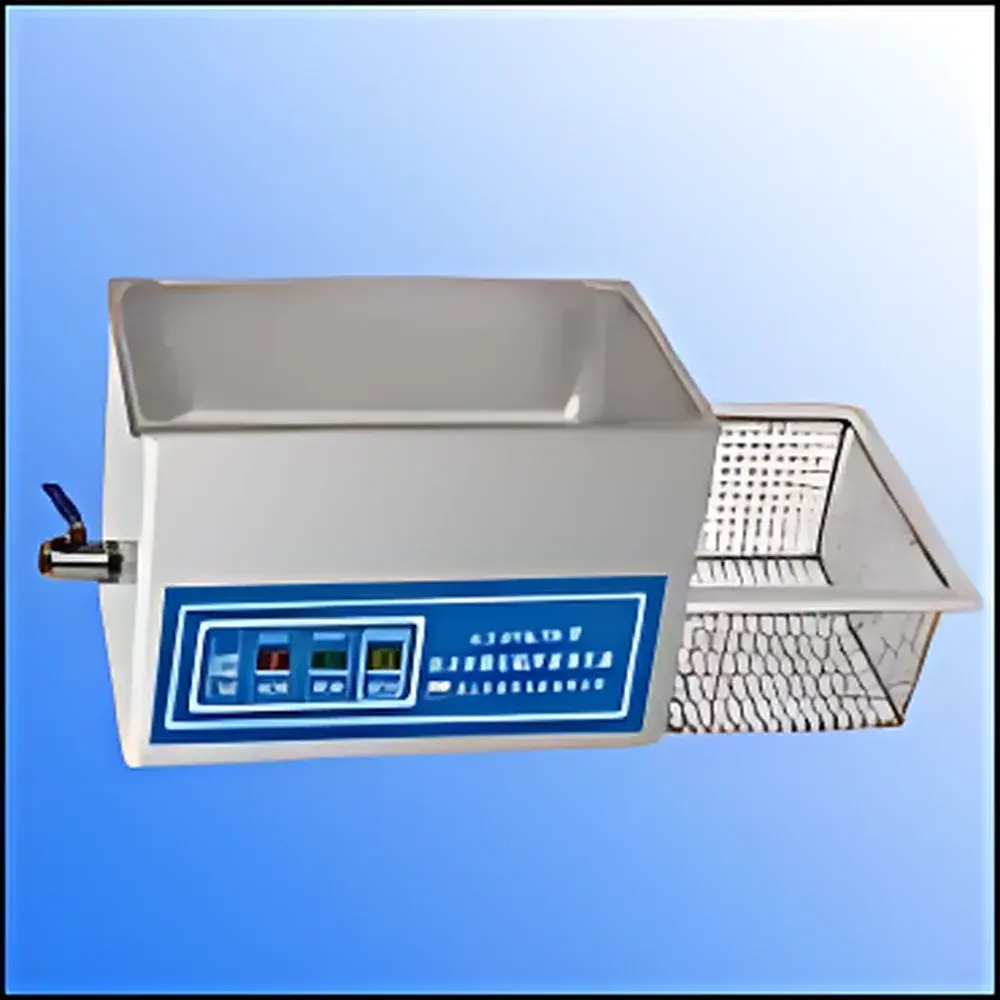
Kunshan KQ-600KDB Benchtop High-Power Digital Ultrasonic Cleaner
| Origin | Shanghai, China |
|---|---|
| Manufacturer Type | Authorized Distributor |
| Country of Origin | China |
| Model | KQ-600KDB |
| Price | USD 1,450 (FOB Shanghai) |
| Dimensions (W×D×H) | 320×264×360 mm |
| Tank Interior (W×D×H) | 300×240×150 mm |
| Capacity | 10 L |
| Ultrasonic Frequency | 40 kHz |
| Ultrasonic Power Output | 600 W |
| Heating Power | 600 W |
| Temperature Range | 20–80 °C |
| Timer Range | 1–480 min |
| Drain Valve | Yes |
| Lid | No |
| Tank Material | 304 Stainless Steel |
| Rack Material | 304 Stainless Steel (argon-welded mesh) |
| Safety Protections | Digital over-temperature, over-voltage, and over-current monitoring with LED indicators |
Overview
The Kunshan KQ-600KDB Benchtop High-Power Digital Ultrasonic Cleaner is an integrated ultrasonic cleaning system engineered for precision laboratory and light industrial applications requiring consistent cavitation intensity, thermal stability, and programmable process control. It operates on the principle of piezoelectric transduction at a fixed frequency of 40 kHz, generating high-intensity acoustic pressure waves in aqueous or compatible solvent media. These waves induce controlled micro-cavitation—formation, growth, and implosive collapse of microscopic vacuum bubbles—delivering mechanical shear forces that remove particulate contaminants, organic residues, biofilms, and loosely adhered oxides from complex surface geometries. Unlike batch immersion methods relying solely on diffusion or agitation, this device delivers reproducible energy delivery across the entire tank volume, making it suitable for critical pre-analytical sample preparation, component degreasing prior to coating or metrology, and routine maintenance of optical, microfluidic, and precision mechanical parts.
Key Features
- Integrated digital control panel with real-time display of set and actual temperature, elapsed ultrasonic time, and operational status indicators
- 600 W total ultrasonic power output distributed across multiple high-efficiency piezoelectric transducers mounted directly to the stainless steel tank base—each rated at 100 W nominal output for uniform energy distribution
- 304 stainless steel tank (300 × 240 × 150 mm internal dimensions) formed via deep-drawn stamping and TIG-welded seams for structural integrity and corrosion resistance under repeated thermal cycling
- Dual independent heating system (600 W) enabling rapid, stable temperature ramping within the 20–80 °C range; PID-based temperature regulation ensures ±2 °C accuracy over full load conditions
- Programmable timer (1–480 minutes) with auto-shutdown and memory retention for repeatable process validation
- Comprehensive digital safety architecture: simultaneous monitoring of tank temperature, input voltage, and current draw—with visual LED alerts and automatic shutdown upon detection of out-of-spec conditions
- Stainless steel wire mesh rack (argon-welded construction) designed for optimal acoustic transparency and mechanical durability; accommodates standard labware including Petri dishes, cuvettes, glassware, and small metal components
- Integrated drain valve with PTFE-sealed brass fitting for safe, residue-free tank emptying—compatible with waste solvent collection protocols
Sample Compatibility & Compliance
The KQ-600KDB is validated for use with water-based detergents, ethanol, isopropanol, acetone, and other low-surface-tension solvents commonly employed in analytical and quality control laboratories. Its 40 kHz operating frequency provides optimal balance between cleaning efficacy and substrate safety for delicate samples—including silicon wafers, MEMS devices, surgical instruments, HPLC columns, and optical lenses—without inducing surface pitting or etching under recommended exposure durations. The unit complies with IEC 61000-6-3 (EMC emission standards) and IEC 61000-6-2 (immunity), and its electrical design conforms to IEC 61010-1 for laboratory equipment safety. While not certified to ISO 13485 or FDA 21 CFR Part 11 out-of-the-box, its digital logging capability (via optional RS232/USB interface) supports integration into GLP/GMP environments where audit-trail documentation of cleaning parameters is required.
Software & Data Management
The KQ-600KDB features embedded firmware supporting parameter recall and non-volatile storage of up to five user-defined cleaning profiles. Though no proprietary PC software is bundled, the unit includes a standard RS232 serial port (with optional USB-to-serial adapter) enabling third-party data acquisition via terminal emulation or LabVIEW-compatible drivers. Time-stamped operational logs—including start/stop timestamps, setpoint deviations, and fault codes—can be exported for traceability. For regulated laboratories, integration with electronic lab notebooks (ELNs) or LIMS systems is achievable through ASCII-based command protocols documented in the technical manual.
Applications
- Pretreatment of substrates prior to SEM, XRD, or thin-film deposition
- Cleaning of reusable pipette tips, centrifuge rotors, and electrophoresis combs
- Removal of flux residues from PCB assemblies in electronics R&D
- Cell lysis and tissue homogenization in molecular biology workflows (when used with appropriate buffers)
- Ultrasonic-assisted extraction of plant metabolites or environmental analytes
- De-gassing of solvents prior to HPLC mobile phase preparation
- Routine decontamination of glassware and stainless steel fixtures in QC/QA labs
FAQ
Is the KQ-600KDB suitable for cleaning delicate optical components?
Yes—when operated at lower power settings (e.g., 30–50% amplitude) and with appropriate low-viscosity solvents, it effectively removes dust, oils, and fingerprints without damaging anti-reflective coatings or fused silica surfaces.
Does the unit support continuous operation?
It is rated for intermittent duty cycles up to 480 minutes per session; for extended use beyond 8 hours/day, forced-air cooling of the transducer housing is recommended to maintain long-term reliability.
Can the cleaning parameters be validated for ISO 17025-compliant labs?
Yes—temperature uniformity mapping, ultrasonic power density verification (via calorimetry), and timer accuracy testing can be performed using NIST-traceable instrumentation; full validation documentation templates are available upon request.
What maintenance is required?
Monthly inspection of the drain valve seal, quarterly descaling of the heating element using 5% citric acid solution, and annual transducer impedance check using a multimeter are recommended for sustained performance.
Is the stainless steel tank passivated?
The 304 stainless steel tank undergoes electropolishing and citric acid passivation during manufacturing to enhance corrosion resistance and minimize metallic ion leaching into cleaning solutions.



