
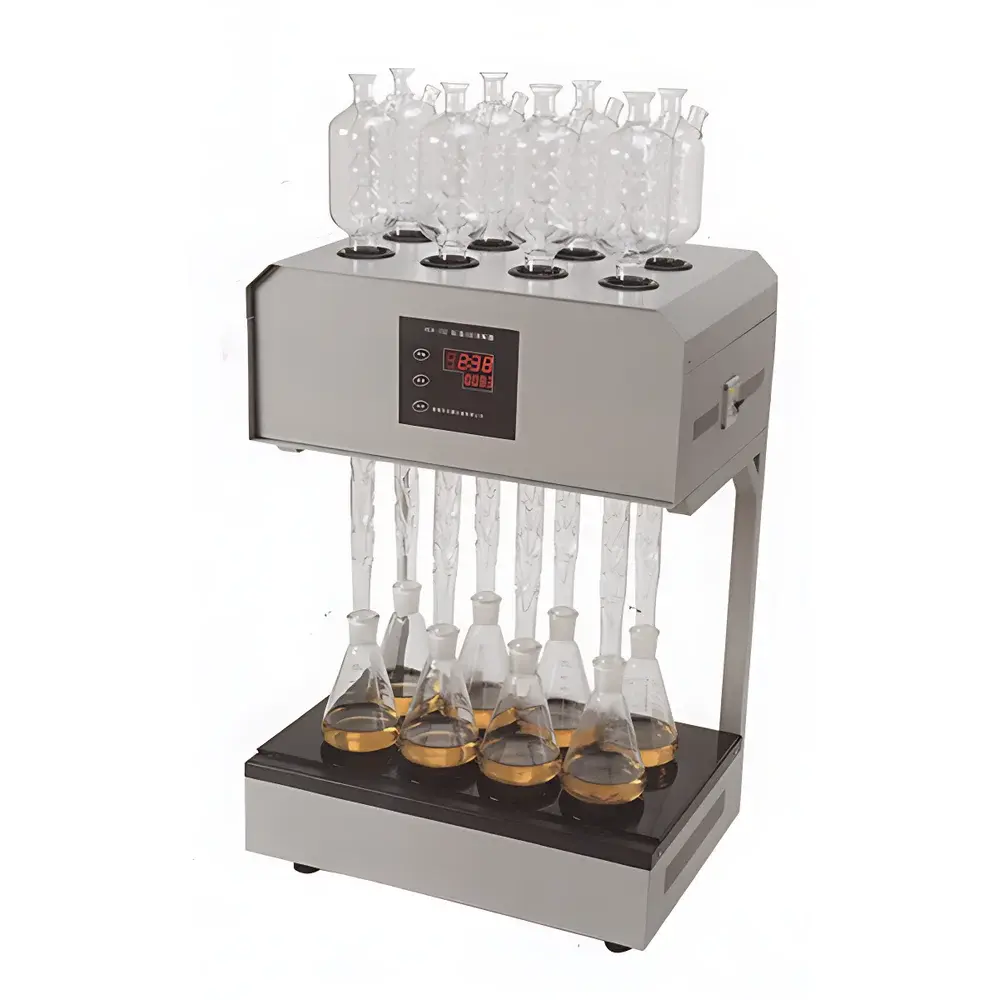
KY-100 Koyuan Digital Microcrystalline Standard COD Digestion Apparatus
| Brand | Koyuan Instruments |
|---|---|
| Origin | Jiangsu, China |
| Manufacturer Type | Direct Manufacturer |
| Country of Origin | China |
| Model | KY-100 |
| Pricing | Upon Request |
| Digestion Vessel Capacity | 250 mL Erlenmeyer Flask (24/29 Ground Joint) |
| Sample Throughput | 8 Samples Simultaneously |
| COD Measurement Range | 0–1000 mg/L (direct) |
| Digestion Time | ≤ 2 h |
| Accuracy | RSD ≤ 5.0% for 500 mg/L Potassium Hydrogen Phthalate Standard |
| Ambient Operating Temperature | ≤ 40 °C |
| Heating Power | 1600 W (AC 220 ± 22 V, 50 Hz) |
| Dimensions (L×W×H) | 450 × 350 × 650 mm |
| Cooling Method | Forced-air convection (no tap water required) |
| Reflux Configuration | Glass spiky condenser (replaces traditional spherical condenser) |
| Compliance Standard | GB 11914–1989 “Water Quality — Determination of Chemical Oxygen Demand (Dichromate Method)” |
Overview
The KY-100 Koyuan Digital Microcrystalline Standard COD Digestion Apparatus is a laboratory-grade, microprocessor-controlled digestion system engineered for precise and reproducible chemical oxygen demand (COD) determination in aqueous samples according to the dichromate oxidation method. It implements the fundamental principle of closed-reflux, high-temperature acid digestion—where samples are heated under reflux conditions at ~150 °C for a defined duration (typically 2 hours), enabling complete oxidation of organic matter by potassium dichromate in concentrated sulfuric acid medium. The apparatus replaces conventional water-cooled spherical condensers with borosilicate glass spiky condensers and substitutes continuous tap-water cooling with intelligent forced-air convection, eliminating water consumption while maintaining thermal stability and vapor containment. Its design strictly adheres to the procedural framework of GB 11914–1989—the Chinese national standard harmonized with ISO 6060—and supports full traceability in environmental compliance testing.
Key Features
- Digital microcontroller-based timing and temperature regulation ensures consistent heating profiles across all eight digestion positions, minimizing inter-vessel variability.
- Spiky condenser geometry increases internal surface area and enhances reflux efficiency compared to spherical condensers—reducing reagent loss and improving analytical reproducibility.
- Energy-efficient 1600 W heating module delivers rapid thermal ramp-up and maintains stable boiling conditions within the 250 mL ground-joint Erlenmeyer flasks (24/29 standard taper).
- Auto-shutdown functionality activates upon completion of the pre-set digestion cycle, enhancing operational safety and reducing standby power consumption.
- Compact vertical chassis (450 × 350 × 650 mm) optimizes benchtop footprint while accommodating standardized glassware and facilitating integration into regulated QC laboratories.
- No external water supply required—fully compliant with water conservation mandates and suitable for facilities with restricted plumbing access or metered utility usage.
Sample Compatibility & Compliance
The KY-100 accommodates a broad spectrum of aqueous matrices, including municipal wastewater, industrial effluents (e.g., textile, pharmaceutical, food processing), surface water, and treated effluent streams. Each digestion position accepts standard 250 mL borosilicate Erlenmeyer flasks fitted with matching spiky condensers, ensuring uniform reagent-to-sample ratios and consistent reflux dynamics. All operational parameters—including reagent volumes, acid concentration, oxidant dosage, and digestion time—are aligned with GB 11914–1989 and functionally equivalent to ISO 6060:1989. The system supports method validation per ISO/IEC 17025 requirements when used in conjunction with certified reference materials (e.g., potassium hydrogen phthalate solutions) and calibrated volumetric glassware. While not intrinsically 21 CFR Part 11–compliant (as it lacks electronic audit trail or user authentication), its procedural fidelity enables seamless incorporation into GLP- or GMP-aligned environmental testing workflows when paired with documented SOPs and manual logbook entries.
Software & Data Management
The KY-100 operates as a standalone hardware platform without embedded software or digital data output interfaces. Timing and power control are managed via an integrated digital timer with LED display and tactile push-button interface—designed for reliability, minimal maintenance, and immunity to electromagnetic interference. Users record digestion start/end times, sample IDs, reagent lot numbers, and observed endpoint conditions manually in laboratory notebooks or LIMS-integrated spreadsheets. For laboratories requiring automated data capture, the apparatus is fully compatible with external time-stamped video monitoring systems or programmable logic controllers (PLCs) interfaced via dry-contact relay outputs (optional accessory). No firmware updates, cloud connectivity, or proprietary drivers are involved—ensuring long-term operational continuity and compatibility with legacy QA documentation systems.
Applications
- Regulatory compliance testing for discharge permits under local environmental protection statutes (e.g., China’s MEP Order No. 48, EU Urban Wastewater Treatment Directive).
- Process control in wastewater treatment plants—monitoring influent, effluent, and sludge digestion streams.
- Environmental impact assessment (EIA) studies requiring batch-wise COD profiling of groundwater, river, or lake samples.
- Research applications in environmental chemistry, where controlled, high-reproducibility digestion is prerequisite for kinetic modeling or method comparison studies.
- Quality assurance in industrial R&D labs evaluating biodegradability of novel surfactants, polymers, or agrochemical formulations.
FAQ
Does the KY-100 support ASTM D1252 or EPA 410.4 methods?
It is configured for GB 11914–1989 and ISO 6060, which share core procedural elements with ASTM D1252 (Method B) and EPA 410.4. Minor adjustments to reagent volumes or digestion time may be required for full method equivalence—validation per ASTM E2554 or ISO/IEC 17025 is recommended prior to adoption.
Can I use standard 24/40 tapered flasks instead of 24/29?
No—the spiky condensers are mechanically and thermally optimized for 24/29 ground joints. Substitution risks vapor leakage, inconsistent reflux, and non-compliant results.
Is calibration required before each use?
No routine calibration is specified; however, periodic verification using certified potassium hydrogen phthalate standards (e.g., 500 mg/L) is mandated by GB 11914–1989 to confirm system performance.
What maintenance does the forced-air cooling system require?
Annual inspection and dust removal from the axial fan intake grilles and heat-sink fins using compressed air or soft brush—no lubrication or replacement parts needed under normal operation.
Is the unit CE or UL certified?
It carries CCC (China Compulsory Certification) marking per GB 4793.1–2018 (Safety Requirements for Electrical Equipment for Measurement, Control, and Laboratory Use); CE/UL certification is not applicable as it is manufactured and marketed exclusively for domestic regulatory frameworks.
Related Products







